While researching current Ethereum network conditions, a striking figure appeared on a live gas tracker: a mere 0.074 gwei. This exceptionally low rate translates to an on-chain cost of mere fractions of a cent for transferring Ethereum (ETH) across its native network. Yet, a stark contrast emerges when examining the withdrawal fees levied by many major centralized cryptocurrency exchanges for the very same asset. The substantial chasm between the minimal actual blockchain transaction cost and the fixed fees charged to users reveals a sophisticated, albeit largely uncommunicated, pricing model rooted in the practice of transaction batching. This article delves into the mechanics behind this discrepancy, exploring the economic incentives, technological underpinnings, and broader implications for users and the cryptocurrency ecosystem.
The Era of Ultra-Low Ethereum Gas Fees
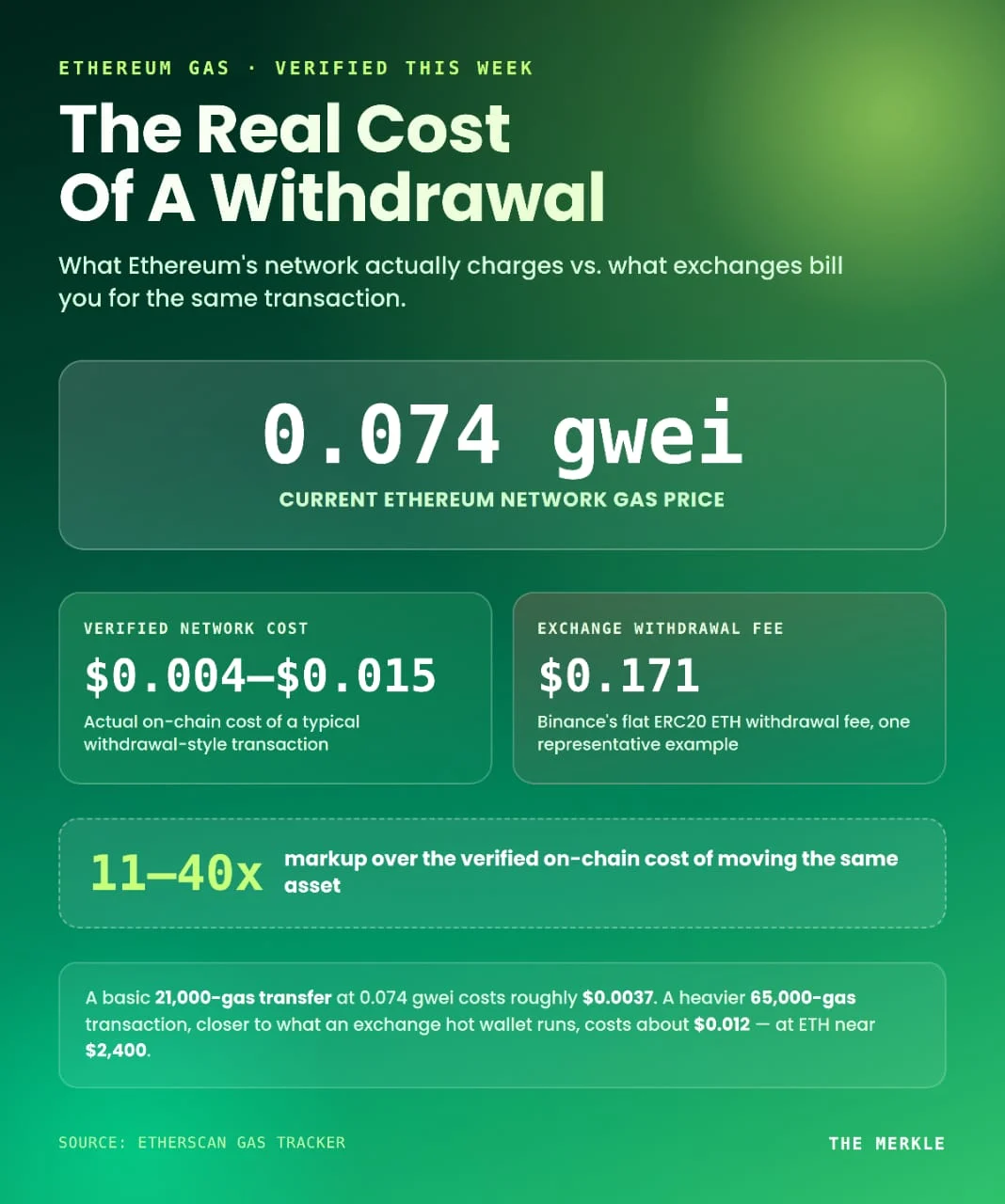
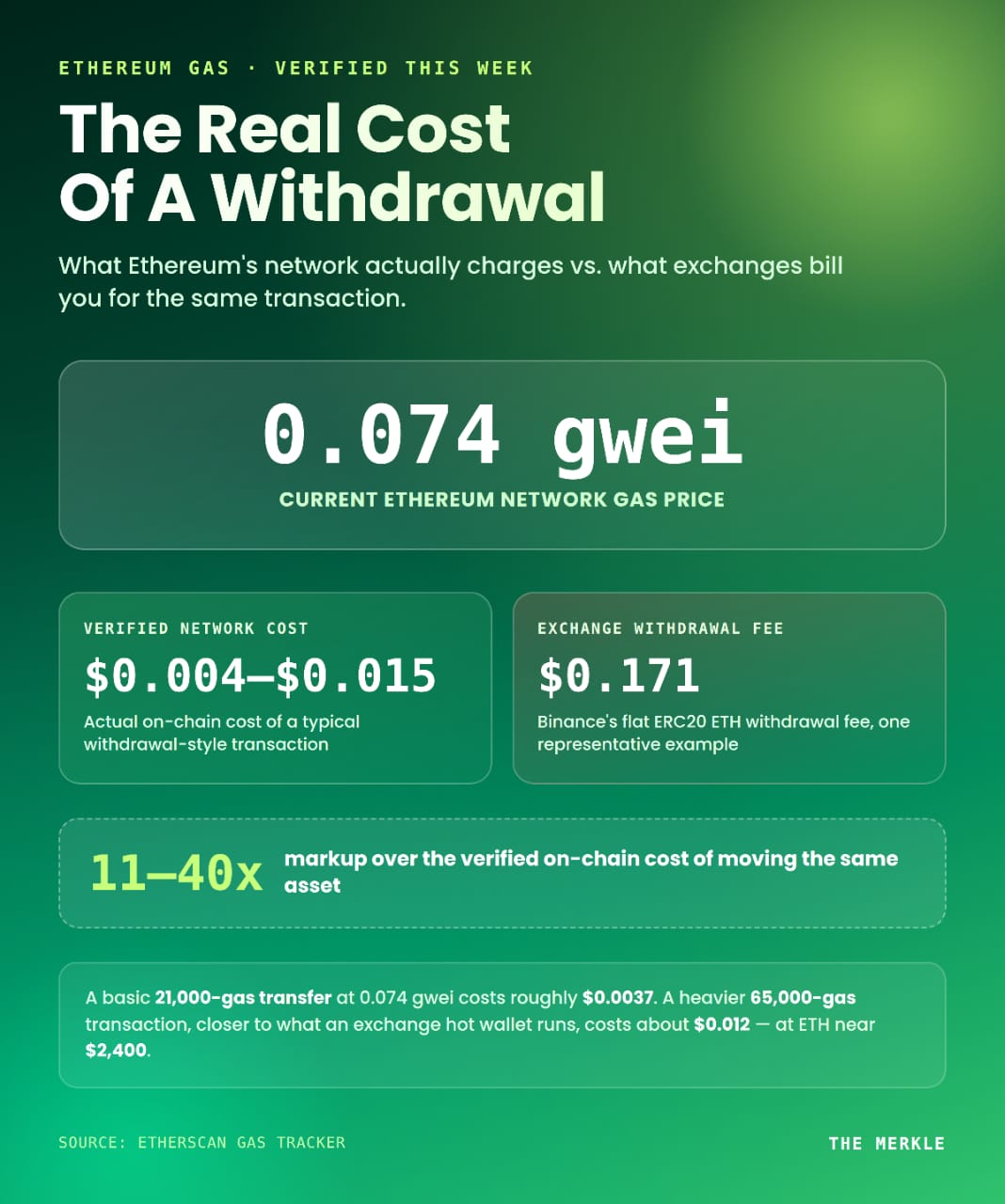
To understand the full scope of the disparity, it is crucial to establish the verified baseline of current Ethereum network costs. As of recent observations, Etherscan’s live gas tracker consistently displayed Ethereum’s network gas price at an astonishing 0.074 gwei. This was not an isolated lucky snapshot; low, average, and high readings were tightly clustered, indicating a sustained period of minimal network congestion. Independent gas tracking tools corroborated this range, with some estimating a standard 21,000-gas transfer at approximately $0.007. Broader industry data even projects daily average gas on Ethereum mainnet to remain below 1 gwei as the norm throughout 2026, a direct and significant outcome of the network’s ongoing efficiency enhancements, most notably the Pectra upgrades and the blob-based scaling introduced by EIP-4844.
The mathematical verification of these costs paints a clear picture. A fundamental 21,000-gas ETH transfer, at 0.074 gwei, equates to roughly 0.0000015 ETH. With Ethereum’s price hovering around $2,400, this calculates to approximately $0.0037 – well under half a cent. Even a more resource-intensive transaction, typical of what an exchange’s hot wallet infrastructure might execute, utilizing around 65,000 gas, would still only incur a cost of approximately $0.012. Therefore, the transparent, verifiable range for what the Ethereum network genuinely charges for a typical withdrawal-style transaction fluctuates between $0.004 and $0.015. Etherscan’s own knowledge base provides a comprehensive breakdown of these calculations, offering a public resource for users to independently verify these figures rather than relying solely on exchange statements. This period of sustained low gas fees marks a significant evolution for Ethereum, moving away from the volatile and often prohibitive costs experienced during peak network congestion events, such as the DeFi summer of 2020 or the NFT boom of 2021-2022.
The Impact of Ethereum’s Dencun Upgrade
The dramatic reduction in gas fees, particularly for certain transaction types, is a direct consequence of Ethereum’s continuous development roadmap, culminating most recently in the Dencun upgrade implemented in March 2024. A cornerstone of Dencun was EIP-4844, also known as "proto-danksharding." This upgrade introduced "blobs" (Binary Large Objects) – a new type of transaction data that can be temporarily stored and attested to by Ethereum nodes but is not permanently stored on the main chain. While primarily designed to scale Layer 2 solutions by significantly reducing their data posting costs to the mainnet, the overall effect of Dencun has been to alleviate general network congestion and improve efficiency across the board. The Pectra upgrades, a subsequent series of enhancements, further aim to streamline transaction processing and reduce the computational burden on the network. These technical advancements have transformed the economic landscape of transacting on Ethereum, making direct on-chain interactions remarkably inexpensive compared to historical norms.
The Discrepancy: Exchange Fees Versus Network Costs
Against this backdrop of incredibly low on-chain costs, the fees charged by centralized exchanges for ETH withdrawals stand in stark contrast. Taking Binance as a representative example – a common practice across many exchanges with similar structures – an ERC20 ETH withdrawal fee is currently listed at 0.00007 ETH. At Ethereum’s approximate price of $2,400, this translates to roughly $0.171. Comparing this $0.171 fee against the verified mainnet cost range of $0.004 to $0.015, the markup imposed by the exchange ranges from approximately 11 to 40 times the actual network expenditure.

This significant divergence immediately raises questions. It is crucial, however, to contextualize this markup. A flat fee exceeding raw network costs does not automatically signify malfeasance. Running a sophisticated cryptocurrency exchange involves substantial operational expenses. These include, but are not limited to, rigorous security audits to protect against vulnerabilities, the complex management of cold and hot storage solutions to safeguard user assets, a large compliance staff to navigate evolving regulatory landscapes, and comprehensive insurance policies to mitigate risks from large-scale hacks that have historically plagued the industry. These essential components of a secure and reliable trading platform undoubtedly require significant funding, and withdrawal fees are one mechanism through which these costs are recuperated. Therefore, the existence of a markup is not the core revelation; rather, the critical insight lies in how this markup scales, particularly when considering the high volume of transactions processed by exchanges.
The Unseen Mechanism: Transaction Batching
The fundamental economic driver behind the substantial profit margins on withdrawal fees is a mechanism that most users are entirely unaware of: transaction batching. When a user initiates a crypto withdrawal from a centralized exchange, their request is rarely processed as a singular, isolated on-chain transfer, as many users might envision. Instead, exchanges routinely consolidate multiple user withdrawal requests into a single, larger on-chain transaction. Alternatively, they route these requests through highly optimized hot wallet infrastructure designed specifically to minimize the total gas paid across a substantial volume of individual withdrawals.
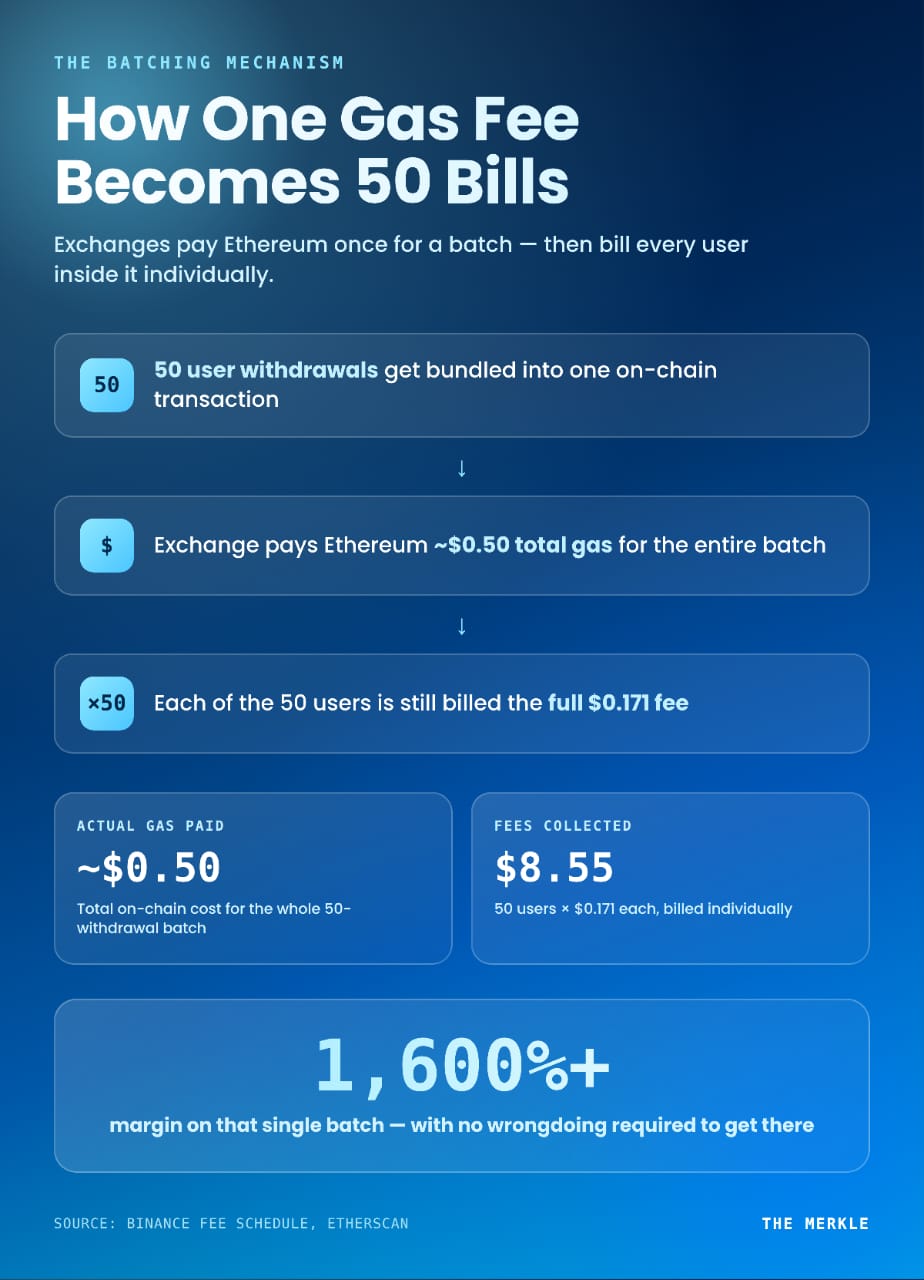
The implications of this practice are profound. A single batched transaction, which might encompass dozens or even hundreds of individual user withdrawals, still incurs Ethereum’s gas fee only once, or very close to it, for that aggregated transaction. Crucially, however, every single user whose withdrawal is swept into that batch is individually billed the full, static withdrawal fee. This is where the exponential economics of the markup become apparent.
Consider a hypothetical scenario: an exchange batches 50 individual user withdrawals into a single on-chain transaction. If this consolidated transaction incurs a total gas cost of, for example, $0.50, and each of the 50 users is charged a flat fee of $0.171, the exchange collectively collects $8.55 in withdrawal fees. Against this revenue, the actual network cost remains a mere $0.50, yielding a staggering profit margin exceeding 1,600% on that single batch alone. This practice, while generating considerable revenue for exchanges, does not typically involve any legal wrongdoing or overt deception. Instead, it highlights that the flat-fee model, widely adopted across the industry, was fundamentally designed for predictability, ease of communication, and robust profitability across a broad spectrum of network conditions, rather than as a precise reflection of real-time underlying transaction costs.
The Alternative: Dynamic Pricing Models
Compelling evidence that flat fees are a business choice rather than a technical necessity comes from exchanges that have diverged from this standard model. Binance.US, for instance, initiated a phased shift for its ETH and ERC-20 token withdrawal fees to a dynamic pricing model, beginning in January 2022. This model was specifically engineered to estimate fees in near real-time, taking into account Ethereum’s prevailing network conditions, rather than applying a static rate irrespective of congestion. The exchange’s official documentation explicitly confirms this transition, clarifying that the withdrawal fee is distinct from, and charged in addition to, the underlying network fee itself.
This distinction is critical because it demonstrates the viability of an alternative approach. If flat withdrawal fees were solely designed to cover legitimate infrastructural costs, there would be little commercial impetus to transition to a pricing model that more closely tracks real-time expenses. Such a dynamic model would inherently generate less excess margin during periods of low network congestion – precisely the environment that current gas trackers indicate. The very existence and functional operation of dynamic pricing models suggest that the flat-fee structure, which remains the industry default for many platforms, is primarily a strategic business decision rather than an unavoidable engineering constraint. It allows exchanges to maintain a consistent revenue stream, insulate themselves from sudden gas spikes, and simplify their fee communication, even if it comes at the cost of charging users significantly more than the direct network cost during periods of low congestion.
Industry Justifications and User Perception
While no major exchange has explicitly commented on the profitability derived from transaction batching in the context of low gas fees, their general justifications for withdrawal fees often encompass a broader range of operational necessities. These typically include:
- Operational Costs: Maintaining secure infrastructure, servers, and data centers.
- Security Measures: Implementing advanced cybersecurity protocols, multi-factor authentication, and cold storage solutions, which are expensive to develop and maintain.
- Regulatory Compliance: Navigating complex and evolving global regulatory frameworks, including KYC/AML procedures, which require significant legal and operational resources.
- Customer Support: Providing 24/7 customer service for troubleshooting and inquiries.
- Liquidity Management: Ensuring sufficient liquidity in hot wallets to facilitate timely withdrawals, which carries its own risks and costs.
- Risk Management: Hedging against potential future spikes in gas prices, ensuring that the exchange can always cover network costs even if they temporarily exceed the flat fee collected.
From the user’s perspective, the opacity around these fee structures can erode trust. Many users, especially those new to cryptocurrency, assume that a withdrawal fee directly reflects the cost of moving their assets on the blockchain. The revelation that a significant portion of this fee is, in fact, a substantial markup—driven by an invisible batching process—can lead to feelings of being overcharged or misled.
Implications for Users and the Broader Crypto Ecosystem
The implications of this pricing model are multifaceted, affecting individual users, market dynamics, and the competitive landscape of the crypto industry.
Financial Impact on Users
For individual users, particularly those making frequent or small withdrawals, the cumulative effect of these markups can be substantial. While $0.17 might seem negligible for a single transaction, it represents a disproportionate cost for small sums of ETH and adds up over time. This can particularly impact users in developing economies where even small fees constitute a larger percentage of their disposable income or transaction value. The transparency deficit also prevents users from making informed decisions about when to withdraw or which platform to use based on true cost efficiency.
Market Efficiency and Arbitrage
In terms of market efficiency, high fixed withdrawal fees can act as a barrier to seamless capital movement. This can subtly impact arbitrage opportunities, where traders seek to profit from price differences across exchanges. If withdrawal fees consume a significant portion of potential profits, it reduces the incentive for such activities, potentially leading to less efficient price discovery across different platforms. It also makes it more costly to move assets to self-custody or to decentralized finance (DeFi) protocols, inadvertently keeping more assets within centralized exchange ecosystems.
Regulatory Scrutiny
While the practice of batching itself is not illegal, the significant margin it creates, coupled with a lack of explicit disclosure regarding the true on-chain cost versus the charged fee, could attract regulatory attention in the future. Regulators increasingly focus on consumer protection and transparency in financial services. A comparison could be drawn to traditional banking fees, where excessive or undisclosed charges have historically led to consumer complaints and regulatory intervention. As the crypto industry matures, greater scrutiny on fee structures is inevitable.
Competition and Innovation
The existence of dynamic pricing models, as demonstrated by Binance.US, suggests a potential competitive edge for exchanges willing to adopt more transparent and cost-reflective fee structures. As users become more educated about on-chain costs, pressure may mount on other exchanges to either reduce their flat fees or transition to dynamic models. This could foster innovation in fee management and potentially drive down costs for users across the industry. Furthermore, the rising popularity of Layer 2 solutions and decentralized exchanges (DEXs) offers alternatives to CEXs for users seeking lower transaction costs, although often with higher complexity.
Looking Ahead: The Future of Crypto Withdrawal Fees
The practical lesson for anyone engaging with centralized crypto exchanges is that a published withdrawal fee provides almost no insight into the actual cost incurred by the network for your specific transaction at that moment. While checking a live gas tracker before initiating a withdrawal won’t alter a flat fee charged by an exchange, it equips users with crucial information. This knowledge allows individuals to accurately gauge how much of that fee constitutes genuine cost recovery for the exchange’s operational expenses versus how much represents built-in profit margin. This understanding is invaluable, whether one is strategically timing a withdrawal or making an informed decision between platforms offering varying fee structures for the same asset.
The broader pattern at play here is not a hidden scandal but rather an open secret, largely uninvestigated by most users who lack a practical reason to delve into the underlying economics. Batching is an undeniably efficient method for exchanges to dramatically reduce their aggregate gas costs. Simultaneously, static flat fees rarely adjust in real-time to reflect fluctuating gas prices, leading to substantial margins during periods of low network congestion. When exchanges periodically announce fee reductions, these are often framed as customer-friendly gestures, rather than explicit acknowledgments of the considerable margin that persists between what users pay and what the blockchain itself genuinely demands. Understanding this economic gap doesn’t necessitate attributing ill intent across the entire industry. It simply requires a willingness to perform the necessary calculations, which, conveniently, can be done in roughly the same amount of time it takes to open a gas tracker in a separate browser tab. As the cryptocurrency ecosystem continues to mature, and user sophistication grows, the demand for greater transparency in these fundamental financial interactions is likely to increase, potentially reshaping how withdrawal fees are structured and communicated in the years to come.
Disclosure: This is not trading or investment advice. Always do your research before buying any cryptocurrency or investing in any services.