


Ethereum has transcended its origins as a nascent experimental network to become a cornerstone of global digital infrastructure. Daily, it facilitates the settlement of billions of dollars in value, orchestrates thousands of decentralized applications, and underpins an entire ecosystem of Layer 2 scaling solutions. At the heart of this complex and ever-expanding network lies a single, critical component: state. This foundational element, representing "everything Ethereum knows right now," is the bedrock upon which the network’s functionality and security are built. However, the relentless growth of this state presents significant challenges, prompting a deep dive into potential solutions to ensure Ethereum’s continued decentralization and resilience.
The concept of state in Ethereum is fundamental to understanding its operations. It encompasses not just account balances, but also smart contract code, storage, and network parameters. Every transaction that alters these elements contributes to the overall state, creating a persistent record that must be maintained by the network. This comprehensive ledger is what allows users to interact with decentralized applications, transfer assets, and verify the integrity of the blockchain. Without a universally accessible and verifiable state, the entire Ethereum ecosystem would cease to function.
However, the very nature of blockchain, which prioritizes immutability and transparency, means that state data, once added, is generally preserved indefinitely. This inherent characteristic, while crucial for security, inevitably leads to a continuous expansion of the network’s state size. As Ethereum scales to accommodate increasing transaction volumes and a burgeoning ecosystem of decentralized applications, this state growth becomes a central concern, posing potential risks to decentralization, network efficiency, and cost-effectiveness.
Scaling L1: A Double-Edged Sword
Ethereum’s journey toward scalability has been a multi-year endeavor, marked by significant upgrades and ongoing research. Innovations such as the widespread adoption of Layer 2 scaling solutions, the implementation of EIP-4844 (Proto-Danksharding) aimed at reducing transaction fees for L2s, increases in gas limits, gas repricing mechanisms, and the proposed enshrined Proposer-Builder Separation (ePBS) have all contributed to the network’s capacity. While each of these advancements allows Ethereum to process more activity, they also introduce new complexities, particularly concerning the management of its ever-growing state.
Challenge #1: The Unrelenting Ascent of State Size
The state of the Ethereum network exhibits a persistent upward trend. Every new account created, every storage slot utilized, and every piece of bytecode written contributes to the permanent data burden that the network must perpetually uphold. This continuous accumulation of data has tangible financial and operational implications.
The increasing state size directly translates to higher resource requirements for running a full node. As this data footprint expands, the computational power, storage capacity, and bandwidth necessary to maintain an up-to-date copy of the state become prohibitive for average users. This trend exacerbates the risk of centralization, as only entities with significant resources can afford to operate full nodes, potentially leading to a concentration of network power and control.
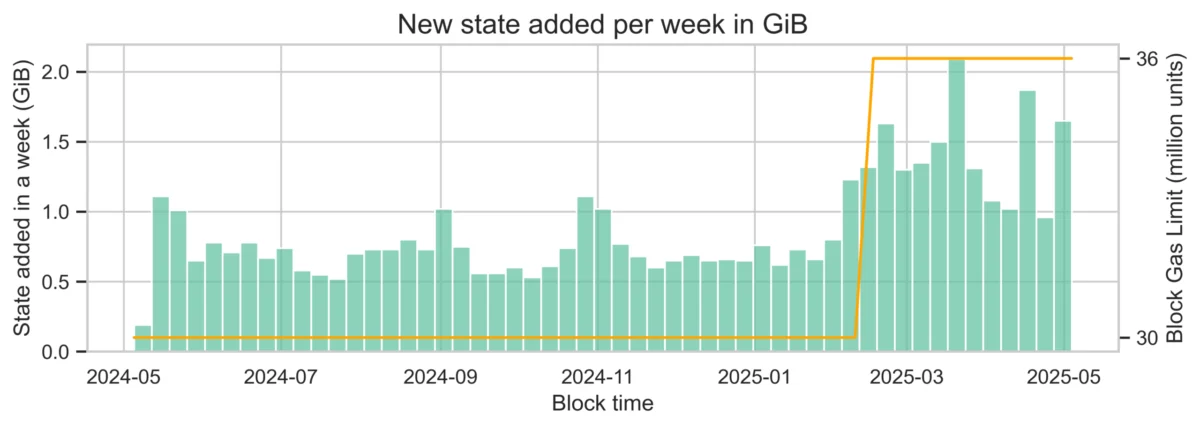
Historically, Ethereum has seen a steady increase in the amount of new state added per week. While specific figures fluctuate, data from the past year illustrates this persistent growth. For instance, analyses using metrics like those related to EIP-8037 have highlighted the ongoing accumulation of new state entries, including accounts, contract code, and storage. This consistent addition of data underscores the fundamental challenge of managing an ever-expanding ledger.
The implications of this growth extend beyond individual node operators. Sophisticated builders already play a crucial role in constructing Ethereum blocks. As state size increases, the ability of independent parties to build blocks end-to-end, capable of processing and verifying the entire state, diminishes. This concentration of block-building capabilities raises concerns about censorship resistance and credible neutrality. If only a select few actors possess the resources to manage and serve the complete state, they could potentially exert undue influence, including the ability to censor specific transactions.
While mechanisms like FOCIL and VOPS are being explored to uphold censorship resistance even within specialized builder environments, their effectiveness is contingent on a robust ecosystem of nodes capable of accessing, storing, and serving the state without incurring prohibitive costs. Therefore, controlling state growth is not merely an optimization; it is a prerequisite for maintaining the decentralized ethos of Ethereum.
To better understand and address this escalating issue, active measurement and stress-testing of state growth are underway. Projects and research initiatives are actively monitoring key metrics and simulating network conditions to identify potential breaking points and inform mitigation strategies. The public availability of data through platforms like bloatnet.info provides transparency and allows the broader community to engage with these critical challenges.
Challenge #2: The Centralization Conundrum in a Stateless Future
The aspiration for statelessness in Ethereum, where validators are no longer required to store the full state to validate blocks but instead rely on proofs, represents a significant scalability leap. This paradigm shift is designed to meet the community’s demand for higher transaction throughput and, crucially, acknowledges that state storage can evolve into a specialized role separate from the core validation function.
However, this transition inherently raises questions about who will ultimately hold and serve this distributed state. In a stateless model, the responsibility for maintaining the complete ledger is likely to shift towards a more specialized set of entities. This could include:
- Dedicated State Providers: Specialized infrastructure providers offering state storage and retrieval services.
- Archival Nodes: Nodes specifically tasked with storing and serving historical state data.
- Potentially Centralized Entities: In the absence of robust decentralized alternatives, there is a risk that a few large entities could dominate state provision.
This potential shift towards a more centralized state storage model carries significant consequences:
- Increased Censorship Risk: If a limited number of entities control state access, they could become points of censorship, impacting the ability of users and applications to interact with the network.
- Reduced Network Resilience: A reliance on a small number of state providers could make the network more vulnerable to outages or malicious attacks targeting those specific entities.
- Degraded User Experience: Users and applications might face increased latency, higher costs, or unreliable access to state data if the serving infrastructure is not sufficiently decentralized and performant.
- Impact on L2s: The ability of Layer 2 solutions to guarantee user safety and transaction finality relies on reliable access to their corresponding rollup contract state on Layer 1. Fragile or highly centralized L1 state access could undermine these safety mechanisms.
Currently, there is no foolproof method to guarantee that a multitude of entities will consistently serve the state, nor are there strong incentives for them to do so. While mechanisms like snap sync are widely served by default, the availability of Remote Procedure Call (RPC) services, which are crucial for many applications, is not as universally guaranteed. Without making state serving more cost-effective and attractive, the network’s ability to access its own foundational data could become concentrated in the hands of a few.

Navigating the Path Forward: Three Broad Directions
Addressing the challenges posed by state growth and potential centralization requires a multi-pronged approach. The Ethereum community is actively exploring several broad directions, each with its own set of trade-offs and implications.
State Expiry: Pruning the Past for a Leaner Future
A key insight driving current research is that not all state data is equally critical at all times. An analysis of Ethereum’s state has revealed that a significant portion, approximately 80%, has not been accessed or modified for over a year. Despite its inactivity, nodes are still burdened with the cost of perpetually storing this dormant data. State expiry proposes mechanisms to temporarily remove such inactive state from the "active set," reducing the immediate burden on nodes while retaining the ability to retrieve it when necessary, often through the use of proofs.
Two primary categories of state expiry are being explored:
- Mark, Expire, Revive: This approach involves marking rarely used state as inactive. Such state would no longer reside in the active set maintained by every node but could be "revived" later by presenting a proof of its prior existence. This allows frequently accessed components, like active contract balances, to remain readily available and inexpensive to access, while long-forgotten state is offloaded from nodes but still recoverable.
- Multi-era Expiry: Instead of expiring individual data entries, this model involves periodically rolling the state into distinct "eras," with each era potentially representing a specific time period, such as one year. The current era remains fully active and accessible, while older eras are "frozen" from live execution. New state is written into the current era, and access to historical data from previous eras would require proofs of its existence within that era.
While "mark-expire-revive" offers more granular control and potentially simpler revival processes, it necessitates additional metadata storage. Conversely, "multi-era expiry" is conceptually more straightforward and aligns well with archival strategies but may involve more complex and larger revival proofs. Both approaches share the common goal of maintaining a smaller active state by temporarily segmenting inactive data, albeit through different mechanisms and with distinct trade-offs in complexity, user experience, and the demands placed on client software and infrastructure.
Additional readings on state expiry and its implications can be found in ongoing research forums and proposal discussions within the Ethereum community.
State Archive: Differentiating Hot and Cold Data
The state archive approach seeks to fundamentally rearchitect how state data is managed by explicitly separating "hot" (frequently accessed) and "cold" (infrequently accessed) portions of the state. In this model, nodes would maintain a distinct storage mechanism for recent, actively used state, while older, less frequently accessed data is stored separately.
This separation ensures that even as the total state of the Ethereum blockchain continues to grow, the "hot set" – the data that requires rapid access for execution performance – can be maintained within manageable limits. The practical implication is that the execution performance of a node, particularly the input/output (I/O) costs associated with state access, can remain relatively stable over time, rather than degrading as the chain ages and accumulates more historical data.
Making State Hosting and Serving More Accessible
A critical question is whether it’s possible to achieve sufficient decentralization and utility without requiring every participant to store the entire state indefinitely. This leads to exploring ways to lower the barrier to entry for running useful infrastructure.
One promising avenue is partial statelessness. This approach aims to enable nodes and wallets to remain functional and participate effectively in the network without necessarily storing the complete historical state. This could involve techniques that allow nodes to operate with a significantly reduced state footprint while still being able to verify transactions and participate in consensus.
Another crucial direction involves enhancing the usability and accessibility of state serving. This encompasses improvements to how nodes and infrastructure providers make state data available to the wider ecosystem. This could include:
- Optimizing RPC Endpoints: Enhancing the performance, reliability, and decentralization of RPC services, which are the primary interface for most users and applications interacting with Ethereum.
- Developing Efficient State Retrieval Mechanisms: Creating more efficient protocols and tools for querying and retrieving state data, reducing latency and bandwidth requirements.
- Incentivizing State Provision: Exploring economic models and protocols that incentivize entities to reliably host and serve state data, ensuring its widespread availability.
These initiatives are strategically chosen for their immediate utility and forward compatibility. They aim to bolster Ethereum’s health in the present while simultaneously laying the groundwork for more ambitious protocol upgrades in the future.
The Road Ahead: Defining Ethereum’s Future State
The management and evolution of Ethereum’s state lie at the nexus of some of the most significant questions shaping the protocol’s future. Key areas of focus include:
- Scaling Through State Reduction: Developing methods to shrink the active state footprint, making it more manageable for nodes and reducing overall network load.
- Lowering State Storage Costs: Finding ways to decrease the economic and technical burden of storing historical state data.
- Enhancing State Serving Accessibility: Ensuring that state data is readily and reliably available to all participants in the ecosystem.
The current priorities of the Stateless Consensus team and the broader Ethereum research community are centered on low-risk, high-reward initiatives that contribute to these overarching goals. This includes ongoing experimentation with out-of-protocol archival solutions designed to keep the active state bounded while relying on archives for older data. These experiments aim to gather real-world data on performance, user experience, and operational complexity. If successful, these solutions could eventually be integrated into the protocol itself.
Furthermore, significant effort is being directed towards developing partial stateless nodes and enhancing RPC services. The goal is to improve the experience for the vast majority of users and applications that rely on centralized RPC providers. This involves work on projects that make Ethereum healthier today and prepare it for future protocol changes.
As this iterative process unfolds, progress updates and open questions will be shared transparently. However, solving these complex state management challenges cannot be achieved in isolation. Client developers, node operators, infrastructure providers, Layer 2 builders, and all stakeholders invested in Ethereum’s long-term health are encouraged to participate. Engaging in discussions, providing feedback on proposals, joining relevant forums and calls, and actively testing new approaches are vital steps in collaboratively shaping the future of Ethereum’s state.














