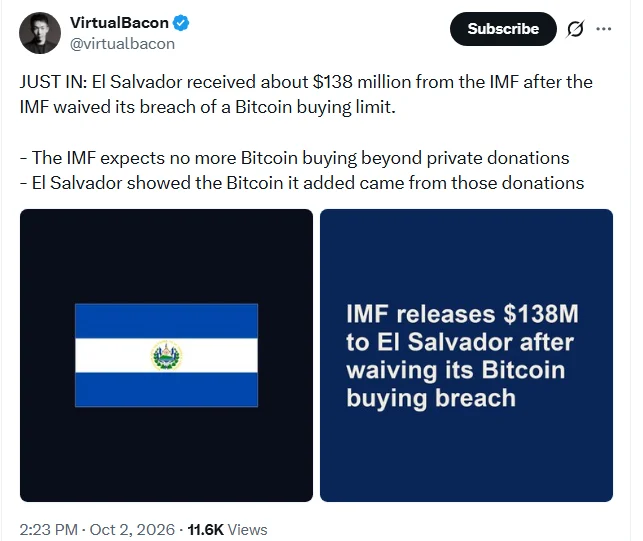
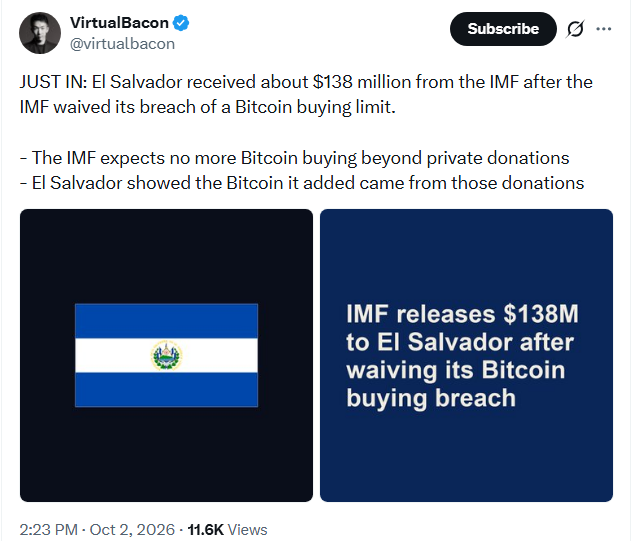
In a significant development for El Salvador’s controversial embrace of Bitcoin, the International Monetary Fund (IMF) has granted the nation a waiver, allowing it to proceed with its financial arrangement despite breaches related to its Bitcoin holdings. This decision, announced via a statement on the X platform (formerly Twitter), effectively signals the IMF’s continued engagement with El Salvador on its economic reform agenda, even as it maintains reservations about the country’s cryptocurrency strategy. The IMF’s action comes as El Salvador has demonstrated economic performance exceeding expectations, leading to an additional $139 million disbursement.
The waiver addresses El Salvador’s violation of limits placed on its Bitcoin holdings as part of a broader $1.4 billion credit facility. The IMF’s completion of the second and third reviews of this facility, initially approved in February of the current year to support the government’s reform agenda, paved the way for these announcements. While the IMF has acknowledged El Salvador’s corrective actions and recommitment to reducing its direct involvement in Bitcoin accumulation, it has also laid out clear expectations for future engagement with the digital currency.
IMF Completes Reviews, Approves Disbursement, and Addresses Bitcoin Holdings
The IMF’s decision to grant the waiver is intrinsically linked to its overall assessment of El Salvador’s economic progress. The disbursement of $139 million is a direct acknowledgment of El Salvador’s improved economic performance, which the IMF attributes to increased investor confidence and significant improvements in national security conditions. This financial injection is intended to bolster the country’s efforts to achieve macroeconomic stability and foster sustainable growth.
However, the central point of contention and the focus of the recent IMF announcement revolves around El Salvador’s pioneering, and at times controversial, adoption of Bitcoin. Since adopting Bitcoin as legal tender in September 2021, El Salvador has been under scrutiny from international financial institutions, including the IMF, which has consistently expressed concerns about the volatility of cryptocurrencies and the potential risks they pose to financial stability, particularly for emerging economies.
The IMF’s press statement explicitly noted that the waiver was granted to "encourage the government to address its failures to meet performance requirements for its Bitcoin holdings." This indicates a delicate balancing act by the IMF, recognizing El Salvador’s broader economic reforms while simultaneously seeking to mitigate the risks associated with its Bitcoin strategy.
El Salvador’s Bitcoin Journey: A Timeline of Adoption and Scrutiny
El Salvador’s integration of Bitcoin into its national financial framework began in September 2021, making it the first country in the world to adopt a major cryptocurrency as legal tender. This bold move was accompanied by the establishment of a national Bitcoin wallet, "Chivo," and significant government investment in acquiring Bitcoin for its national reserves.
Key Milestones:
- September 2021: El Salvador officially adopts Bitcoin as legal tender, alongside the U.S. dollar. The government launches the "Chivo" digital wallet.
- Late 2021 – Early 2022: El Salvador begins accumulating Bitcoin, making several purchases of the cryptocurrency for its treasury. This period also sees initial reports of mixed adoption rates among the general population.
- February 2023: The IMF approves a $1.4 billion credit facility for El Salvador, aimed at supporting the country’s economic reform agenda. However, concerns regarding the Bitcoin holdings are raised during these discussions.
- Current Period (as per the article’s context): The IMF completes its second and third reviews of the credit facility, leading to the approval of the $139 million disbursement and the granting of a waiver concerning El Salvador’s Bitcoin holdings. This is accompanied by specific directives regarding future Bitcoin activities.
Throughout this period, the IMF has maintained a cautious stance, frequently advising El Salvador to be mindful of the risks associated with Bitcoin’s price volatility and the potential impact on its fiscal position. The fund has emphasized the importance of transparency and prudent management of public funds.
Details of the IMF’s Waiver and Future Expectations
The IMF’s waiver is not a blank check for El Salvador to continue its Bitcoin accumulation unabated. Instead, it comes with clear stipulations and expectations designed to ensure greater fiscal discipline and transparency. The core of the IMF’s directive is to significantly curb the government’s direct involvement in Bitcoin transactions and holdings.
Key Directives from the IMF:
- Cessation of Bitcoin Accumulation: El Salvador is expected to refrain from purchasing any further Bitcoin. The only exception to this rule is for documented donations received by the government.
- Increased Transparency: The IMF demands enhanced transparency regarding the country’s public Bitcoin holdings. This implies a need for clearer reporting mechanisms and public accessibility of information related to the government’s Bitcoin assets.
- Reduced Government Involvement: The waiver reinforces the IMF’s expectation that El Salvador will reduce its overall government involvement in Bitcoin activities. This suggests a move towards a more hands-off approach, with less direct intervention in the cryptocurrency market.
These directives are a clear indication that while the IMF is willing to work with El Salvador on its broader economic challenges, it remains committed to safeguarding against the perceived risks of unbridled cryptocurrency adoption by sovereign nations. The emphasis on transparency is particularly crucial, given the often opaque nature of cryptocurrency markets.
El Salvador’s Current Bitcoin Holdings and Stance
Despite the IMF’s cautionary approach and the reported challenges in widespread adoption, El Salvador has maintained its commitment to Bitcoin as a component of its national reserves. As of the reporting period, the country holds a substantial amount of Bitcoin.
Current Holdings:
- Total Bitcoin: Approximately 7,787.37 BTC.
- Estimated Value: Valued at around $658 million, this figure fluctuates significantly with market prices.
- Recent Acquisitions: The article notes recent purchases, including eight BTC two weeks prior to the report and an additional 31 BTC within the preceding 30 days. These acquisitions underscore the government’s ongoing conviction in Bitcoin as an investment.
This continued accumulation, even in the face of international skepticism, highlights President Nayib Bukele’s administration’s firm belief in the long-term potential of Bitcoin. The government views these holdings not just as a speculative investment but also as a potential hedge against inflation and a catalyst for financial innovation.
Analysis of Implications: Navigating the Intersection of Sovereign Finance and Cryptocurrency
The IMF’s decision to grant El Salvador a waiver, while imposing strict conditions, carries significant implications for both the country and the broader landscape of sovereign cryptocurrency adoption.
For El Salvador:
- Continued Access to Funding: The waiver and disbursement are crucial for El Salvador’s access to much-needed financial support from the IMF, vital for its economic stability and reform efforts.
- Navigating Regulatory Pressure: The IMF’s clear directives signal that El Salvador must tread carefully regarding its Bitcoin strategy. Continued non-compliance could jeopardize future financial assistance and international financial relations.
- Demonstrating Fiscal Responsibility: By agreeing to the IMF’s terms, El Salvador is attempting to balance its innovative approach to finance with the need for fiscal prudence and transparency, which are paramount for international financial credibility.
For the International Community and Cryptocurrency:
- Precedent for Future Engagements: This situation sets a precedent for how international financial institutions might engage with other nations considering or already engaged in sovereign cryptocurrency adoption. The IMF’s approach, a mix of conditional support and strict oversight, could become a model.
- Emphasis on Transparency and Risk Management: The IMF’s insistence on transparency and reduced government intervention underscores the global demand for robust regulatory frameworks surrounding cryptocurrencies, especially when sovereign entities are involved.
- Ongoing Debate on Bitcoin’s Role: El Salvador’s experience continues to fuel the debate about Bitcoin’s viability as a national reserve asset and a tool for economic development. While proponents point to potential benefits like financial inclusion and reduced transaction costs, critics highlight volatility, security risks, and environmental concerns.
The IMF’s stance acknowledges that outright prohibition of cryptocurrency adoption by sovereign nations might not be the most effective approach. Instead, it favors a path of controlled engagement, emphasizing responsible practices and risk mitigation. El Salvador’s journey remains a high-stakes experiment, and the outcome will likely provide valuable lessons for other countries contemplating similar ventures into the evolving world of digital assets. The coming months will be critical in observing how El Salvador adheres to the IMF’s directives and how this influences its ongoing economic trajectory and its unique relationship with Bitcoin.