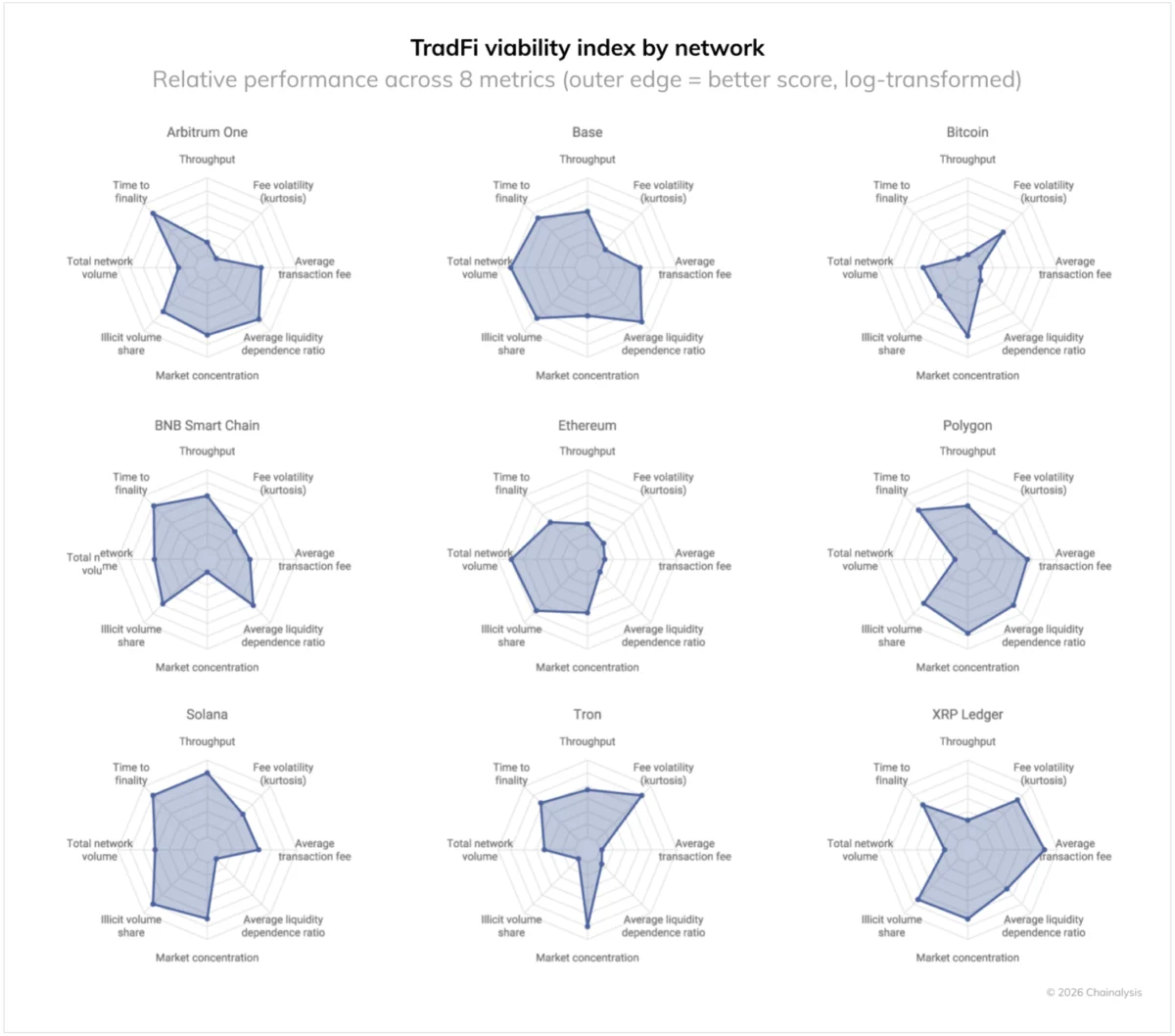
The tokenization of Real World Assets (RWAs) has moved decisively beyond the realm of theoretical experimentation and into the core of traditional financial (TradFi) strategy. As major global banks, asset managers, and sovereign wealth funds transition from isolated pilot programs to live, multi-billion-dollar deployments, the industry faces a fundamental infrastructure dilemma: the selection of the underlying blockchain architecture. This decision is no longer merely technical; it is a strategic choice involving complex trade-offs between speed, cost predictability, contagion risk, illicit exposure, and governance.
According to recent data and analysis from the forthcoming report by Chainalysis, the "perfect" general-purpose blockchain for financial institutions does not exist. Instead, the landscape is defined by five critical axes of competition. For institutions like BlackRock, Franklin Templeton, and Société Générale, the choice of network must align with the specific characteristics of the asset being tokenized, moving away from brand recognition and toward data-driven architectural suitability.
The Evolution of Tokenization: From Pilots to Production
The journey of RWA tokenization has followed a distinct chronological path. In the early 2020s, financial institutions primarily engaged in "permissioned" or private blockchain experiments to test the feasibility of distributed ledger technology (DLT). However, by 2023 and 2024, the focus shifted toward public blockchains to leverage existing liquidity and interoperability.

In March 2024, the launch of BlackRock’s USD Institutional Digital Liquidity Fund (BUIDL) on the Ethereum network marked a watershed moment, signaling that the world’s largest asset manager viewed public ledgers as viable for institutional-grade products. This was followed by a wave of expansions in late 2024 and early 2025, where funds began migrating to multi-chain architectures to capture different market segments. The objective has shifted from proving the technology works to optimizing the "rails" upon which these assets travel.
Mapping the Three Architectural Archetypes
Current on-chain data suggests that the blockchain landscape has crystallized into three distinct archetypes, each serving a specific institutional need.
1. Institutional Anchors
Bitcoin and Ethereum represent the "Institutional Anchors." These networks prioritize security, decentralization, and macro-settlement over high-speed performance or low cost. They act as the foundational layer for high-value transactions where the cost of a transaction is secondary to the absolute certainty of its settlement.
2. The Goldilocks Networks
Ethereum Layer-2 (L2) solutions, including Arbitrum, Base, Optimism, and Polygon, form what analysts call the "Goldilocks" sweet spot. These networks offer a balance of performance, cost efficiency, and compliance. By inheriting the security of Ethereum while offloading execution to a more efficient secondary layer, they provide an environment suitable for retail-facing tokenization and mid-tier institutional activity.

3. High-Frequency Engines
Networks such as Solana, BNB Chain, XRP Ledger, and TRON function as "High-Frequency Engines." These are characterized by massive throughput and negligible fees. They are designed to handle high-volume, low-latency applications, such as high-frequency trading or global stablecoin payments, though they often involve higher degrees of market concentration or different governance risks.
Operational Costs and the Statistical Reality of Tail Risk
For a financial institution’s profit and loss (P&L) statement, the absolute price of a transaction is often less important than the predictability of that price. To quantify this, analysts utilize "kurtosis," a statistical measure of tail risk. A high kurtosis score indicates that a network is prone to violent, unpredictable fee spikes during periods of congestion.
Bitcoin exhibits extreme tail risk, with a kurtosis score of 246. This volatility is largely driven by non-financial activities, such as the "Runes" and "Ordinals" mania, which can cause transaction fees to spike from a few dollars to hundreds of dollars without warning. For daily institutional operations, such unpredictability is a significant barrier.
In contrast, TRON maintains a kurtosis of near zero, making its operational costs the most predictable in the industry. This stability explains TRON’s emergence as a dominant rail for global stablecoin settlements. Ethereum, following its "Dencun" upgrade, has also seen a significant reduction in fee volatility by offloading data to Layer-2s, creating a more stable environment for high-value fund management.

Throughput vs. Finality: The Speed Paradox
In traditional finance, speed is often measured by how many transactions can be processed (throughput) and how quickly those transactions become irreversible (finality).
Solana remains the undisputed leader in raw throughput, processing more than twice the transactions per second (TPS) of its nearest competitor, TRON. This capability was a primary driver for Franklin Templeton’s decision to expand its OnChain US Government Money Fund (FOBXX) to Solana in early 2025. The firm noted that Solana’s monolithic architecture and high throughput were essential for the next stage of fund maturity.
However, throughput is only one side of the coin. Arbitrum currently leads the industry in "time to finality," offering the fastest block completion among major networks. This is critical for Real World Assets where true finality is paramount. Institutions building on L2s must account for "L1 processing risk"—the delay (ranging from 15 minutes to several hours) required for an L2 to finalize its batch on the Ethereum Mainnet. This dynamic resembles a regional clearinghouse that processes trades instantly but only settles with the central bank at the end of the day.
Assessing Contagion Risk and Institutional Dependency
Systemic risk in the digital asset space is often measured by the interconnectivity of centralized exchanges (CEX). When exchanges rely heavily on one another for liquidity to cover user withdrawals, the system becomes fragile.

Solana’s history provides a stark example of this dependency. Prior to the FTX collapse, Solana exhibited a high degree of "institutional dependency," where direct CEX-to-CEX transfers represented over 60% of on-chain liabilities. This interconnectivity can act as a catalyst for contagion during market stress. Conversely, older networks like Bitcoin and Ethereum consistently maintain lower dependency ratios (often below 50%), suggesting a more resilient and decentralized liquidity profile that is less susceptible to a single-point-of-failure event.
The Compliance Mandate: Liquidity vs. Illicit Exposure
For regulated entities, the "Green Zone" of blockchain infrastructure is defined by high liquidity and low illicit exposure. Data shows that Ethereum, Solana, and Base currently sit in this institutional sweet spot, maintaining illicit activity shares below 1% while hosting multi-trillion-dollar liquidity pools.
BlackRock’s BUIDL fund, which has expanded across Ethereum, Solana, Polygon, Arbitrum, and Avalanche, reflects a strategy of maximizing investor optionality while remaining within these high-compliance environments. BlackRock CEO Larry Fink has explicitly stated that tokenization is the "next major evolution in market infrastructure," intended to eliminate intermediaries and enable instantaneous settlement.
TRON occupies a more complex position. While it facilitates massive institutional-scale liquidity—serving as a primary rail for Over-The-Counter (OTC) desks—its proportion of volume linked to illicit sources has approached 4%. This does not necessarily preclude institutional use, but it necessitates the deployment of robust compliance tools, such as Know Your Transaction (KYT) and real-time address screening, to mitigate regulatory risk.

Governance and Crisis Management
The final, and perhaps most qualitative, trade-off involves governance. Financial institutions require clarity on who is in charge during a technical crisis or a security breach.
The governance models range from the "immutability" of Bitcoin, where centralized intervention is effectively impossible, to the structured oversight of networks like Arbitrum. Arbitrum utilizes a "Security Council" and Decentralized Autonomous Organization (DAO) structures that can, in theory, pause or reverse transactions during catastrophic events. For TradFi legal frameworks, the existence of an oversight authority is often a prerequisite for handling high-value assets, providing a "safety valve" that purely immutable chains lack.
Conclusion: Aligning Asset Class to Architecture
The emerging decision matrix for financial institutions suggests that the "best" blockchain is entirely dependent on the asset class:
- Tokenized Bonds and Securities: Ethereum’s settlement finality and deep institutional liquidity make it the primary choice, as evidenced by Société Générale’s Forge platform.
- High-Frequency Trading: Solana’s TPS and low-latency profile offer the necessary performance for rapid-fire execution.
- Retail and Consumer Finance: Layer-2s like Base and Optimism provide the cost-efficiency and predictability required for mass-market applications.
As the industry moves toward 2035, with stablecoin volume projected to reach $1.5 quadrillion, the infrastructure decisions made today will determine the winners of the on-chain financial economy. For global finance, the transformation of the "rails" is no longer a technical experiment—it is an existential evolution. Institutions that successfully navigate these five dimensions of cost, speed, risk, compliance, and governance will be the ones to define the foundations of 21st-century finance.