


The global financial landscape is currently witnessing a fundamental shift in how value is exchanged, driven by the necessity to accommodate the burgeoning ecosystem of Artificial Intelligence (AI) and autonomous machine operations. For decades, payment systems were designed by humans, for humans, operating on timelines that allowed for manual authorization, account setups, and multi-day settlement periods. However, as AI agents increasingly take the lead in commerce, financial services, and data analytics, these legacy rails have become a primary bottleneck. The emergence of the x402 protocol, particularly its active deployment on the Base network, represents one of the first successful attempts to build a native payment infrastructure for the machine economy, effectively bridging the gap between high-speed computation and financial execution.
The Friction of Legacy Finance in an AI-Driven World
The core challenge facing modern finance is a mismatch in operational speeds. AI agents today possess the capability to analyze vast quantities of market data, assess credit risks, and monitor regulatory compliance at speeds that no human team can replicate. Despite this computational advantage, these agents are frequently forced to halt their operations when a financial transaction is required. Whether an agent needs to access a premium data feed, perform a real-time sanctions screening, or query a credit bureau, the workflow currently mandates human intervention for payment authorization.
In the context of high-frequency trading or millisecond-long arbitrage opportunities, this delay is fatal to the objective. Traditional financial systems require the establishment of billing relationships, the management of API keys, and the manual funding of accounts—processes that are fundamentally incompatible with the autonomous, high-velocity nature of AI operations. To solve this, a programmable, self-executing payment rail is required, allowing machines to transact directly without a human intermediary.

The x402 Protocol: A Technical Foundation for Machine Commerce
Developed by Coinbase and named after the largely dormant HTTP status code 402 ("Payment Required"), the x402 protocol is designed to facilitate direct machine-to-machine payments within standard web requests. The logic follows a streamlined loop: when an AI agent requests a specific resource or service from a server, the server responds with a payment specification. The agent then evaluates the cost against its programmed budget, executes a stablecoin micro-payment on-chain, and resubmits the original request accompanied by a digital receipt (an on-chain signature).
This architecture allows for "agentic transactions," which are identifiable by their unique on-chain signatures where wallets interact directly with the x402 protocol. While the protocol is blockchain-agnostic—compatible with networks such as Solana and Polygon—the Base network has emerged as the primary hub for its development and adoption. The low-fee environment of Base, a Layer 2 scaling solution, is essential for the viability of the micro-payments that define machine commerce.
A Chronology of Adoption: From Experimentation to 100 Million Transactions
The trajectory of x402 on the Base network provides a clear timeline of how nascent technology transitions from a theoretical concept to a functional utility.
Mid-2025: The Genesis Phase
During the middle of 2025, agentic transactions were virtually non-existent. The period was characterized by low transaction counts and minimal transfer sizes as developers began to integrate the x402 protocol into experimental AI frameworks. At this stage, the primary users were crypto-native developers testing the limits of automated "send-to-self" functions to verify the protocol’s stability.

Q4 2025: The PING Phenomenon and Stress Testing
The final quarter of 2025 saw a massive surge in transaction volume, driven by an unconventional catalyst: meme coin activity. A project named PING launched as a "pay-to-mint" experiment, requiring users to query a URL, receive an HTTP 402 response, and pay 1 USDC via the x402 protocol to mint tokens. This gamified the protocol, leading to a transaction explosion of over 10,000% in a single week. PING alone processed more than 150,000 transactions in its first month. While speculative in nature, this event served as a critical stress test, proving that x402 and the Base network could handle high-concurrency transaction loads—a prerequisite for any infrastructure intended to support global autonomous commerce.
Q1 2026: Consolidation and Maturation
By the first quarter of 2026, the speculative fever associated with PING began to cool, leading to a moderation in transaction growth. However, the cumulative transaction count surpassed the 100 million mark. More importantly, the nature of these transactions began to shift. The market moved away from purely experimental micro-payments toward more substantial value transfers, suggesting that the protocol was being integrated into more serious, recurring workflows.
Analyzing the Data: Shifting Economic Weight
The data surrounding x402 usage reveals a significant evolution in how value is being moved by autonomous agents. In early 2025, transactions valued at $1 or more represented only 49% of the total volume. By early 2026, this category surged to account for 95% of the economic weight on the protocol. Conversely, transactions between 10 cents and $1, which once made up 46% of the volume, collapsed to a mere 4%.
This concentration in larger transaction sizes indicates that users and developers are moving beyond "dust" transactions. It suggests that agents are being funded with more significant capital to cover higher-value services, such as sophisticated data processing or complex financial executions. While the protocol still handles a large number of sub-cent transactions, the shift toward dollar-plus transfers signals that agentic payments are finding "product-market fit" in real-world economic scenarios.

User Behavior and Retention: The Tester-to-Payer Conversion
One of the most promising signals for the long-term viability of agentic payments is the improvement in user retention and conversion. Behavioral patterns on the Base network show that the "tester-to-payer" conversion rate—the percentage of wallets that move from a single "test" transaction to making real payments to other wallets—improved fourfold within a six-month period.
Weekly wallet retention has also trended upward, albeit with some volatility. In October 2025, during the PING craze, retention spiked to 87% before crashing to 5% as speculators exited. However, the subsequent "drift" higher in 2026 occurred without a speculative catalyst. This indicates that a core group of users is building agentic spending into recurring, automated workflows. In the world of infrastructure, retention is the ultimate metric; it proves that the system is no longer a novelty but a necessary tool for the user’s operations.
Demographic Profile of the Agentic Economy
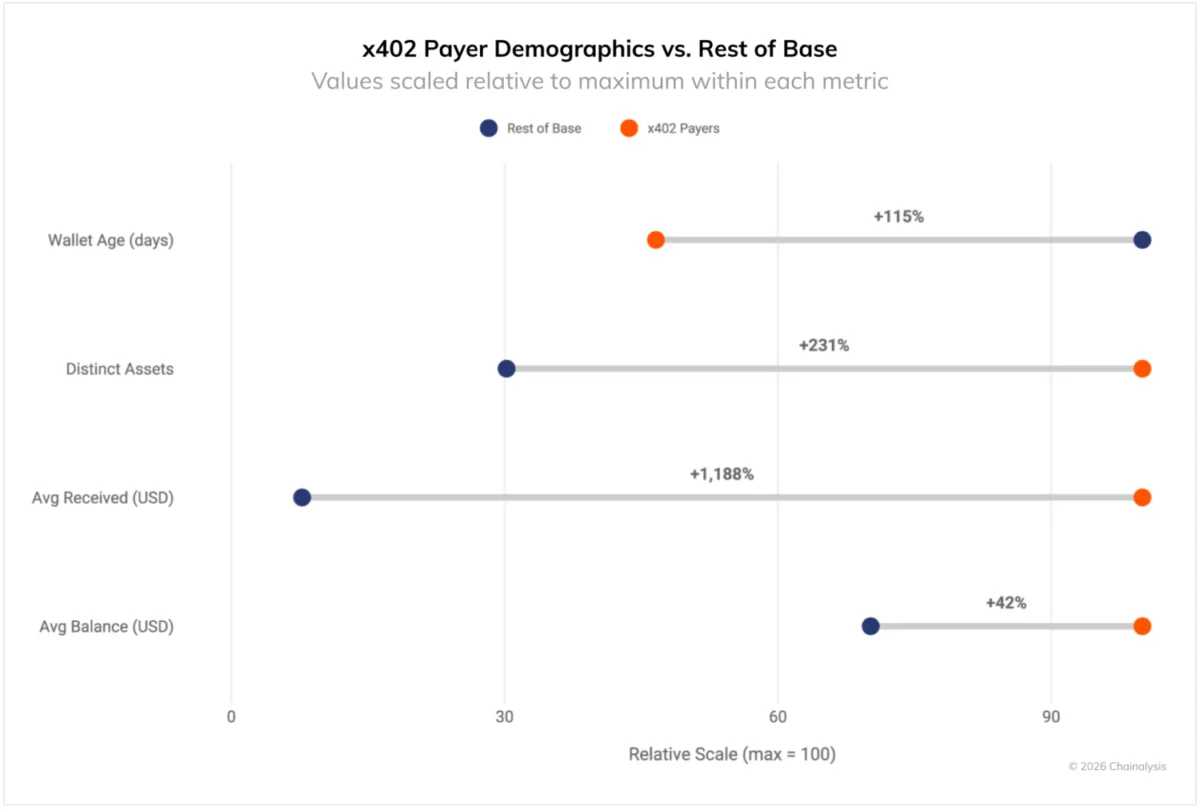
The demographic profile of x402 users differs markedly from the general Base user base. Data suggests that x402 payers are generally newer to the ecosystem, with younger wallet ages. This implies that x402 is not merely converting existing crypto users but is actually attracting new participants who are creating wallets specifically to interact with the machine-to-machine economy.
Furthermore, these users tend to maintain higher inflows and balances than the average wallet. This indicates a higher level of commitment and a perceived value in the services being purchased through the protocol. These are not passive holders; they are active participants who are pre-funding their autonomous agents to ensure uninterrupted operation.

Institutional Implications and the Path Forward
For traditional financial institutions and enterprises, the rise of x402 on Base offers several strategic takeaways. First, the proof-of-concept phase is over. The technology has scaled to 100 million transactions and has demonstrated its ability to handle high-concurrency demands. Second, the limitations of traditional rails have been laid bare. As AI continues to integrate into every facet of the global economy, the demand for "streaming money" and autonomous settlement will only grow.
However, challenges remain. The current user base is largely crypto-native, and institutional participation is still in its early stages. For mass adoption to occur, there must be a bridge between these new "agentic rails" and established regulatory frameworks. This is where on-chain intelligence becomes vital. Tools provided by firms like Chainalysis allow institutions to monitor adoption curves, track counterparty exposure, and ensure that while payments are autonomous, they remain compliant with global anti-money laundering (AML) and know-your-customer (KYC) standards.
The broader implication is that the "New Rails" of finance are being built from the ground up to support a world where machines are primary economic actors. Traditional systems that rely on human speed and manual intervention are increasingly obsolete in the face of agents that require thousands of micro-transactions per second, settled in real-time.
Conclusion: The Infrastructure of the Future
The x402 protocol and its success on the Base network represent more than just a new way to send money; they represent the scaffolding for a new era of autonomous commerce. By solving the "HTTP 402" problem, developers have unlocked a path for AI agents to participate fully in the global economy.

As we move deeper into 2026, the focus will likely shift from scaling transaction counts to refining the services these transactions support. Whether it is decentralized cloud computing, automated supply chain management, or high-frequency algorithmic finance, the foundation is now in place. The question for market participants is no longer if machine-to-machine payments will happen, but how quickly they can adapt to a world where the foundations of finance are no longer built for humans alone, but for the autonomous agents that will define the next century of economic growth.














