


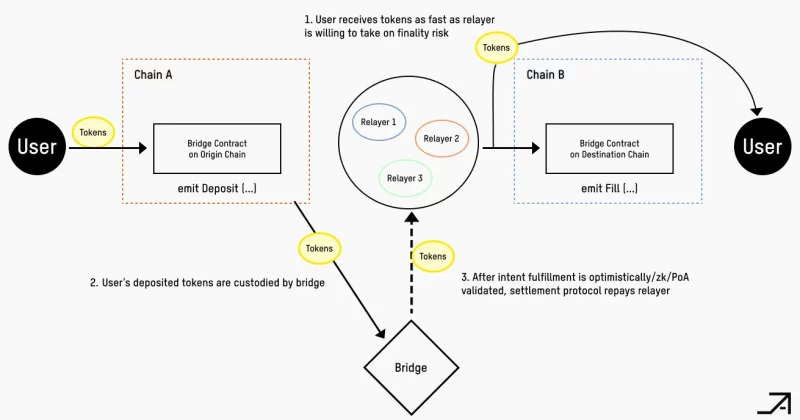
The burgeoning landscape of decentralized finance (DeFi) and blockchain technology is increasingly defined by its interconnectedness. As more blockchain networks emerge and existing ones expand, the ability for assets and data to move seamlessly between these disparate chains – known as cross-chain interoperability – has become a critical bottleneck. Addressing this challenge head-on, the Open Intents Framework (OIF), launched in February 2025 by the Ethereum Foundation in collaboration with Hyperlane and Bootnode, is rapidly gaining momentum. This innovative framework is not merely another technological solution; it is a concerted effort to establish a neutral, open-standard infrastructure for building and executing cross-chain intents, a concept that promises to redefine how users and applications interact across the blockchain ecosystem.
The significance of OIF is underscored by the overwhelming industry support it has garnered. Over 30 prominent teams have aligned with the project, a testament to its potential impact. This coalition includes major players in the Layer 2 scaling space, such as Arbitrum, Optimism, Polygon, ZKsync, and Starknet, alongside other influential blockchain protocols. This broad backing suggests a collective recognition of the need for a standardized, non-proprietary approach to cross-chain communication, moving away from fragmented and often closed-off solutions. The framework’s positioning as a neutral standard, rather than a product controlled by a single entity, is a key factor in its growing adoption. This open-source philosophy fosters trust and encourages wider integration, as developers can build upon it without fear of vendor lock-in or future restrictive changes.
Decoding the Mechanics: How the Open Intents Framework Operates
At its core, the Open Intents Framework provides a comprehensive toolkit designed to facilitate the seamless operation of cross-chain intents across multiple blockchain networks. This toolkit is not a monolithic entity but rather a modular suite comprising smart contracts, open-source solvers, aggregators, and a Software Development Kit (SDK). Developers can integrate these components into their applications without requiring explicit permission from any central authority. This permissionless nature is a cornerstone of OIF’s design, promoting decentralization and accessibility.
The architectural foundation of OIF rests upon three pivotal smart contract types: InputSettler, OutputSettler, and Oracle contracts. The InputSettler contracts are responsible for receiving and validating intents originating from one chain, preparing them for processing on another. Conversely, OutputSettler contracts handle the execution and finalization of intents on the destination chain. Oracle contracts, crucial for any cross-chain interaction, provide the necessary external data and verification mechanisms to ensure the integrity of transactions and the state of different blockchains. These three contract types are intrinsically linked and orchestrated by the interoperability SDK, which acts as the connective tissue, enabling developers to abstract away the complexities of cross-chain communication.
The framework builds upon the established ERC-7683 standard, a crucial development that provides a standardized format for structuring cross-chain intents. This standardization is vital for interoperability, ensuring that different systems can understand and process intent requests consistently. When a user submits an intent – for example, a desire to swap a token from Ethereum to Arbitrum – this request is broadcast to the network. The magic of OIF lies in its competitive solver ecosystem. Independent entities, known as solvers, then race to fulfill this request as efficiently and cost-effectively as possible. These solvers are incentivized by the potential to earn a profit by accurately and promptly executing the user’s intent. This competitive dynamic drives innovation and ensures that users receive the best possible execution for their cross-chain operations.
The practical implementation of OIF is already demonstrating its efficacy. Deployments are live on various testnets, including Ethereum Sepolia and Optimism Sepolia, allowing developers to test and refine their integrations. Under optimal network conditions, the framework has shown impressive performance, with solver-filled orders typically completing within a rapid 10 to 60 second timeframe. This speed is critical for user experience and for enabling a wide range of decentralized applications that require near-instantaneous cross-chain interactions. The ongoing deployments and performance metrics suggest that OIF is not just a theoretical concept but a tangible solution being actively adopted and tested in real-world scenarios.
Coinbase’s Strategic Endorsement: A Milestone for Cross-Chain Standardization
A significant endorsement for the Open Intents Framework arrived in September 2025 when Coinbase Payments, the dedicated payments arm of the prominent cryptocurrency exchange Coinbase, announced its participation as a core contributor. This collaboration marks a pivotal moment for OIF, injecting substantial industry credibility and accelerating its mission to standardize cross-chain asset transfers. Coinbase’s involvement signals a strong belief in the framework’s ability to provide a robust and scalable solution for facilitating the movement of digital assets between different blockchain networks, a fundamental requirement for the widespread adoption of cryptocurrencies and decentralized applications.
The strategic alignment with Coinbase Payments is particularly noteworthy. As a leading global digital asset exchange, Coinbase processes a massive volume of transactions and has a deep understanding of the challenges and opportunities associated with asset management and transfers. By contributing to OIF, Coinbase Payments is not just adopting the technology but actively shaping its development, aiming to help standardize cross-chain asset transfers. This collaboration has the potential to influence how millions of users and businesses interact with digital assets across various blockchains, making cross-chain transactions more accessible, secure, and efficient. The exchange’s expertise in navigating regulatory landscapes and ensuring robust security protocols will undoubtedly be invaluable in the development and deployment of OIF.
The framework’s inherent design principles are central to its appeal to such major players. OIF is deliberately engineered to be modular and permissionless. This means that any team, regardless of its size or influence, can deploy and extend the OIF contracts without requiring the approval of a central governing body. This decentralized approach is reinforced by the absence of a dedicated governance token. Such tokens often introduce complexities related to tokenomics, staking requirements, and fluctuating governance dynamics. OIF deliberately sidesteps these issues, aiming for a pure infrastructure play. Furthermore, the framework eschews any protocol fee extraction, ensuring that it remains a neutral utility rather than a profit-generating entity for its core developers. This commitment to a non-proprietary, open standard minimizes the risk of vendor lock-in for developers and users alike, fostering a more equitable and collaborative ecosystem.
The impact of these design choices is already being felt. Production-ready OIF contracts have been deployed across various testnets and mainnets, indicating a growing readiness for widespread adoption. The project team is actively pursuing ongoing security audits to ensure the robustness and integrity of the framework. In parallel, there is a dedicated focus on the development of additional solver solutions, which are critical for the competitive execution of intents. These efforts highlight a continuous cycle of development, testing, and refinement, aimed at solidifying OIF as a reliable and scalable solution for cross-chain interoperability.
The Strategic Significance of a Tokenless Framework
The decision to develop the Open Intents Framework without a dedicated token is a deliberate and strategically significant choice. This absence positions OIF as a foundational layer of infrastructure, akin to a public utility, rather than a speculative asset or a protocol with a self-interested economic model. For developers, this tokenless approach offers a clear advantage: it removes the need to navigate complex tokenomics, understand fluctuating staking requirements, or factor in potential fee structures that could be altered by the decisions of token holders. This simplicity and predictability are highly attractive for building robust and long-term decentralized applications.
However, the absence of a token also presents a unique challenge: how to bootstrap a network of solvers and participants without direct financial incentives. Traditional blockchain networks often rely on token emissions and rewards to attract initial users and validators. OIF circumvents this by leveraging the inherent competitive dynamics of the market. The framework is designed such that solvers are motivated by profit derived from efficiently and accurately fulfilling user intents. The more effectively and quickly a solver can execute a cross-chain transaction, the greater their potential to earn fees from the underlying execution mechanisms, which are typically handled by the connected blockchain networks themselves. This creates a self-sustaining ecosystem where efficiency and reliability are directly rewarded.
The long-term implications of this tokenless model are profound. It fosters an environment where the focus remains squarely on the utility and functionality of the interoperability solution, rather than on speculative token price movements. This can lead to a more stable and predictable ecosystem for developers and users. Moreover, by eliminating the need for token governance, OIF reduces the potential for conflicts of interest and ensures that the framework’s evolution is guided by technical merit and community consensus rather than the whims of token holders. This approach is crucial for establishing OIF as a truly neutral and enduring standard for cross-chain communication, a vital component for the continued growth and maturation of the decentralized web.
The collaboration with Hyperlane and Bootnode, along with the backing of over 30 teams including major Layer 2s, indicates a broad industry consensus on the need for such a neutral, open standard. The recent involvement of Coinbase Payments further solidifies this sentiment, signaling a move towards mainstream adoption and integration of cross-chain solutions. As the blockchain ecosystem continues to expand and diversify, the Open Intents Framework is poised to play a pivotal role in knitting these disparate networks together, unlocking new possibilities for decentralized applications and user experiences. The framework’s commitment to open standards, permissionless access, and a tokenless model positions it as a significant development in the ongoing quest for a truly interconnected and interoperable blockchain future. The ongoing deployments and audits suggest a rapid path towards wider adoption, promising to simplify cross-chain interactions for developers and users alike. The success of OIF could very well mark a turning point in how value and data traverse the blockchain landscape, making the vision of a seamless multi-chain future a tangible reality.














