The global cryptocurrency mining landscape has undergone a seismic shift following the successful execution of the Ethereum "Merge," a transition that effectively terminated the era of Proof-of-Work (PoW) on the world’s second-largest blockchain. While the move to Proof-of-Stake (PoS) was celebrated as a milestone for environmental sustainability, it has precipitated a severe economic crisis for millions of GPU-based miners. In the days following the transition, mining profits for alternative PoW cryptocurrencies—including Ethereum Classic (ETC), Ravencoin (RVN), and Ergo (ERG)—have plunged into negative territory. This phenomenon is the direct result of a massive migration of hashing power, as former Ethereum miners flood smaller networks, driving mining difficulty to unprecedented levels that far outpace the market value of the coins being produced.
The Mechanics of the Hashrate Migration
For nearly a decade, Ethereum was the primary destination for GPU (Graphics Processing Unit) mining due to its high liquidity, significant market capitalization, and its Ethash algorithm, which was specifically designed to be resistant to Application-Specific Integrated Circuits (ASICs). At its peak, the Ethereum network commanded a hashrate of approximately 850 to 900 Terahashes per second (TH/s).
When the Merge occurred on September 15, 2022, this massive computational force was instantly displaced. Unlike Bitcoin mining, which requires specialized ASIC hardware, Ethereum was mined using consumer-grade and professional GPUs. When Ethereum switched to PoS, these miners were left with expensive hardware and two primary choices: liquidate their equipment or point their hashrate at alternative "altcoin" chains.
The sheer scale of Ethereum’s former hashrate compared to its competitors created an immediate mathematical imbalance. Ethereum Classic, the most logical destination for displaced miners due to its similar algorithm, saw its hashrate explode from roughly 30 TH/s to over 200 TH/s within 48 hours of the Merge. Other networks, such as Ravencoin and Ergo, experienced similar surges. Because these networks utilize difficulty adjustment algorithms to ensure consistent block times, the sudden influx of miners triggered a massive increase in mining difficulty.

The Profitability Collapse: A Data-Driven Overview
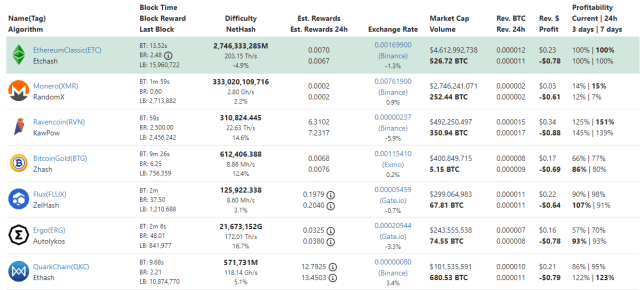
Current data from mining profitability calculators, such as WhatToMine, paints a grim picture for the industry. Under current market conditions, almost no GPU-minable cryptocurrency offers a positive return on investment when accounting for electricity costs.
As of the latest reports, mining Ethereum Classic—the most popular post-Merge alternative—yields an estimated profit of -$0.78 per hour for a standard rig configuration consisting of three AMD Radeon RX 480 graphics cards. This calculation assumes an average electricity cost of $0.10 per kilowatt-hour (kWh). Even for miners utilizing top-of-the-line hardware, such as the Nvidia GeForce RTX 3090 Ti, the hourly profit remains negative, hovering around -$0.50.
The fundamental issue is the "Hashrate-to-Market Cap" ratio. Ethereum’s market capitalization was large enough to provide substantial block rewards that could sustain millions of miners. In contrast, the market caps of ETC, RVN, and ERG are orders of magnitude smaller. When the mining difficulty increases by 500% but the price of the coin remains stagnant or declines, the "yield per megahash" drops below the cost of the power required to generate it. For most miners in regions with standard electricity rates, continuing to mine is effectively "buying" the coin at a premium compared to simply purchasing it on an exchange.
A Chronology of the Transition
The road to this profitability crisis was paved over several years, marked by key technical milestones:
- December 2020: The launch of the Beacon Chain, the foundation of Ethereum’s PoS system, which ran in parallel with the original PoW chain for nearly two years.
- August 2021: The London Hard Fork and the implementation of EIP-1559. This introduced a "base fee" burn mechanism, which began reducing the total revenue available to miners even before the Merge.
- Early 2022: Developers successfully completed several "shadow forks" and testnet merges (Goerli, Sepolia, and Ropsten), signaling that the end of PoW was imminent.
- September 15, 2022: The Merge is completed at a Terminal Total Difficulty (TTD) of 58750000000000000000000. Ethereum officially ceases PoW operations.
- September 16–20, 2022: A "Hashrate War" ensues as miners bounce between various altcoins seeking profitability, leading to massive volatility in network difficulty across the PoW ecosystem.
Industry Reactions and Strategic Shifts
The sudden obsolescence of Ethereum mining has drawn varied reactions from key stakeholders in the crypto space. Vitalik Buterin, the co-founder of Ethereum, had long advised miners that the transition to PoS was inevitable, suggesting as early as 2021 that miners should eventually look toward Ethereum Classic if they wished to remain in the PoW space.

However, the reality has been more complex. Several prominent mining pools, such as Ethermine, the largest Ethereum pool prior to the Merge, announced they would not support a PoW fork of Ethereum and instead launched staking services. Meanwhile, a faction of the mining community attempted to maintain the status quo by launching "EthereumPoW" (ETHW), a hard fork that preserved the PoW mechanism. Despite initial interest, ETHW has struggled to gain significant market traction or provide a profitable haven for miners.
The hardware sector is also feeling the impact. Nvidia and AMD, which saw record-breaking revenues during the mining boom, are now facing a secondary market flooded with used GPUs. As unprofitable miners liquidate their rigs to recoup capital, the prices of graphics cards have plummeted, returning to—and in some cases falling below—Manufacturer’s Suggested Retail Price (MSRP) for the first time in years.
Broader Implications and Fact-Based Analysis
The current state of PoW mining suggests a fundamental restructuring of the industry. Several implications are becoming clear to market analysts:
1. The End of "Hobbyist" Mining: For years, individuals could run small mining rigs in their homes and turn a modest profit. With margins now deep in the negative, GPU mining is becoming a "rich man’s game," viable only for those with access to ultra-low-cost electricity (under $0.03–$0.04 per kWh) or those who are "speculative mining"—operating at a loss today in the hope that the coins they earn will appreciate significantly in value in the future.
2. Network Security Concerns: While high hashrate generally implies high security, the extreme volatility in hashrate across smaller PoW chains can be problematic. If a significant portion of miners suddenly goes offline due to sustained unprofitability, it could lead to slower block times and potential vulnerabilities until the difficulty adjusts downward.
3. The Pivot to AI and High-Performance Computing (HPC): Some industrial-scale mining operations are attempting to repurpose their GPU clusters for non-crypto tasks. The computational power used for mining can, in some cases, be redirected toward AI model training, 3D rendering, or scientific simulations. This transition, however, requires significant software reconfiguration and a different business model.
4. Environmental Rebranding: The Merge has successfully reduced Ethereum’s energy consumption by an estimated 99.95%. This has put immense pressure on remaining PoW chains to justify their environmental footprint. As the narrative around "Green Crypto" gains momentum, PoW networks may find it increasingly difficult to attract institutional investment.
Future Outlook
The question remains: Can GPU mining survive? Historically, mining has been a cyclical industry. When miners exit the market due to unprofitability, the hashrate eventually drops, leading to a decrease in difficulty. This "shakeout" period eventually allows the remaining, most efficient operators to return to profitability.
However, the scale of the Ethereum displacement is unprecedented. There is currently no single PoW coin, or even a combination of coins, with enough "economic bandwidth" to absorb the nearly $19 billion in annual revenue that Ethereum mining once generated. Unless a new PoW-based project emerges with a massive market cap, or existing altcoins like Ethereum Classic see a price surge of several hundred percent, the era of widespread, profitable GPU mining appears to be at a definitive end.
For now, the market is in a state of "wait and see." As Ether’s price continues to face macroeconomic headwinds, currently trading around the $1,400 mark (a 6% decline over the last week), the incentive for miners to hold onto their hardware is dwindling. The transition has proven that while the code of a blockchain can be changed overnight, the economic ecosystem built around it takes much longer to find a new equilibrium.