The long-standing debate over what constitutes the ultimate "store of value" has historically been framed as a binary choice between the enduring appeal of gold and the digital scarcity of Bitcoin. However, a recent market analysis posits a provocative new perspective, suggesting that Ethereum (ETH) possesses characteristics that could elevate it beyond both, potentially positioning it as a superior form of "productive money." This analysis, which forecasts a remarkable long-term valuation of $250,000 per ETH, is predicated on the cryptocurrency’s ability to capture a significant portion of the estimated $31 trillion monetary premium currently attributed to gold and Bitcoin.
At the heart of this ambitious thesis lies the resolution of a fundamental economic quandary that has perplexed investors for generations. For decades, prominent figures such as Warren Buffett have characterized gold as "sterile" due to its inability to generate compounding returns. Bitcoin, while offering digital advantages, shares this limitation; its supply is finite, and one Bitcoin remains precisely one Bitcoin, incapable of generating intrinsic yield. Ethereum, in contrast, purports to transcend this constraint. Through its sophisticated proof-of-stake (PoS) consensus mechanism, ETH generates a native yield, effectively rewarding holders who contribute to the security and operation of the network, without the need for intermediaries or traditional financial institutions. This unique attribute, the analysis suggests, makes ETH the first asset in history to seamlessly integrate the "bearer" qualities of money—its portability and direct ownership—with the wealth-generating potential of a productive asset. In essence, while gold and Bitcoin are considered inert stores of value, ETH is framed as a dynamic "toll road" for the global financial ecosystem, collecting fees and distributing rewards to those who secure its infrastructure.
Challenging Traditional Monetary Metrics: Ethereum’s Strengths
The comprehensive market analysis, drawing upon foundational economic principles articulated by figures like Carl Menger, contends that Ethereum not only matches but potentially surpasses gold and Bitcoin across a spectrum of critical monetary metrics.
One of the most significant distinctions highlighted is Ethereum’s controlled supply issuance. Unlike gold, whose mining can be accelerated in response to rising prices, thereby potentially diluting its scarcity, ETH’s issuance is governed by a fixed protocol. Furthermore, a built-in "burn" mechanism actively destroys a portion of ETH supply as network usage increases, creating a deflationary pressure that is directly tied to adoption and activity. This dynamic supply model stands in stark contrast to the fixed and predictable issuance of Bitcoin, which, while designed for scarcity, does not inherently adjust based on network demand in the same way.
Beyond supply dynamics, the analysis asserts that Ethereum offers arguably the strongest form of property rights globally. Historically, gold has been susceptible to confiscation, as evidenced by the U.S. government’s seizure of privately held gold in 1933. While Bitcoin offers a degree of self-custody, concerns about mining centralization and potential governmental interventions persist. Ethereum, with its decentralized nature and robust network security, is presented as being inherently resistant to such forms of seizure or control. The protocol’s design, with its forced-inclusion mechanisms, aims to ensure that transactions are immutable and censorship-resistant, providing a level of security and autonomy that is difficult to replicate.
Moreover, Ethereum’s security budget is designed to scale intrinsically with its value. As the network becomes more valuable and accrues more economic activity, the cost and complexity of launching a successful attack on the network increase exponentially. This presents a structural advantage over Bitcoin’s security model, which relies heavily on diminishing block rewards to incentivize miners. As these rewards decrease over time, the network’s security budget will increasingly depend on transaction fees, a factor whose long-term sufficiency remains a subject of debate among analysts.
Historical Precedents and Potential "Demonetization" Risks
History offers compelling precedents for the transition of monetary standards. The late 19th century witnessed the dramatic shift from silver to gold as the dominant global monetary metal. Nations that failed to adapt to this new standard often experienced significant economic upheaval and collapse. The current analysis suggests that Bitcoin may face a similar existential threat, a form of "demonetization," due to its perceived ossified development trajectory and evolving security economics. As new, more adaptable monetary technologies emerge, assets that fail to innovate or address fundamental economic limitations risk becoming obsolete.

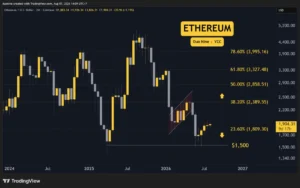
The current market environment sees Ethereum trading in the vicinity of $2,325, a price point that has recently been influenced by the sustained inflows into institutional spot Bitcoin Exchange-Traded Funds (ETFs). While the $250,000 target per ETH represents a monumental leap from its present valuation, analysts behind this projection argue that the market is still largely treating ETH as a speculative "tech bet" rather than recognizing its potential as the world’s first truly productive monetary standard. This perspective suggests that a significant re-evaluation of Ethereum’s fundamental value proposition is yet to occur within the broader investment landscape.
The "Productive Money" Framework: A Paradigm Shift
The concept of "productive money" is central to the analysis’s optimistic outlook for Ethereum. Unlike traditional forms of money, which primarily serve as a medium of exchange and a store of value, productive money possesses an inherent ability to generate returns. This is achieved through mechanisms that allow the asset itself to participate in economic activities and yield benefits to its holders.
For gold, its "productivity" is indirect. It can be used in industrial applications or as collateral, but the gold itself does not inherently generate wealth. Bitcoin, as a digital asset, is often lauded for its scarcity and decentralized nature, but it too lacks an intrinsic yield-generating mechanism. Its value appreciation is driven primarily by market demand and its perceived utility as a hedge against inflation or a censorship-resistant store of value.
Ethereum’s proof-of-stake model fundamentally alters this dynamic. By staking ETH, users contribute to the network’s security and validate transactions. In return, they receive rewards in the form of newly minted ETH and a portion of transaction fees. This creates a direct, compounding yield for ETH holders, a feature that is absent in both gold and Bitcoin. This yield-generating capability transforms ETH from a purely speculative asset into one that can actively contribute to wealth accumulation, mirroring the characteristics of traditional income-generating assets but with the added benefits of digital scarcity and decentralized ownership.
Addressing Criticisms and Future Outlook
While the analysis presents a bullish case for Ethereum, it is important to acknowledge potential criticisms and challenges. The scalability of Ethereum, despite ongoing upgrades like the Merge and subsequent network improvements, remains a crucial factor. Ensuring that the network can handle a significant increase in transactional volume without compromising speed or increasing fees will be paramount to realizing its potential as a global monetary standard. Furthermore, regulatory scrutiny surrounding cryptocurrencies continues to be a significant consideration for institutional adoption and broader market acceptance.
The journey to a $250,000 ETH valuation is not anticipated to be linear or without volatility. The cryptocurrency market is known for its inherent price fluctuations, driven by a multitude of factors including macroeconomic conditions, technological developments, and investor sentiment. However, the core argument of this analysis is that the fundamental economic properties of Ethereum, particularly its productive yield and scalable security, position it for long-term value appreciation that could significantly outperform traditional assets.
The implications of such a valuation are far-reaching. If Ethereum were to capture even a fraction of the monetary premium currently held by gold and Bitcoin, it would represent a substantial reallocation of global wealth. It could also catalyze a broader adoption of decentralized finance (DeFi) and blockchain-based applications, further integrating these technologies into the fabric of the global economy. The narrative of Ethereum as "productive money" could fundamentally reshape how investors perceive digital assets, moving beyond speculative trading to a more fundamental, yield-oriented investment thesis.
The ongoing development of Ethereum’s ecosystem, including the continued evolution of layer-2 scaling solutions and the expansion of decentralized applications, will play a critical role in its future trajectory. As these components mature and become more integrated, they contribute to the network’s overall utility and attractiveness, reinforcing the argument for its potential as a dominant monetary asset. The convergence of technological innovation, economic principles, and increasing institutional interest suggests that the "store of value" debate is far from over, and Ethereum is emerging as a compelling contender in this evolving landscape.