


The long-anticipated "altseason"—a cyclical phenomenon where alternative cryptocurrencies outperform Bitcoin and yield exponential returns—has failed to materialize in the current market cycle, giving way to a structural "reckoning" that is purging a significant portion of the digital asset landscape. Recent data and market analysis reveal that the altcoin market is not merely experiencing a temporary correction but is undergoing a fundamental devaluation driven by unprecedented liquidity dilution and a shift in investor behavior. Leading market analyst Darkfost, utilizing data from the on-chain analytics platform CryptoQuant, has identified a staggering trend: more than 40% of all altcoins are currently trading at or near their all-time lows (ATL), a figure that surpasses the most bearish periods of the 2022 market downturn.
This statistical milestone serves as a grim indicator of the current state of the market. During the previous bear market, the percentage of altcoins reaching their all-time lows peaked at approximately 38%. The fact that the current cycle, which saw Bitcoin reach new record highs above $100,000, has produced a higher rate of altcoin failure than a dedicated bear market suggests a decoupling between the "blue-chip" assets and the broader altcoin ecosystem. For many investors, the current environment has proven more destructive than the 2022 collapse of FTX and Terra (LUNA), as the slow bleed of liquidity has systematically hollowed out the valuations of thousands of projects.
The Statistical Reality of the Altcoin Decline
The findings published by Darkfost underscore a harsh reality for retail participants who have held onto diverse portfolios in hopes of a market-wide rotation. The "40% threshold" represents a point of no return for many assets; when a token nears its all-time low during a period when the primary market leader (Bitcoin) is relatively strong, it indicates a total lack of buyer interest and a failure of the "buy the dip" mentality that characterized previous cycles.
In previous bull runs, such as those in 2017 and 2021, the market followed a predictable "waterfall" of capital. Liquidity would flow first into Bitcoin, then into large-cap assets like Ethereum and Solana, before finally cascading into mid-cap and small-cap "moonshots." In 2024 and 2025, this waterfall has been replaced by a "closed-loop" system. Institutional capital, largely funneled through Spot Bitcoin Exchange-Traded Funds (ETFs), remains trapped within the Bitcoin ecosystem, rarely venturing out into the high-risk, low-liquidity world of altcoins. Consequently, while Bitcoin maintains its dominance and price floors, the vast majority of the 40% of altcoins at ATLs are effectively being "starved" of the capital necessary to sustain their valuations.
The 47 Million Part Problem: Liquidity Dilution at Scale
While macroeconomic pressures play a role, Darkfost argues that the primary culprit behind the altcoin collapse is an internal structural failure: the sheer explosion in the number of tradable assets. According to current data, there are now more than 47 million cryptocurrencies in existence. This astronomical figure represents a total departure from previous years, where the number of tokens was measured in the thousands, not the tens of millions.
The breakdown of token issuance across major blockchains highlights the scale of the problem:
- Solana: Over 22 million tokens, largely driven by the rise of "meme-coin" launchpads like Pump.fun, which allow users to create tokens in seconds for a negligible cost.
- Base (Coinbase’s Layer 2): Over 18 million tokens, benefiting from low transaction fees and high user accessibility.
- BNB Smart Chain: Over 4 million tokens.
The problem is one of simple mathematics. The total pool of capital available in the cryptocurrency market has not grown at a rate that can accommodate 47 million individual assets. In 2021, a few billion dollars in retail "hype" could lift the entire top 100 altcoins simultaneously. Today, that same amount of capital is spread across an effectively infinite supply of tokens. This results in "liquidity dilution," where the available buying power is spread so thin that no single asset—outside of a few viral exceptions—can sustain a meaningful upward trend. The result is a market that is structurally fragile; without a massive influx of new retail capital, the vast majority of these 47 million tokens are destined to trend toward zero.
Technical Breakdown: The Death of the "OTHERS" Index
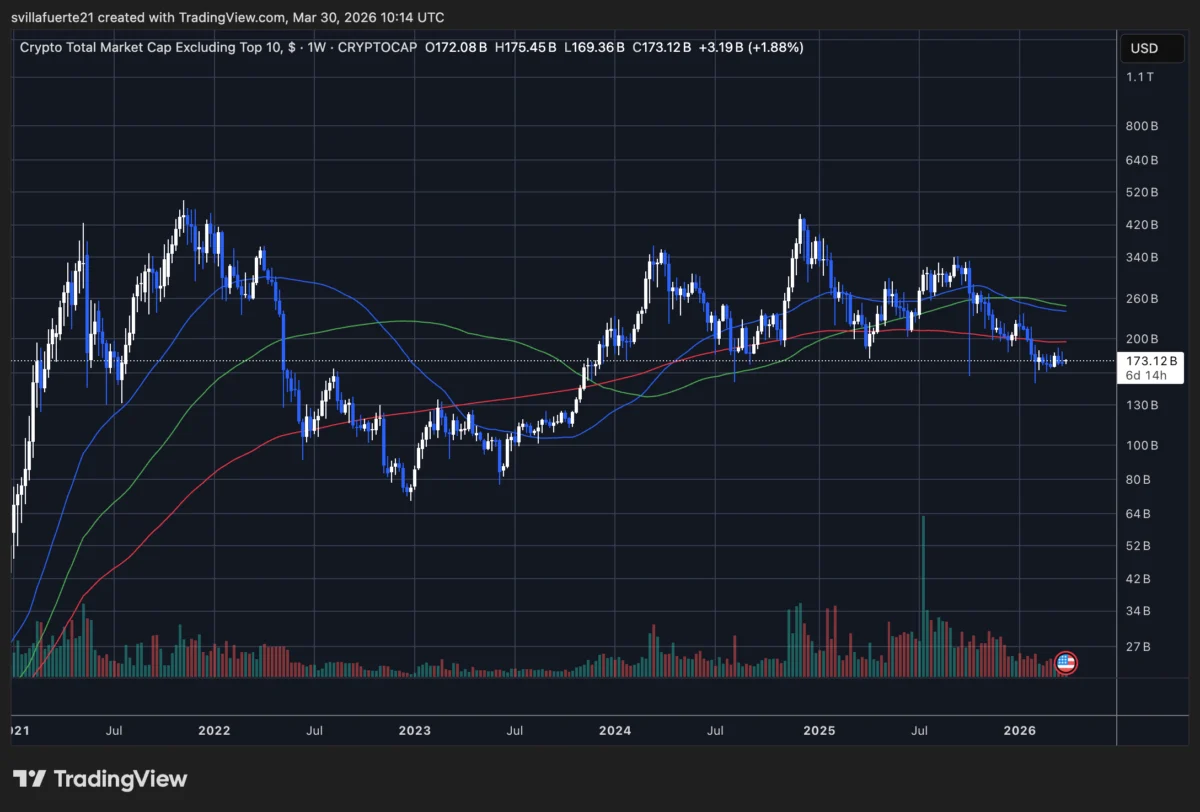
To understand the health of the altcoin market, analysts often look at the "OTHERS" chart, which tracks the total cryptocurrency market capitalization excluding the top 10 largest assets. This index provides the purest look at the mid-to-small-cap market. Currently, the OTHERS index sits at approximately $173.12 billion. While this represents a modest 1.88% gain over the last week, the broader context is devastating.
The OTHERS index peaked near $480 billion in late 2024. Since then, it has collapsed by 64%, erasing all gains made during the 2023–2024 rally. Essentially, the entire "bull run" for the average altcoin has been completely unwound, returning prices to levels last seen in mid-2023 when the market was still in the depths of a post-FTX depression.

Technical indicators confirm the severity of this downtrend. The index has broken below three critical support levels: the 50-week, 100-week, and 200-week Moving Averages (MAs). Furthermore, a "death cross"—where the 50-week MA crosses below the 100-week MA—has been confirmed. This signal historically precedes prolonged periods of underperformance and suggests that the "path of least resistance" for altcoins remains downward. The 200-week MA, which acted as a definitive floor for the market for nearly two years, has now turned into a "ceiling" of resistance. Until the market can reclaim the $190 billion level, any minor price increases are viewed by professional traders as "dead cat bounces" rather than the start of a new altseason.
Macroeconomic Headwinds and Geopolitical Tensions
The internal rot of the altcoin market is being exacerbated by a hostile external environment. The global financial landscape is currently characterized by "risk-off" positioning due to escalating geopolitical tensions and economic uncertainty. Altcoins, occupying the furthest end of the risk spectrum, are the first assets investors sell when fear enters the market.
Geopolitical conflicts in the Middle East and Eastern Europe have created volatility in traditional markets, leading to the worst performance for the traditional "60/40" investment portfolio (60% stocks, 40% bonds) since 2022. In such an environment, the "altcoin thesis"—that these assets serve as high-beta plays on a growing digital economy—breaks down. Instead, they are treated as speculative liabilities. When global tensions rise, capital flees to "safe havens" like Gold, the US Dollar, and, increasingly, Bitcoin. Altcoins are left behind, absorbing the initial shock of market fear but failing to participate in the subsequent recovery.
The Evolution of the Market: A Great Bifurcation
The current data suggests that the cryptocurrency market is entering a phase of "The Great Bifurcation." In previous cycles, the market moved as a monolith; when Bitcoin went up, everything went up. In the 2024-2025 era, the market is splitting into two distinct categories:
- Institutional-Grade Assets: Bitcoin and, to a lesser extent, Ethereum and Solana. these assets are increasingly integrated into the global financial system through ETFs and institutional custody solutions.
- The Speculative Long Tail: The 47 million tokens that constitute the "altcoin" market. These assets remain largely unregulated, illiquid, and dependent on retail speculation.
This split explains why Bitcoin can hover near $100,000 while 40% of the market is at all-time lows. The "altcoin" label is becoming less useful as a catch-all term. Investors are beginning to realize that most "utility tokens" lack a sustainable economic model, and most "memecoins" are zero-sum games where the vast majority of participants lose money to sophisticated bots and insiders.

Future Outlook: Survival of the Resilient
The current "reckoning" is not necessarily the end of the altcoin market, but it is likely the end of the altcoin market as it has been known for the last decade. The era of "blindly buying the dip" on any top-100 project and waiting for a 10x return is likely over.
Darkfost’s analysis suggests that while the current underperformance is extreme, it creates a unique opportunity for "those willing to do the work." The massive culling of the market will eventually leave behind only the projects with genuine users, revenue, and resilience. However, the process of reaching that equilibrium will be painful. If the OTHERS index fails to hold its current support at $173 billion, the next logical technical floor is the 2022 bear market low of $80 billion—a further 50% drop from current levels.
As the market continues to mature, the distinction between "crypto-assets" and "speculative tokens" will become the most important factor for investors. In a world of 47 million choices, the market is no longer rising together; it is deciding which few deserve to survive. For the 40% of tokens currently at their all-time lows, the window for a miracle recovery is closing as the "altseason" promise fades into a permanent structural shift.














