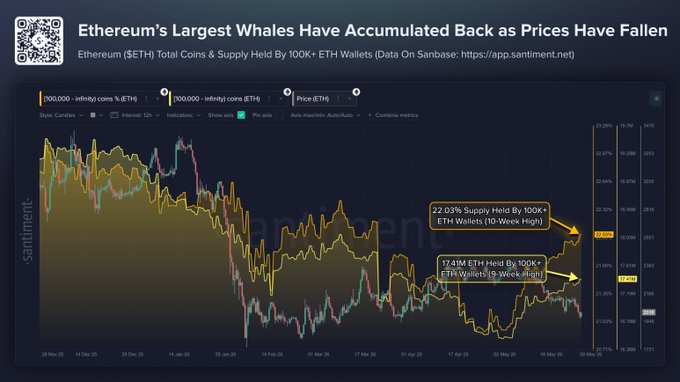
Despite a recent dip below the psychologically significant $2,000 mark, a notable shift in investor sentiment is unfolding within the Ethereum ecosystem. Data from on-chain analytics firm Santiment reveals that the top ten largest Ethereum whale wallets have collectively amassed a staggering amount of Ether, marking a significant increase in their holdings and reaching a nine-week high. These large-scale accumulations, totaling an estimated $4 billion worth of ETH, signal a growing conviction among major players in the cryptocurrency market, even as broader price action shows some weakness.
The aggregation of these substantial ETH reserves by the top ten whales underscores a pattern of strategic accumulation. According to Santiment’s analysis, these influential wallets now control a combined total of 17.41 million Ether. This represents the highest balance observed in these elite addresses for the past nine weeks, indicating a sustained and escalating interest in acquiring the second-largest cryptocurrency by market capitalization.
Furthermore, this increased concentration of wealth among the largest holders is becoming more pronounced. These whale addresses now collectively own 22.03% of Ethereum’s circulating supply, a figure that has also reached a ten-week high. This growing percentage highlights a trend of further consolidation of Ether holdings among a select group of very large investors, a phenomenon that market observers closely scrutinize for potential insights into future market movements.
At the time of reporting, Ethereum was trading at approximately $1,973 on CoinGecko, having recently fallen below the critical $2,000 threshold. This price action, while indicating some short-term downward pressure, has not deterred these prominent whales from increasing their exposure. Instead of reducing their stakes in response to the price dip, these large investors appear to be steadily augmenting their positions, a move often interpreted as a vote of confidence in Ethereum’s long-term value proposition.

The Significance of Whale Accumulation in a Volatile Market
The actions of "whales" – individuals or entities holding substantial amounts of cryptocurrency – are frequently monitored by the broader market due to their potential to influence price movements. Their investment decisions are often based on extensive research, sophisticated trading strategies, and a deep understanding of market dynamics. Therefore, when these large holders begin to accumulate assets during periods of price decline or market uncertainty, it can be interpreted as a signal of underlying strength and potential future recovery.
This current trend of whale accumulation in Ethereum is particularly noteworthy. Typically, periods of price weakness can trigger a wave of fear and capitulation among retail investors, leading to sell-offs. However, the sustained buying pressure from the top ten whales suggests that these sophisticated market participants perceive value in Ethereum at its current price levels, despite the short-term volatility. This does not guarantee an immediate price surge, but it does indicate that informed investors believe Ethereum’s fundamental value remains robust and that current prices offer an attractive entry point for long-term holding.
Contrasting Trends: Retail Investor Behavior
In contrast to the strategic accumulation by whales, Santiment’s analysis also points to an interesting, albeit potentially deceptive, trend among retail traders. While many smaller investors might be expected to react to Ethereum’s price decline with apprehension, a significant portion appears to be adopting a "buy-the-dip" mentality. Social media platforms have been observed to be flooded with calls for accumulating ETH at discounted prices, suggesting a widespread optimistic outlook among the retail segment of the market.
This collective enthusiasm from retail investors, while seemingly positive, often presents a divergence from the actual market trajectory. Historical market behavior has frequently shown that prevailing retail sentiment can sometimes be at odds with the direction of price movements. When retail investors are overwhelmingly optimistic and vocal about buying, it can sometimes precede a market downturn, as the market may be poised to move against the prevailing narrative. This dynamic suggests that while retail optimism is present, it may not be the primary driver of immediate price action, and caution might still be warranted when interpreting these signals.
Underlying Factors and Market Dynamics
The current situation for Ethereum is multifaceted, characterized by seemingly contradictory investor behaviors and a backdrop of increasing institutional interest. On one hand, the significant accumulation by whales, coupled with their highest holdings in nine weeks and a 10-week high in their percentage of circulating supply, points towards a strong belief in Ethereum’s future prospects. This accumulation has occurred amidst a period of heightened activity and interest from Wall Street institutions in the broader digital asset space. Recent developments, such as Wells Fargo’s increased ETF bets and JPMorgan’s exploration of tokenized funds, indicate a growing institutional embrace of blockchain technology and digital assets, with Ethereum often at the forefront of these initiatives. This institutional engagement can provide a foundational layer of support and legitimacy, potentially influencing the long-term outlook for Ether.
On the other hand, the retail investor sentiment, while optimistic, presents a potential cautionary tale. The "buy-the-dip" sentiment, if widespread and driven by a herd mentality, could indicate that retail traders are entering the market at a point where larger, more informed players might be preparing for different market conditions. This divergence in sentiment between whales and retail investors is a critical factor for market analysts to consider.
Historical Context and Potential Implications
The accumulation patterns observed among Ethereum whales are not unprecedented. Historically, periods of significant whale accumulation have often preceded periods of price recovery and upward momentum for the cryptocurrency. For instance, during previous market downturns, large holders have been observed to strategically buy up significant portions of the supply, effectively absorbing selling pressure and setting the stage for future gains once sentiment shifts. The current nine-week high in holdings for the top ten whales and the ten-week high in their share of the circulating supply are particularly compelling data points. These metrics suggest a deliberate and sustained effort to increase their stake, potentially positioning themselves for a future bull run.
The implications of this whale activity are significant for several reasons. Firstly, it suggests that major market participants believe Ethereum’s current price is undervalued relative to its long-term potential. This could be driven by a variety of factors, including the ongoing development and adoption of Ethereum’s ecosystem, the potential for increased utility through scaling solutions like Layer 2 networks, and the eventual approval and integration of Ethereum-based financial products by institutional investors.
Secondly, the increasing concentration of supply among these large holders could have implications for market liquidity and price volatility. A higher percentage of Ether held by a smaller number of entities might mean that fewer coins are available for active trading on exchanges. This could potentially exacerbate price swings if significant buying or selling pressure emerges from these whale wallets. However, it can also indicate a stable holding pattern, where these entities are less likely to engage in short-term speculative trading, thus contributing to overall market stability.
The contrasting retail sentiment also presents a dynamic that could influence market outcomes. If the retail "buy-the-dip" enthusiasm continues unabated and is met with significant selling pressure from larger players or a lack of sustained buying power, it could lead to a period of price stagnation or even further declines, disappointing those who have entered the market at perceived discounts. Conversely, if the whale accumulation proves to be a precursor to a broader market uptrend, then the retail investors who have embraced the dip may indeed benefit significantly.

The Ethereum Ecosystem and Future Outlook
Beyond the immediate price action and whale accumulation, the underlying health and development of the Ethereum ecosystem continue to be critical factors influencing its long-term value. Ethereum is undergoing continuous upgrades and advancements aimed at improving its scalability, security, and efficiency. The transition to Ethereum 2.0, with its Proof-of-Stake consensus mechanism, has been a significant milestone, and ongoing development in areas like sharding and Layer 2 scaling solutions are crucial for handling increased transaction volumes and reducing gas fees.
The increasing interest from traditional financial institutions, as evidenced by the actions of major banks and investment firms, further bolsters the narrative of Ethereum’s growing importance in the global financial landscape. These institutions are exploring various avenues, including spot and futures ETFs, tokenized assets, and decentralized finance (DeFi) applications built on Ethereum. Such institutional adoption can unlock significant capital flows into the ecosystem and drive further innovation and adoption.
The current divergence in sentiment between large-scale investors and retail traders, against the backdrop of ongoing technological development and institutional interest, creates a complex but potentially exciting scenario for Ethereum. The actions of the top ten whales, characterized by sustained accumulation and reaching multi-week highs in their holdings, offer a strong signal of confidence from well-resourced market participants. While retail sentiment leans towards optimism, the true market direction will likely be shaped by the interplay of these diverse forces, the continued evolution of the Ethereum network, and broader macroeconomic factors influencing the cryptocurrency market as a whole. Investors and observers will be closely watching to see how these dynamics unfold in the coming weeks and months.