



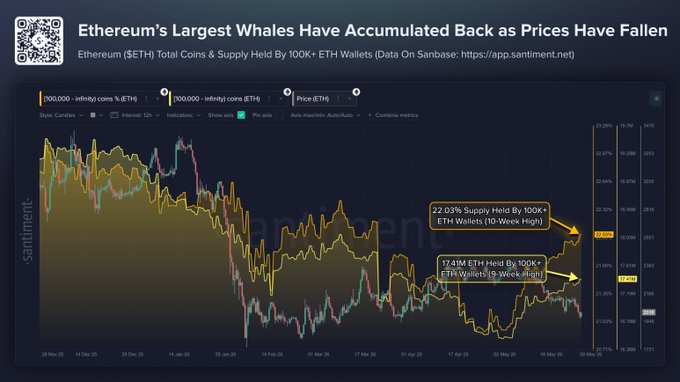
Despite trading below the significant psychological barrier of $2,000, major holders of Ethereum, often referred to as "whales," are demonstrating a strong conviction in the cryptocurrency’s future. Data from the on-chain analytics firm Santiment reveals a substantial accumulation of Ether by these large-scale investors, reaching a new record high in their collective holdings over the past nine weeks. This trend suggests a significant shift in sentiment among sophisticated market participants, even as the broader market experiences a temporary downturn.
The latest analysis from Santiment indicates that wallets containing at least 100,000 ETH now collectively manage a staggering 17.41 million ETH. This figure represents the highest balance these large holders have controlled in nearly two and a half months, signaling an aggressive buying spree. This accumulation is not just about sheer volume; it also reflects a growing concentration of wealth within a smaller group of influential players. These whale addresses now account for 22.03% of Ethereum’s total circulating supply, a 10-week peak that underscores their increasing dominance in the market.
At the time of reporting, Ethereum was trading at approximately $1,973, according to CoinGecko data, having dipped below the crucial $2,000 mark. This price action, while potentially concerning for some investors, appears to have spurred rather than deterred these whales. Instead of reducing their exposure, they have been steadily increasing their positions, a move that often precedes a significant market shift. This behavior is particularly noteworthy given the prevailing market sentiment, which often sees smaller investors react more emotionally to price fluctuations.
The Significance of Whale Accumulation
The actions of large-scale investors like Ethereum whales are closely scrutinized by the broader cryptocurrency community. Their substantial capital allows them to influence market dynamics, and their investment decisions are often interpreted as leading indicators of future price movements. Whales typically possess a more sophisticated understanding of market cycles and tend to accumulate assets when uncertainty is high and general sentiment is weak, precisely because they perceive long-term value at discounted prices. While their accumulation does not guarantee an immediate price recovery, it strongly suggests that these seasoned market participants believe Ethereum has robust underlying value that will eventually be recognized by the market.

This strategic accumulation by whales during a period of price weakness contrasts sharply with the behavior of some retail traders. Santiment’s data also points to a growing "buy-the-dip" mentality among smaller investors. Social media platforms have seen an influx of retail traders advocating for the accumulation of ETH at its current discounted prices. This widespread optimism among the retail segment, while indicative of a growing interest in Ethereum, can sometimes be a contrarian signal in market analysis, as markets often move against prevailing popular sentiment.
Historical Context and Market Dynamics
The current accumulation trend by Ethereum whales can be viewed within the broader context of institutional interest and regulatory developments surrounding cryptocurrencies. The past year has seen an escalating race among major financial institutions to establish a foothold in the digital asset space. Wells Fargo, for instance, has been actively increasing its bets on Ethereum, notably through its involvement in the burgeoning spot Ethereum ETF market. Similarly, JPMorgan Chase has been exploring tokenized funds, indicating a broader trend of Wall Street integrating blockchain technology and digital assets into its traditional financial offerings.
These developments suggest a growing institutional acceptance of Ethereum as a legitimate asset class, distinct from its speculative appeal. The potential approval of spot Ethereum ETFs in various jurisdictions, mirroring the path of Bitcoin ETFs, could unlock significant capital inflows from institutional investors. Whales, being closer to the institutional ecosystem and possessing greater market insight, are likely positioning themselves to capitalize on these anticipated inflows and the subsequent price appreciation.
The timeline of this whale accumulation further adds to its significance. The current nine-week high in holdings marks a sustained period of buying pressure from these large entities. This is not a fleeting speculative surge but a consistent expansion of their ETH reserves. This sustained effort indicates a deep-seated belief in Ethereum’s long-term viability and growth potential, potentially fueled by the upcoming upgrades to the Ethereum network and the increasing adoption of decentralized applications (dApps) and the burgeoning DeFi (Decentralized Finance) ecosystem.
Underlying Technology and Network Development
Ethereum’s appeal to whales and institutional investors is also intrinsically linked to its ongoing technological evolution. The successful transition to a Proof-of-Stake (PoS) consensus mechanism, known as "The Merge," marked a significant milestone, drastically reducing the network’s energy consumption and paving the way for future scalability improvements. The ongoing development roadmap for Ethereum includes further enhancements aimed at increasing transaction speeds and reducing gas fees, such as the Cancun-Deneb upgrade, which is expected to bring substantial improvements through EIP-4844 (Proto-Danksharding).
These technical advancements are crucial for Ethereum’s ability to support a growing number of users and dApps. As the network becomes more efficient and cost-effective, its utility as a platform for decentralized finance, NFTs, gaming, and other blockchain-based applications increases, thereby enhancing its intrinsic value. Whales, with their substantial holdings, are likely betting on these improvements to drive future demand and, consequently, price appreciation.
Contrasting Retail Sentiment and Market Implications
While whales are strategically accumulating, the sentiment among retail investors presents a different picture. The prevailing "buy-the-dip" narrative on social media, as observed by Santiment, highlights a segment of the market that is actively seeking opportunities during price downturns. However, this can be a double-edged sword. In many instances, markets tend to move against the collective retail sentiment. If the majority of retail traders are bullish and buying, it could signal that the market is approaching a potential reversal or consolidation phase, especially if this optimism is not supported by fundamental shifts.
The divergence in behavior between whales and retail traders creates an interesting market dynamic. Whales are demonstrating a strategic, long-term approach, accumulating significant positions in anticipation of future growth, possibly driven by institutional adoption and network upgrades. Retail traders, on the other hand, appear to be reacting more to short-term price movements, albeit with a positive outlook.
The implications of this whale accumulation are manifold:
- Potential for Price Recovery: Increased buying pressure from large holders can lead to a stabilization and subsequent recovery of Ethereum’s price. Their substantial capital can absorb selling pressure and drive demand.
- Market Consolidation: The growing concentration of ETH among a few large holders could lead to periods of consolidation, where the price might trade within a defined range as these whales continue to build their positions.
- Indicator of Institutional Interest: The sustained accumulation by whales, many of whom are closely linked to or influenced by institutional trends, serves as a strong signal of growing confidence in Ethereum from larger financial players.
- Risk of Centralization Concerns: While not inherently negative, a significant concentration of supply in the hands of a few entities can sometimes raise concerns about market centralization and the potential for manipulation. However, in the context of a decentralized network like Ethereum, the long-term value proposition often outweighs these concerns for strategic investors.
Expert Reactions and Future Outlook
While direct quotes from specific whales are not publicly available due to the anonymous nature of many cryptocurrency holdings, the data from Santiment is a widely accepted proxy for their actions. Analysts in the cryptocurrency space often interpret such accumulation patterns as strong bullish signals. For instance, market analysts often point to these on-chain metrics as crucial indicators for understanding the underlying health and sentiment of a cryptocurrency.

The fact that Ethereum is trading below $2,000, a level that has historically been a significant psychological support, makes this whale accumulation even more compelling. It suggests that these large investors are not merely reacting to price levels but are making strategic decisions based on a broader assessment of Ethereum’s fundamental value and future potential. The ongoing developments in the institutional adoption of digital assets, coupled with Ethereum’s continuous network upgrades, provide a strong foundation for this optimism.
In conclusion, the current trend of Ethereum whales aggressively accumulating ETH, reaching a nine-week high in their holdings, is a significant development in the cryptocurrency market. This strategic buying behavior, occurring even as Ethereum trades below a key psychological threshold, signals strong confidence from major market participants. It suggests that despite short-term price volatility, these sophisticated investors foresee substantial long-term value in Ethereum, potentially driven by increasing institutional interest and ongoing technological advancements within the network. The contrasting sentiment among retail traders adds another layer of complexity, highlighting the diverse approaches to market participation. As the cryptocurrency landscape continues to evolve, the actions of these whales will remain a critical indicator to watch.














