Despite trading below the significant psychological barrier of $2,000, the largest holders of Ethereum, often referred to as "whales," are demonstrating a robust vote of confidence by accumulating substantial amounts of the second-largest cryptocurrency. Recent data from the on-chain analytics firm Santiment reveals that wallets holding at least 100,000 ETH have collectively amassed 17.41 million ETH, marking the highest balance observed in the past nine weeks. This accumulation signifies a notable shift in sentiment among major stakeholders, even as the broader market grapples with price volatility.
The increased holdings by these top whale addresses are not just a matter of quantity; they represent a growing concentration of ownership within a select group. These entities now command an impressive 22.03% of Ethereum’s total circulating supply, a level not seen in the last ten weeks. This concentration suggests that a significant portion of the network’s value is being consolidated by a few powerful entities, a trend that often draws close observation from market analysts and participants alike.
As of the latest reporting, Ethereum was trading at approximately $1,973 on CoinGecko, having dipped below the critical $2,000 mark. This price action, while seemingly bearish to some, appears to be viewed by these large-scale investors as an opportune moment to increase their exposure rather than reduce it. This behavior contrasts with typical market reactions where price declines often trigger sell-offs, especially among smaller investors.
The Significance of Whale Accumulation
The actions of whale investors are closely scrutinized in the cryptocurrency market for several key reasons. Historically, these large players often position themselves during periods of heightened uncertainty and subdued market sentiment. Their decisions are frequently informed by extensive research, deep market understanding, and a longer-term investment horizon. Therefore, when whales begin to accumulate, it can be interpreted as a signal that they perceive underlying value and potential for future appreciation, even amidst short-term price dips.
While this accumulation does not serve as a definitive guarantee of an impending price recovery, it is a strong indicator that sophisticated market participants believe in Ethereum’s long-term prospects. Their strategic buying during a downturn suggests a belief that the current price point is attractive for building positions that could yield significant returns in the future. This behavior is often contrasted with the more reactive trading patterns of retail investors.

Contrasting Retail Investor Sentiment
Interestingly, Santiment’s analysis also highlights a diverging trend among retail traders. Instead of reacting to Ethereum’s price decline with fear or capitulation, many smaller investors appear to be adopting a "buy-the-dip" mentality. Social media platforms are reportedly flooded with discussions and calls to action encouraging the accumulation of ETH at discounted prices. This widespread retail optimism, while seemingly positive, can sometimes be a contrarian indicator in financial markets.
The prevailing narrative among retail investors often moves in tandem with widespread sentiment, which can sometimes be at odds with market movements. Markets can frequently move against the dominant retail sentiment, meaning that extreme optimism among smaller traders might precede a period of consolidation or even further decline, while fear and pessimism could signal a bottom. Therefore, while the "buy-the-dip" sentiment from retail is notable, it warrants a degree of caution when interpreting its potential impact on price action.
Ethereum’s Market Dynamics: A Dual Narrative
The current state of the Ethereum market presents a compelling dichotomy. On one side, we have the silent, strategic accumulation by whales, pushing their ownership levels to multi-week highs. This activity is occurring against a backdrop of increasing institutional interest and involvement from Wall Street. Recent developments, such as Wells Fargo’s increased bet on Ethereum ETFs and JPMorgan’s exploration of tokenized funds, underscore a growing institutional acceptance and integration of Ethereum into traditional finance. This institutional influx can provide a foundation of stability and long-term demand for the cryptocurrency.
On the other side, there’s the persistent optimism from retail traders, who are actively seeking to capitalize on lower prices. This divergence in sentiment and action between large and small investors creates a complex market environment. The interplay between these two groups, alongside the influence of institutional capital, will be crucial in determining Ethereum’s short-to-medium term price trajectory.
Historical Context of Whale Behavior and Market Cycles
Understanding the current whale accumulation requires a look at historical patterns in cryptocurrency markets. Large holders, due to their significant capital, often have the capacity to influence market prices. Their accumulated holdings can act as a buffer against extreme volatility or, conversely, can be strategically deployed to drive prices in a desired direction.
Historically, periods of significant whale accumulation have often preceded major market uptrends. For instance, during the bull run of 2020-2021, sustained accumulation by large ETH holders was a key indicator of underlying strength. Conversely, when whales begin to distribute their holdings, it can signal a topping phase in the market. The current trend of whales increasing their ETH balances, therefore, is being viewed by many as a positive sign for the future.
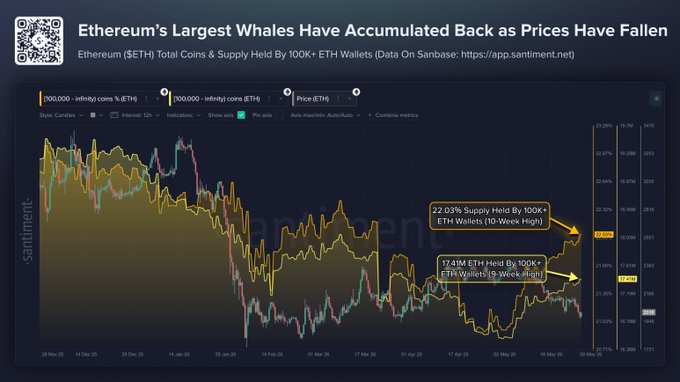
The nine-week high in whale holdings is particularly significant. This period suggests a consistent strategy of buying rather than sporadic opportunistic purchases. The 10-week high in their percentage of circulating supply further amplifies this message of consolidation and increasing control. This trend is not an isolated incident but rather a sustained effort to acquire more ETH during a period of market uncertainty.
The Role of On-Chain Analytics
The insights provided by Santiment are invaluable in deciphering these complex market dynamics. On-chain analytics allows observers to look beyond the surface-level price action and understand the actual movements of digital assets within the blockchain. Metrics such as wallet balances, transaction volumes, and network activity provide a real-time, transparent view of investor behavior.
Santiment’s data specifically focuses on a defined cohort of "whales" – those holding 100,000 ETH or more. This threshold is significant as it represents a substantial financial commitment and typically indicates entities with the resources and knowledge to engage in strategic accumulation. By tracking the collective balance of these wallets, analysts can gauge the overall sentiment and conviction of the most influential market participants.
The firm’s reporting on the percentage of circulating supply held by these whales adds another layer of analysis. An increasing percentage indicates that these large holders are acquiring ETH faster than the overall market supply is growing or that they are outperforming smaller holders in their acquisition efforts. This concentration can have implications for market liquidity and price discovery.
Broader Implications for the Ethereum Ecosystem
The sustained accumulation of ETH by whales has several potential implications for the broader Ethereum ecosystem:
- Increased Price Stability: A significant portion of the supply being held by long-term oriented investors can lead to reduced selling pressure during market downturns. This can contribute to greater price stability and potentially cushion against sharp declines.
- Confidence in Future Growth: Whale accumulation often reflects a belief in the long-term utility and growth potential of the Ethereum network. This includes its role in decentralized finance (DeFi), non-fungible tokens (NFTs), and the ongoing development of Web3 technologies.
- Institutional Adoption Signal: The continued interest from large holders, coupled with increasing institutional interest from traditional finance, suggests a growing acceptance of Ethereum as a legitimate asset class. This can pave the way for further integration and mainstream adoption.
- Potential for Future Bull Runs: Historically, periods of significant accumulation by large holders have often preceded periods of substantial price appreciation. If these whales are accumulating with a long-term view, their current actions could be a precursor to a future bull market for ETH.
However, it’s also important to consider potential risks. A high concentration of ownership among a few entities can also lead to concerns about market manipulation, though the decentralized nature of blockchain and regulatory oversight aim to mitigate such risks. Furthermore, the behavior of these whales is not always predictable and can be influenced by a multitude of factors, including macroeconomic conditions and regulatory changes.

The Role of Market Infrastructure and Development
The context of this whale accumulation is also shaped by ongoing developments within the Ethereum ecosystem itself. The network has undergone significant upgrades, most notably the transition to Proof-of-Stake (PoS) with "The Merge." This upgrade not only made Ethereum more energy-efficient but also introduced a staking mechanism, allowing ETH holders to earn rewards by validating transactions. This has likely contributed to the attractiveness of holding ETH for the long term.
Further development roadmaps, including upgrades like "Shanghai/Capella" (which enabled staked ETH withdrawals) and upcoming enhancements focused on scalability and efficiency, continue to bolster the fundamental value proposition of Ethereum. These improvements are designed to make the network more robust, secure, and capable of handling a larger volume of transactions, which in turn supports increased adoption and demand for ETH.
The increasing involvement of established financial institutions also plays a critical role. Companies like BlackRock, Fidelity, and others are actively exploring or have launched products related to Ethereum, such as spot Ethereum ETFs. This institutional stamp of approval lends credibility to the asset and opens up new avenues for capital inflow, further supporting the long-term outlook favored by whale investors.
Conclusion
The current trend of Ethereum whales aggressively accumulating ETH, reaching new highs in their holdings and their share of the circulating supply, presents a compelling narrative of confidence amidst market headwinds. While Ethereum trades below the $2,000 mark, these large stakeholders are demonstrating a conviction that suggests a belief in the cryptocurrency’s future value. This behavior, contrasted with the more speculative "buy-the-dip" mentality of some retail investors, paints a complex picture of market sentiment.
The significance of whale accumulation cannot be overstated, as it often signals a strategic long-term outlook from informed market participants. Coupled with the growing institutional interest and continuous development within the Ethereum ecosystem, these factors collectively suggest that despite short-term price fluctuations, the underlying fundamentals for Ethereum remain robust in the eyes of its most influential holders. The coming weeks and months will be crucial in observing whether this whale accumulation translates into sustained upward price momentum and further solidifies Ethereum’s position in the global digital asset landscape.