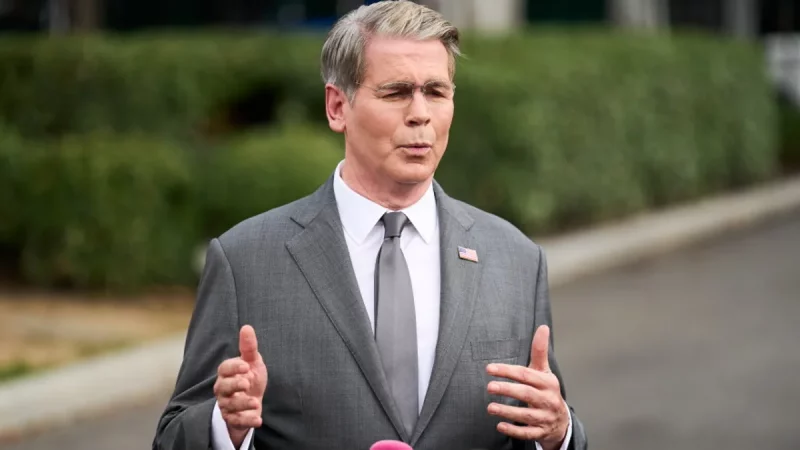
Treasury Secretary Scott Bessent has emerged as the leading candidate to fill a newly proposed "AI czar" position within the administration of President Donald Trump, according to several individuals familiar with the internal deliberations. The potential appointment signals a strategic shift in the administration’s approach to emerging technology, placing a high-ranking economic official at the helm of a policy area that increasingly intersects with global trade, national security, and financial stability. While no final decision has been reached, Bessent’s growing influence over the administration’s artificial intelligence portfolio suggests he is the frontrunner for a role intended to coordinate the United States’ competitive stance against global rivals, most notably China.
White House spokesperson Kush Desai has urged caution regarding the reports, stating that any personnel decisions not officially announced by the administration should be regarded as speculation. Despite this official stance, the momentum behind Bessent’s candidacy is underscored by his recent high-level diplomatic engagements. This week, Bessent held extensive discussions regarding artificial intelligence with Chinese Vice Premier He Lifeng. These talks served as a critical precursor to the scheduled meeting between President Donald Trump and Chinese President Xi Jinping at the White House on September 24.
The Strategic Importance of the AI Czar
The creation of an "AI czar" reflects a recognition within the executive branch that artificial intelligence is no longer merely a niche sector of the tech industry but a foundational component of modern statecraft. The role is expected to serve as a central node for policy coordination across various departments, including State, Defense, Commerce, and Energy. By appointing a sitting Treasury Secretary to this position, the administration would be integrating AI policy directly into the nation’s economic framework.
The dual-role structure is not without precedent in the Trump administration. The President has historically utilized cabinet officials to lead specialized task forces or policy initiatives that fall outside their traditional departmental purviews. For Bessent, holding the AI czar title alongside his duties at the Treasury would allow for a unified strategy that links AI development with capital markets, export controls, and international investment flows.
Diplomatic Maneuvering: The US-China AI Dialogue
A central component of Bessent’s recent activities has been the management of the technological rivalry between Washington and Beijing. During his meetings with Vice Premier He Lifeng, Bessent explored the possibility of a formal, ongoing dialogue between the two nations specifically focused on artificial intelligence. This proposal comes at a time when both superpowers are racing to achieve "AI supremacy," a goal that carries profound implications for military capability and economic productivity.
One of the most significant outcomes of these preliminary talks was the discussion of a notification mechanism for AI-related incidents. Such a system would function similarly to "hotlines" established during the Cold War to prevent accidental escalations. In the context of AI, this could involve notifying the other party of malfunctions in autonomous systems, large-scale data breaches, or the unintended deployment of high-risk algorithms that could be misinterpreted as a national security threat. Bessent has indicated that both the U.S. and China intend to continue these discussions, viewing them as a necessary guardrail in an otherwise competitive relationship.
Policy Philosophy: Accountability and Innovation
Beyond the diplomatic sphere, Bessent has begun to articulate a clear philosophical framework for AI governance. He has recently advocated for a "human-centric" approach to legal and corporate responsibility. Bessent argues that humans and corporations must remain legally and ethically responsible for the actions and outputs of AI systems. This stance is designed to prevent a legal vacuum where companies could potentially shield themselves from liability by blaming "black box" algorithms for harmful outcomes.
This perspective aligns with a broader push within the administration to foster innovation while maintaining traditional structures of accountability. By resisting the urge to grant AI systems a unique legal status that might dilute human responsibility, Bessent aims to ensure that the deployment of AI in the financial and industrial sectors remains grounded in existing regulatory principles. This approach is expected to be a cornerstone of the administration’s domestic AI policy, focusing on deregulation to spur growth while reinforcing the liability of the actors who deploy the technology.
Potential Candidates and the Selection Process
While Bessent is currently viewed as the frontrunner, the administration is reportedly considering other high-profile figures for the AI czar position. These include:
- Michael Kratsios: Currently the Director of the White House Office of Science and Technology Policy (OSTP), Kratsios has a long history of managing technology policy. He served as the Chief Technology Officer of the United States during Trump’s first term and is well-regarded for his technical expertise and familiarity with the federal bureaucracy.
- Scott Kupor: The Director of the Office of Personnel Management (OPM) and a former managing partner at the venture capital firm Andreessen Horowitz. Kupor brings a deep understanding of the Silicon Valley ecosystem and the private sector’s role in driving AI advancement.
The selection of Bessent over more tech-focused candidates like Kratsios or Kupor would suggest that the administration prioritizes the economic and geopolitical dimensions of AI over purely technical or administrative management. It would signal that the U.S. views AI primarily through the lens of global power dynamics and economic competition.
The Economic and National Security Context
The urgency surrounding the appointment of an AI czar is driven by a series of compounding factors. Economically, AI is projected to add trillions of dollars to the global GDP over the next decade. For the United States, maintaining a lead in AI research and deployment is seen as essential for long-term prosperity. However, this economic potential is mirrored by significant national security risks, including the use of AI in cyber warfare, autonomous weapons systems, and the spread of sophisticated disinformation.
The upcoming September 24 summit between President Trump and President Xi Jinping is expected to be a watershed moment for these issues. The two leaders are slated to discuss a range of topics, including trade imbalances and regional security, but artificial intelligence has risen to the top of the agenda. The administration’s goal is to establish a position of strength before these negotiations, ensuring that the U.S. remains the global standard-setter for AI ethics and technical protocols.
Timeline of Recent AI Policy Developments
To understand the current trajectory of the AI czar appointment, it is helpful to look at the timeline of the administration’s recent actions:
- Early Summer: The administration begins internal discussions on the need for a centralized authority to manage AI policy, citing fragmentation across different agencies.
- August: Reports surface that the President is looking for a "high-impact" individual to lead the AI initiative, with a focus on someone who understands both markets and technology.
- Early September: Scott Bessent’s role in AI policy becomes more visible as he prepares for the US-China high-level economic talks.
- Mid-September: Bessent meets with Vice Premier He Lifeng to discuss AI incident notification and formalizing a bilateral dialogue.
- September 24 (Scheduled): Trump and Xi are set to meet at the White House, where AI policy is expected to be a primary focus.
Analysis of Implications
The potential appointment of Scott Bessent as AI czar carries several major implications for the future of U.S. technology policy. First, it reinforces the trend of "securitizing" technology. By placing AI under the purview of the Treasury Secretary, the administration is effectively treating AI as a strategic asset subject to the same level of scrutiny as currency or critical infrastructure.
Second, the move could streamline the implementation of export controls and investment restrictions. The Treasury Department already manages the Committee on Foreign Investment in the United States (CFIUS). If Bessent holds the AI czar role, he would be uniquely positioned to align domestic AI development with restrictions on foreign adversaries’ access to American technology and capital.
Third, Bessent’s focus on human responsibility for AI actions suggests a regulatory environment that will favor established corporate players who have the resources to manage liability. This could lead to a more stable, albeit perhaps more consolidated, AI industry in the United States.
Finally, the focus on a notification mechanism with China indicates a pragmatic approach to "de-risking" the tech rivalry. While the administration remains committed to out-competing China, there is a clear recognition that an unmanaged AI race could lead to catastrophic misunderstandings. Establishing formal channels of communication is a step toward creating a "managed competition" that seeks to avoid open conflict while still pursuing American dominance in the field.
As the September 24 summit approaches, the world will be watching to see if the administration officially confirms Bessent’s new role. Regardless of the final announcement, it is clear that the intersection of finance, diplomacy, and artificial intelligence has become the new front line of American policy, with Scott Bessent positioned at its center.