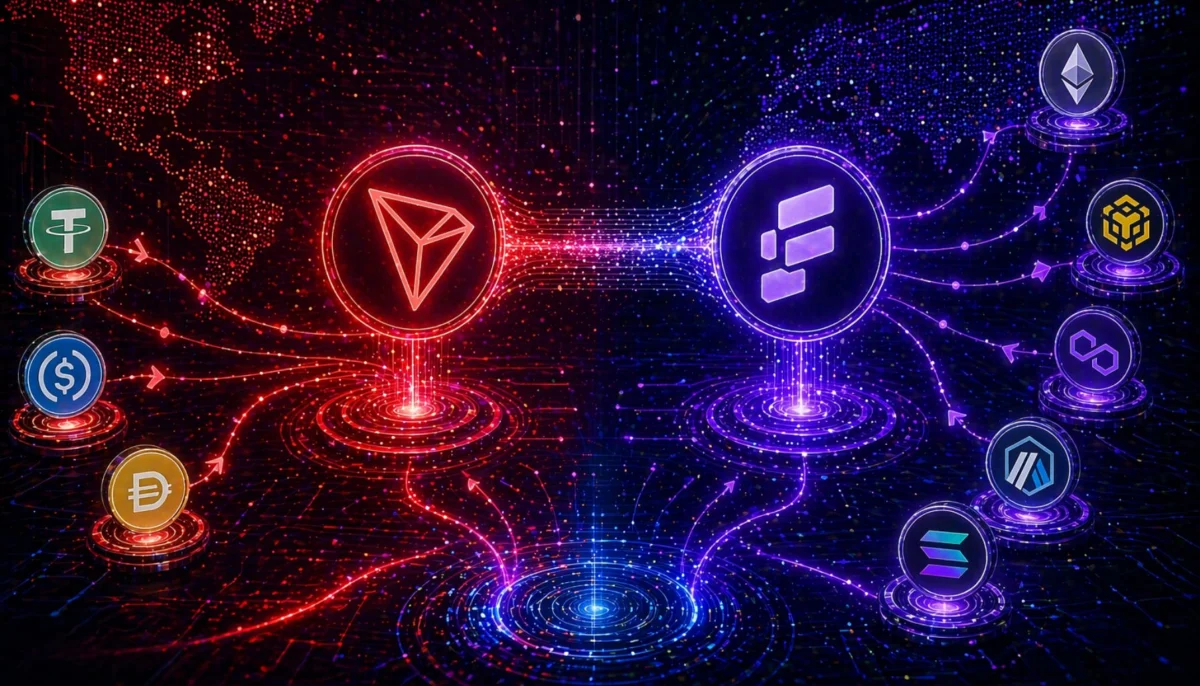
The decentralized finance (DeFi) landscape has long been characterized by a paradox: TRON, despite maintaining a dominant share of the world’s most used stablecoin, has historically operated as an isolated island relative to the broader Ethereum-centric ecosystem. This structural divide was significantly narrowed this week following the announcement that LI.FI, a leading multichain liquidity aggregator and orchestration protocol, has officially integrated the TRON network into its stack. This integration marks a pivotal moment in the maturation of cross-chain infrastructure, providing a direct, programmatic pipeline between TRON’s $85 billion in Tether (USDT) liquidity and the diverse array of applications, wallets, and decentralized exchanges (DEXs) that comprise the modern DeFi market.
For years, TRON has quietly cemented its position as the primary settlement layer for global stablecoin transactions. With $85 billion in circulating USDT and a consistent daily transfer volume exceeding $21 billion, the network handles a level of economic throughput that rivals or exceeds most major financial networks. However, because TRON utilizes a different virtual machine architecture and consensus mechanism than Ethereum and its various Layer 2 scaling solutions, bridging assets into and out of TRON has traditionally required specialized technical knowledge or the use of centralized exchanges. By incorporating TRON into the LI.FI orchestration layer, developers can now access this liquidity through a single API, effectively ending TRON’s era of technical isolation.
The Evolution of TRON as a Global Settlement Layer
To understand the significance of the LI.FI integration, one must examine the historical trajectory of the TRON network. Launched in 2017 by Justin Sun, TRON was initially positioned as a decentralized content-sharing platform. However, as the cryptocurrency market evolved, the network found its "product-market fit" not in social media, but in low-cost, high-speed value transfer.
While Ethereum struggled with high gas fees during periods of network congestion, TRON offered a high-throughput environment where stablecoin transfers cost a fraction of a dollar and settled in seconds. This efficiency led to TRON becoming the preferred network for Tether (USDT) issuers and users, particularly in emerging markets where remittances and cross-border payments are vital. By 2023, more USDT was circulating on TRON than on any other blockchain, including Ethereum.
Despite this massive liquidity, TRON’s ecosystem remained largely siloed. DeFi users on networks like Arbitrum, Base, or Polygon had little reason to interact with TRON because the friction of moving assets across chains was too high. Conversely, TRON’s massive user base was often locked out of the innovative yield-bearing protocols and lending markets being built on Ethereum-compatible chains. The LI.FI integration serves as the technical bridge that finally connects these two massive liquidity pools.
Technical Mechanics of the LI.FI Orchestration
LI.FI does not function as a simple bridge; rather, it acts as a meta-aggregator or an "orchestration layer." It scans various bridging protocols and decentralized exchanges to find the most efficient route for a user’s transaction across multiple chains. By adding TRON to this layer, LI.FI has automated the complex logic required to swap an asset on one chain (e.g., USDC on Ethereum) for an asset on TRON (e.g., USDT on TRC-20) in a single transaction.
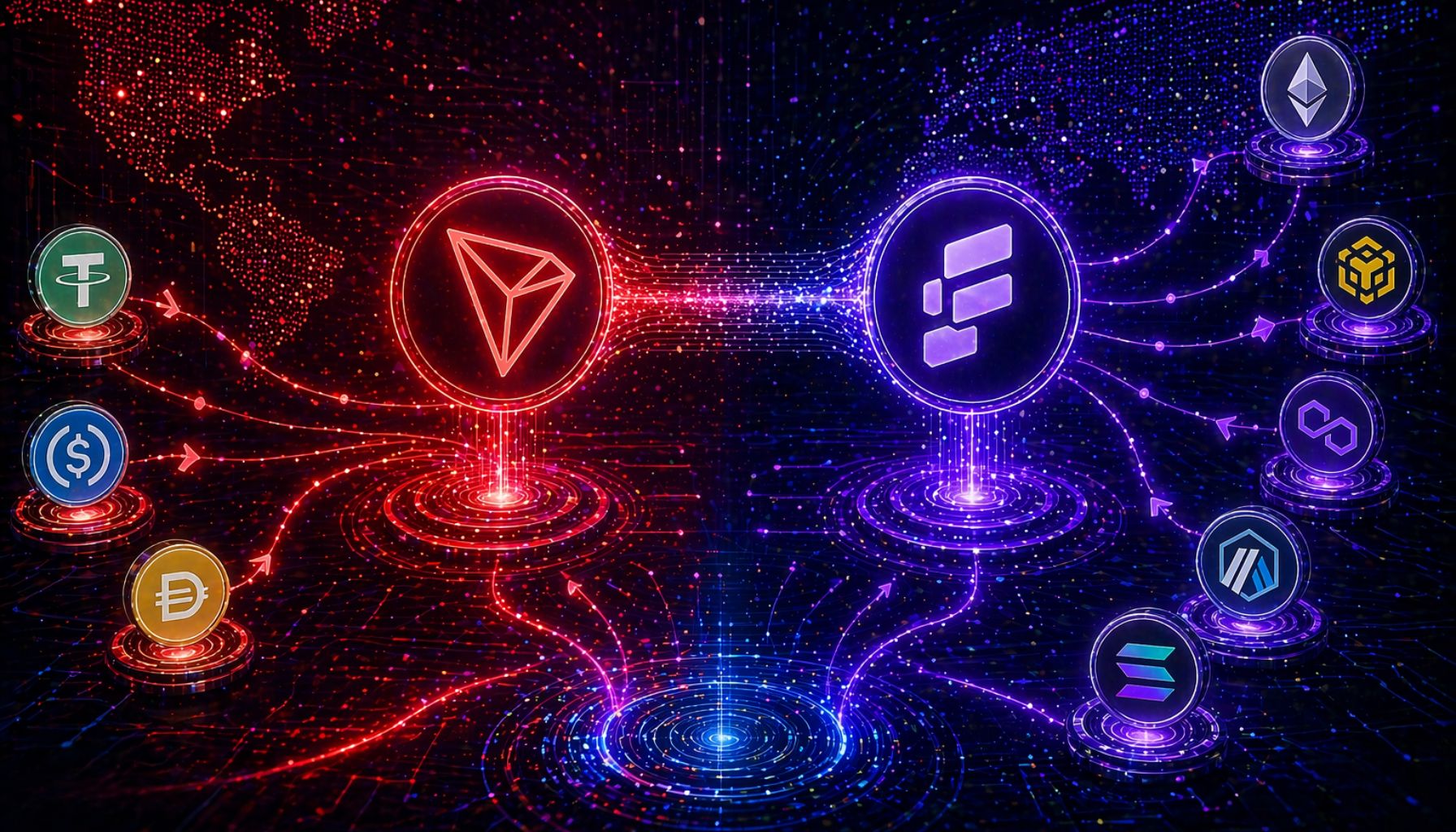
For developers, the integration means that any decentralized application (dApp) using LI.FI’s software development kit (SDK) or API now automatically supports TRON. This removes the "overhead of integration" that has historically discouraged developers from supporting the network. Previously, a developer wanting to connect their protocol to TRON would have to write custom code to interact with TRON’s unique smart contract standards and integrate specific TRON-compatible bridges. Now, that complexity is abstracted away into LI.FI’s unified interface.
For end-users, the experience is designed to be "chain-agnostic." A user in a supported wallet can initiate a swap from a Layer 2 network directly to TRON without ever leaving the wallet interface or manually interacting with a third-party bridge website. This reduction in "clicks" and cognitive load is widely considered the key to achieving mass adoption in the DeFi space.
Strategic Implications for Developers and Institutions
The integration of TRON into a major liquidity aggregator like LI.FI has profound implications for institutional players and retail developers alike. In the realm of institutional finance, TRON has become a staple for Over-the-Counter (OTC) desks and payment processors who require deep liquidity and reliable settlement. By streamlining the connection between TRON and the rest of DeFi, these institutions can now move capital more efficiently between high-yield DeFi opportunities and their primary settlement network.
From a developer’s perspective, the move unlocks new possibilities for "cross-chain native" applications. A lending protocol on Arbitrum, for example, could theoretically allow users to use their USDT on TRON as collateral without the user needing to manually bridge the funds. This type of interoperability is what industry experts refer to as "liquidity fragmentation repair." By treating TRON’s $85 billion USDT pool as part of the wider DeFi liquidity pool, the entire industry becomes more capital-efficient.
Furthermore, the integration addresses a long-standing criticism of TRON—that its activity is "invisible" to the broader DeFi community. Because TRON’s volume was largely concentrated in peer-to-peer transfers and centralized exchange deposits, it was often excluded from the metrics tracked by DeFi-specific aggregators. With LI.FI routing real-time DeFi swaps through the network, TRON’s economic activity will become more integrated into the standard data feeds used by traders and analysts.
Chronology of Cross-Chain Expansion
The integration of TRON follows a series of strategic expansions by LI.FI and other infrastructure providers aimed at unifying the fragmented blockchain landscape.
- 2021-2022: The Rise of Multi-Chain: As the "L1 Wars" peaked, users began spreading liquidity across dozens of chains, creating a desperate need for aggregators.
- Early 2023: LI.FI established itself as a leader in the EVM (Ethereum Virtual Machine) space, connecting Ethereum, Binance Smart Chain, and various L2s.
- Late 2023 – Early 2024: The industry began looking beyond EVM compatibility. Protocols started integrating non-EVM chains like Solana and Bitcoin (via L2s) to capture untapped liquidity.
- Q1 2025: Recognizing the sheer scale of stablecoin volume on TRON, LI.FI prioritized the integration of the network into its orchestration layer to serve the growing demand for cross-chain stablecoin utility.
This timeline reflects a broader trend in the industry: the move away from "maximalism" (the belief that one chain will win) toward "interoperability" (the belief that multiple chains will serve different functions but must be connected).

TRX Technical Market Analysis: Testing Multi-Month Resistance
As the fundamental utility of the TRON network expands through the LI.FI integration, the native token of the network, TRX, has exhibited a remarkably resilient price structure. Unlike many altcoins that have suffered from extreme volatility and deep drawdowns over the past year, TRX has maintained a consistent uptrend, characterized by higher lows and steady accumulation.
Currently, TRX is testing a critical resistance zone between $0.33 and $0.34. This price level has historical significance, acting as a ceiling for several rallies since the market peak in late 2025. Technical analysts note that TRX is currently trading well above its 50-week and 100-week moving averages, both of which are sloping upward, indicating a healthy long-term trend.
The recent price action suggests a period of "base-building." After a brief pullback from local highs near $0.36, the token found strong support in the $0.27–$0.29 range. This consolidation allowed the market to absorb selling pressure without breaking the macro bullish structure. However, the current attempt to break $0.34 faces a challenge: volume. For a breakout to be considered sustainable, analysts typically look for an expansion in trading volume to confirm that institutional buyers are stepping in at these higher prices.
If TRX successfully establishes a foothold above the $0.34 resistance, the next major price targets are projected to be in the $0.38 to $0.40 range. Conversely, if the price is rejected at this level, it is likely to continue its current consolidation pattern, rotating back toward the $0.28 support level. This sideways movement, while frustrating for short-term traders, is often viewed by long-term investors as a necessary phase of "re-accumulation" before the next leg up.
Broader Impact on the Stablecoin Ecosystem
The long-term impact of the LI.FI and TRON integration extends beyond price action and developer convenience; it touches upon the very nature of global digital dollars. By making TRON’s USDT more accessible, the integration reinforces the dominance of the US dollar-pegged assets in the crypto economy.
Furthermore, it highlights a shifting power dynamic in the blockchain space. While Ethereum remains the home of smart contract innovation and "blue-chip" DeFi protocols, TRON has successfully positioned itself as the "utility layer" for the world’s most successful crypto product: the stablecoin. The LI.FI integration ensures that these two worlds—the "innovation layer" and the "utility layer"—are no longer mutually exclusive.
As the industry moves toward 2026, the success of such integrations will likely determine which networks remain relevant. In an era where "chain abstraction" is the goal, the networks that are the easiest to reach and the most liquid will inevitably attract the most volume. With LI.FI providing the map and the vehicle, TRON’s $85 billion stablecoin reserve is now closer to the heart of DeFi than ever before.