TRON DAO has officially announced a massive tenfold expansion of its dedicated Artificial Intelligence (AI) Development Fund, increasing its total capital allocation from an initial $100 million to $1 billion. This strategic pivot represents one of the most significant financial commitments to the intersection of blockchain and artificial intelligence to date, signaling a transformative shift in the network’s long-term roadmap. The move is designed to catalyze the "agentic economy," a burgeoning sector where autonomous AI agents act as primary economic participants, requiring specialized financial infrastructure that operates outside the constraints of traditional legacy banking systems.
By scaling its investment vehicle by 1,000%, TRON aims to provide the foundational liquidity and technical framework necessary for AI-to-AI commerce. The expanded fund will prioritize the acquisition of early-stage startups and the support of developers building decentralized identity systems, stablecoin-based settlement layers, and programmable ownership structures. This initiative reflects a growing consensus within the cryptocurrency industry that while AI provides the cognitive capacity for digital tasks, blockchain provides the necessary "trustless" environment for those tasks to be monetized and settled securely.
The Evolution of TRON’s AI Strategy: A Chronological Context
The journey toward this $1 billion commitment began in early 2023 when TRON first established its $100 million AI Fund. At that time, the focus was primarily on enhancing user experiences and optimizing smart contract efficiency through machine learning. However, as the capabilities of Large Language Models (LLMs) and autonomous agents evolved throughout 2024 and 2025, the TRON DAO leadership recognized a more profound structural opportunity.
In late 2023, TRON began emphasizing the synergy between decentralized storage (via BitTorrent Chain) and AI data processing. By mid-2024, the network had established itself as the dominant layer for USDT (Tether) circulation, providing a massive liquidity pool that was increasingly being tapped by automated trading bots and early-stage AI protocols. The decision to expand the fund to $1 billion in March 2026 follows a period of intense internal research into the "agentic economy," where the limitations of traditional fiat rails became a clear bottleneck for autonomous software growth.
The timeline of this expansion coincides with a broader industry trend where "DePIN" (Decentralized Physical Infrastructure Networks) and AI-driven decentralized finance (DeFi) have moved from niche concepts to central market themes. TRON’s massive capital injection is intended to ensure that the network remains the preferred settlement layer for these emerging technologies.
Defining the Agentic Economy: The Four Pillars of TRON’s Investment
The expanded fund is not merely a general-purpose grant program but a targeted investment into four core components of the machine-driven economy. TRON has identified these areas as the critical "bottlenecks" preventing AI agents from achieving full economic autonomy.
First, the fund targets Agent Identity Systems. In a world where AI agents perform tasks on behalf of humans or other machines, verifying the "personhood" or "origin" of an agent is paramount. TRON is investing in decentralized identifiers (DIDs) that allow AI agents to hold verifiable credentials without compromising privacy. This allows an AI to prove its reputation or creditworthiness on-chain, enabling it to access loans or enter into service-level agreements.
Second, the fund prioritizes Stablecoin-Based Payment Rails. AI agents operate 24/7 and cannot wait for traditional banking hours or navigate the complexities of opening a corporate bank account. Stablecoins, particularly USDT on the TRON network, offer a programmable, instant, and permissionless medium of exchange. The fund will support projects that build "agent-native" wallets—software interfaces that allow AI agents to manage their own private keys and execute transactions based on pre-defined logic.
Third, the focus extends to Tokenized Real-World Assets (RWAs). For an agentic economy to thrive, AI agents must be able to own and manage more than just digital tokens; they need access to yield-bearing assets, equity, and even physical resources. By tokenizing these assets on the TRON blockchain, the network allows AI agents to hedge risks, reinvest profits, and maintain diverse portfolios of value.
Finally, Developer Tooling and SDKs represent a significant portion of the fund’s allocation. TRON aims to lower the barrier to entry for AI developers who may not be blockchain experts. By providing specialized Software Development Kits (SDKs) that bridge popular AI frameworks like PyTorch or TensorFlow with the TRON Virtual Machine (TVM), the network hopes to attract a new wave of "AI-first" decentralized applications.
Infrastructure and Liquidity: The TRON Competitive Advantage
The ambitious goal of hosting a billion-dollar AI ecosystem is supported by TRON’s existing infrastructure, which currently ranks among the most robust in the digital asset space. As of the first quarter of 2026, the TRON network boasts over 370 million user accounts and consistently processes more than $21 billion in daily transaction volume.
The most critical factor in TRON’s bid for AI dominance is its role as the primary host for USDT. With over $85 billion in circulating USDT on its rails, TRON provides a level of liquidity that few other blockchains can match. For AI agents, liquidity is the lifeblood of operation. If an autonomous system needs to pivot its strategy or settle a high-value contract, it requires a deep pool of stable assets to ensure minimal slippage and instant finality.
Furthermore, TRON’s high throughput and low transaction costs are uniquely suited for the micro-transaction nature of AI interactions. An AI agent performing thousands of small tasks per hour—such as data labeling, API calls, or sentiment analysis—would find the high gas fees of the Ethereum mainnet prohibitive. TRON’s delegated Proof-of-Stake (dPoS) consensus mechanism allows these micro-payments to remain economically viable, providing a "high-frequency" financial environment for machine logic.
Technical Market Analysis: TRX Price Action and Momentum
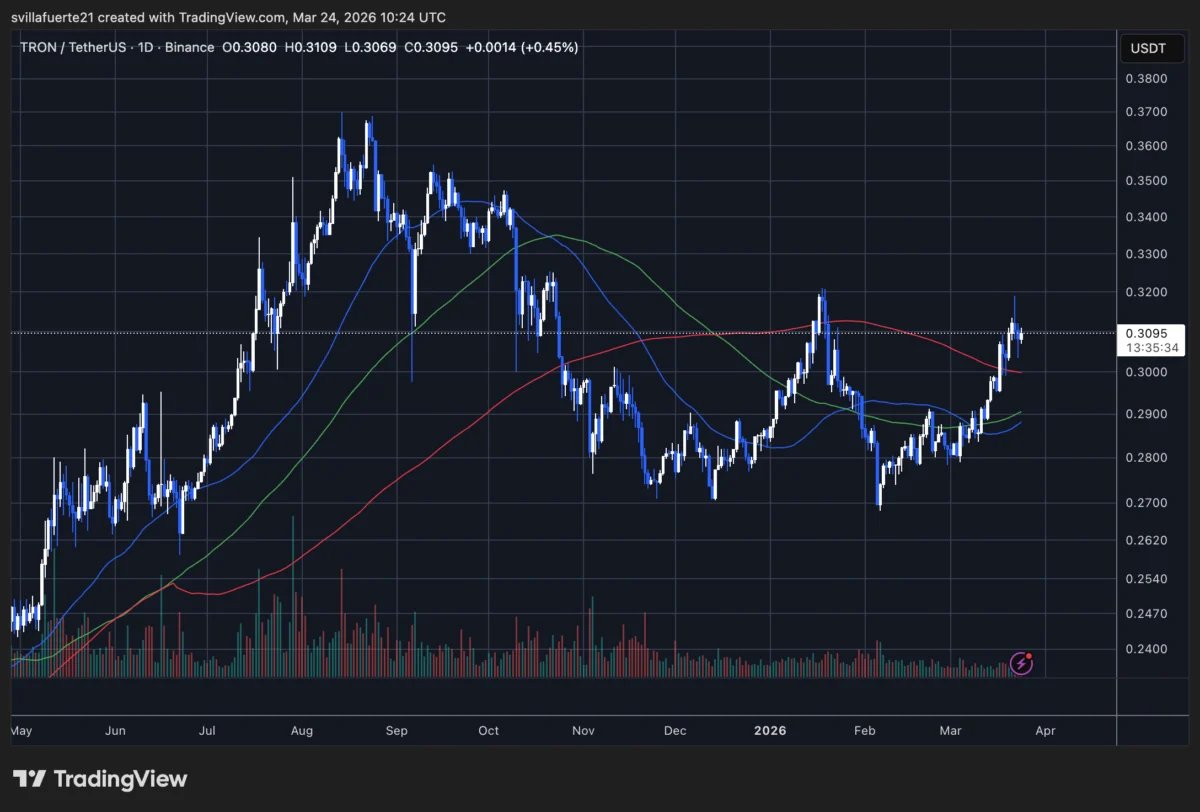
The announcement of the $1 billion fund comes at a pivotal moment for TRON’s native token, TRX. After reaching cyclical highs near $0.36 in late 2025, the asset entered a corrective phase that saw it retreat to test foundational support levels. Currently, TRX is trading within a range of $0.30 to $0.31, showing signs of stabilization after a period of market-wide volatility.
Technical indicators suggest that TRX is in a transitionary phase. The price has recently moved back above the 50-day and 100-day moving averages, which are beginning to level out. This flattening of the moving averages often precedes a period of consolidation before a new trend emerges. However, the 200-day moving average continues to loom overhead near the $0.32 level, acting as a significant psychological and technical barrier.

Market observers note that while the recovery from the $0.27 base has been constructive, it lacks the aggressive volume typically seen during a definitive breakout. This suggests that the current price action is characterized by "quiet accumulation" rather than speculative fervor. For a sustained bullish reversal to take hold, TRX would need to clear the $0.32 resistance level on high volume, which would likely open the door for a retest of the $0.36 all-time highs. Conversely, if the price fails to hold the $0.29 support zone, it could signal a deeper retracement as the market absorbs the implications of the network’s massive capital commitment.
Broader Impact and Industry Implications
The expansion of TRON’s AI Fund is likely to trigger a "capital arms race" among major Layer-1 blockchain networks. As the narrative of the agentic economy gains steam, competitors such as Solana, Ethereum, and Near Protocol are expected to increase their own incentive programs to attract AI developers.
Industry analysts suggest that TRON’s move could also have significant regulatory implications. As AI agents begin to manage larger sums of capital autonomously, global regulators may be forced to accelerate the development of frameworks for "algorithmic legal personality." By building the infrastructure for these agents now, TRON is positioning itself at the center of a future debate regarding how autonomous software should be governed and taxed.
Furthermore, the integration of AI and blockchain addresses the growing concern over AI centralization. Currently, the most powerful AI models are controlled by a handful of massive corporations. By moving the financial and identity layers of AI to a decentralized network like TRON, the industry moves closer to "Open AI" in the literal sense—systems that are transparent, auditable, and not subject to the whims of a single boardroom.
Conclusion: A Strategic Bet on the Machine-Driven Future
TRON’s decision to commit $1 billion to the AI and blockchain convergence is more than a marketing headline; it is a calculated bet on the next phase of the digital economy. The shift from human-centric finance to agent-centric finance represents a fundamental change in how value is created and moved across the globe.
While challenges remain—including technical hurdles in cross-chain interoperability and the ongoing volatility of the crypto markets—TRON’s massive liquidity, established user base, and now, its significant capital reserves, make it a formidable contender in the race to build the "backbone of the machine age." As the agentic economy moves from theory to reality, the infrastructure laid down by the TRON DAO today will likely determine the efficiency and accessibility of the autonomous systems of tomorrow.