


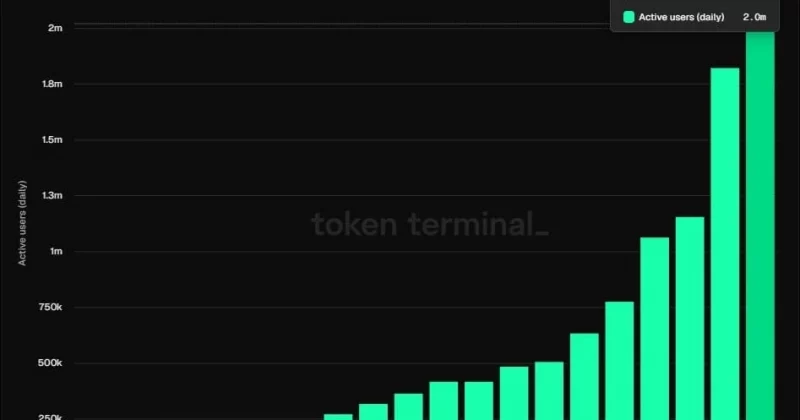
Tron has surged past Solana to become the leading blockchain network in terms of daily active users (DAU), a remarkable feat driven not by the volatile tides of decentralized finance (DeFi) speculation or the fleeting frenzy of non-fungible tokens (NFTs), but by the consistent and powerful engine of stablecoins, primarily Tether (USDT). This shift in network dominance highlights a fundamental driver of blockchain adoption and underscores the critical role of stable value assets in fostering widespread user engagement.
The network’s ascent has been a steady climb. In the fourth quarter of 2025, Tron was averaging approximately 2.8 million DAU, trailing closely behind Solana’s 2.9 million. By February 2026, Tron had already made significant inroads, boosting its DAU to around 3.2 million. The most recent data reveals a dramatic acceleration, with Tron now consistently clearing the 4 million daily active user threshold, solidifying its position as the most active major blockchain network.
This substantial growth is inextricably linked to the immense volume of stablecoin activity on the Tron network. USDT transfer volumes on Tron frequently surpass an astounding $20 billion per day. As of May 2025, the circulating supply of USDT on the Tron network had already exceeded $75 billion, a figure that represented more than half of Tether’s total global supply. This concentration of stablecoin liquidity signifies a robust and continuous flow of value and transactions, forming the bedrock of Tron’s user engagement.
The sheer scale of activity is further illustrated by the network’s transaction processing capabilities. Tron consistently handles over 8 million daily transactions, a testament to its high-throughput architecture. This massive volume of transactions has contributed to the accumulation of over 306 million total user accounts on the network since its inception, indicating a broad and deep user base.
The Stablecoin Machine: A Constant Hum of Activity
The sustained success of Tron in attracting and retaining users through stablecoin activity presents a compelling case study in blockchain adoption. While other networks have often seen their user growth ebb and flow with speculative market cycles, Tron’s reliance on stablecoins offers a more predictable and foundational driver of engagement. The constant need for stable value – whether for remittances, cross-border commerce, or simply a stable store of value within the crypto ecosystem – ensures a perpetual demand for transactions.
This "stablecoin machine," as it has become known, operates with remarkable efficiency on Tron. The network’s design, which prioritizes high throughput and low transaction fees, has made it an attractive venue for stablecoin transfers. Unlike some other networks where transaction costs can become prohibitive, particularly during periods of high congestion, Tron’s cost-effectiveness ensures that even small, frequent transfers are economically viable. This is crucial for use cases like international remittances, where margins can be tight.
The genesis of Tron, founded in 2017 by Justin Sun, with its mainnet launching in 2018, was rooted in the ambition to create a decentralized internet that offered superior performance. From its earliest days, the network’s core architecture was engineered to support a high volume of transactions with minimal latency and negligible fees. This foundational design choice has proven to be prescient, particularly in the context of the growing global demand for efficient and low-cost value transfer mechanisms, a demand that stablecoins are uniquely positioned to meet.
The Role of USDT in Tron’s Dominance
Tether (USDT) has emerged as the undisputed king of stablecoins on the Tron network, and by extension, a primary catalyst for Tron’s user growth. Its widespread adoption and deep liquidity have created a powerful network effect. Users and businesses find it advantageous to conduct their stablecoin transactions on Tron due to the established infrastructure, low costs, and the sheer volume of other participants already utilizing the network for USDT transfers.
The figures are stark: over half of Tether’s total circulating supply resides on the Tron network. This means that a significant portion of the global stablecoin market, as represented by USDT, is actively transacting on Tron. This concentration of liquidity makes Tron a natural hub for any activity requiring stable value, from trading and investment to remittances and the facilitation of business transactions.
The implications of this stablecoin-driven growth are multifaceted. It suggests that for a significant segment of the global population, the primary utility of blockchain technology is not speculative investment but rather access to efficient and cost-effective financial services. Stablecoins, by offering a bridge between traditional fiat currencies and the digital asset world without the volatility of cryptocurrencies, fulfill this need admirably.
Why Stablecoins Outpace Speculation for User Growth
The narrative of blockchain adoption has often been dominated by the excitement surrounding volatile cryptocurrencies and the potential for rapid gains. However, Tron’s recent success story offers a counter-narrative, demonstrating that utility-driven adoption, powered by stablecoins, can be a more sustainable and impactful driver of user growth.
DeFi speculation, while contributing to network activity, is often characterized by a more transient user base. Participants in DeFi protocols are often seeking to maximize returns, leading to a dynamic and sometimes volatile engagement with a particular blockchain. Similarly, NFT markets, while experiencing periods of intense activity, can also be subject to speculative bubbles and shifts in consumer interest.
Stablecoins, on the other hand, provide a foundational utility. They are used for everyday financial activities: hedging against inflation, facilitating international payments, conducting business-to-business transactions, and as a stable store of value within the digital economy. These are not ephemeral trends but ongoing needs that a robust and efficient blockchain network can effectively address.
Tron’s infrastructure, with its emphasis on low fees and high transaction speeds, is perfectly suited to cater to these fundamental use cases. The network has effectively captured a significant portion of the global demand for stable value transfer, transforming it into a dominant player in terms of daily active users. This strategic alignment between the network’s capabilities and the practical utility of stablecoins has proven to be a powerful growth engine.
Implications for Investors and the Broader Ecosystem
For investors holding Tron’s native token, TRX, the network’s reliance on stablecoins presents both opportunities and risks. The structurally tied baseline of transaction volume to global remittance flows and cross-border commerce suggests a stable and consistent demand for TRX, as it is required to pay transaction fees and participate in network governance. This provides a fundamental economic underpinning for the token.
However, the concentration of activity around a single asset, USDT, introduces a significant risk factor. The principle of "don’t put all your eggs in one basket" is particularly relevant here. If Tether, or USDT specifically, were to face substantial regulatory challenges, a loss of confidence, or a significant competitor gaining ground on the Tron network, the consequences for Tron’s user numbers and, consequently, TRX’s value could be severe.
For instance, a major regulatory crackdown on Tether could lead to a mass exodus of USDT from the Tron network. Similarly, if a rival stablecoin, such as USD Coin (USDC), were to gain significant traction and market share on Tron, it could dilute USDT’s dominance and fragment the user base. In such scenarios, the impressive user numbers that Tron has cultivated could reverse rapidly, as the primary utility driver of the network would be compromised.
This concentration risk necessitates careful monitoring by investors and stakeholders. While the current dominance of USDT has fueled Tron’s growth, it also creates a point of vulnerability. The long-term sustainability of Tron’s leading position may depend on its ability to foster a more diversified ecosystem of stablecoins or to continue to attract users with other compelling use cases that are less reliant on a single asset.
Looking Ahead: Diversification and Continued Utility
Tron’s achievement of surpassing Solana in daily active users is a significant milestone, underscoring the power of utility-driven blockchain adoption. The network’s success is a testament to its robust infrastructure and its ability to cater to the growing global demand for efficient stablecoin transactions.
While the reliance on USDT presents a concentration risk, it also highlights the immense value that stablecoins bring to the blockchain ecosystem. As the world increasingly seeks digital, low-cost, and stable financial solutions, networks like Tron, which can effectively facilitate these transactions, are poised for continued growth.
The future for Tron may involve further efforts to diversify its stablecoin offerings and to broaden its appeal beyond stablecoin transfers, potentially exploring other areas of decentralized finance or utility applications. However, for the foreseeable future, the humming stablecoin machine, powered primarily by USDT, appears to be the engine driving Tron’s remarkable user growth and its ascent to the top of the blockchain rankings. This evolution signals a maturing of the blockchain space, where practical utility is increasingly taking precedence over pure speculation.














