


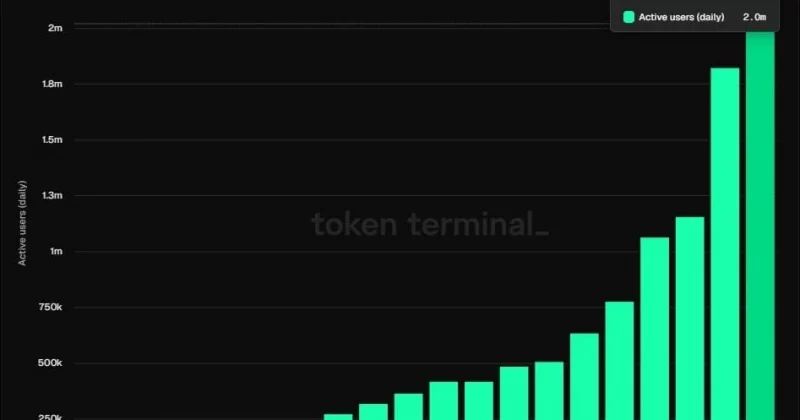
Tron has ascended to the vanguard of major blockchain networks, eclipsing Solana by breaching the significant milestone of 4 million daily active users (DAU). This remarkable surge in user engagement is not attributed to the speculative fervor of Decentralized Finance (DeFi) or the transient excitement of Non-Fungible Tokens (NFTs). Instead, the primary catalyst behind Tron’s ascendance is the ubiquitous presence and extensive utilization of stablecoins, with Tether (USDT) standing out as the dominant force. This strategic reliance on stablecoins has fundamentally reshaped Tron’s user growth trajectory, positioning it as a critical hub for financial transactions.
The Resounding Hum of the Stablecoin Engine
The trajectory of Tron’s daily active user growth reveals a consistent and accelerating upward trend. In the fourth quarter of 2025, the network reported an average of approximately 2.8 million DAU, placing it in close proximity to Solana’s 2.9 million DAU at that time. A discernible shift began to manifest in early 2026, with the DAU figure climbing to around 3.2 million by February of that year. This steady expansion culminated in the recent achievement of clearing the 4 million DAU mark, a testament to the network’s growing appeal and utility.
The sheer volume of stablecoin activity on Tron is staggering. Daily transfer volumes for USDT on the network frequently surpass the $20 billion threshold, indicating a robust and continuous flow of capital. As of May 2025, the circulating supply of USDT on Tron had already exceeded $75 billion, a figure that represents more than half of Tether’s total global supply. This concentration highlights Tron’s pivotal role in the stablecoin ecosystem.
Beyond stablecoin transactions, Tron’s infrastructure is supporting a vast number of overall network activities. The network consistently processes over 8 million daily transactions, a high throughput that underpins its operational efficiency. Furthermore, Tron has cultivated a substantial user base, amassing more than 306 million total user accounts since its inception. This expansive account base provides a fertile ground for continued growth and diversification of network usage.
The Strategic Advantage: Stablecoins Over Speculation for User Acquisition
The founding of Tron in 2017 by entrepreneur Justin Sun was predicated on a clear vision: to create a blockchain network capable of delivering high throughput and exceptionally low transaction fees. The launch of its mainnet in 2018 marked the beginning of an ambitious journey to challenge existing blockchain paradigms. From its earliest stages, Tron’s architecture was designed with scalability and cost-effectiveness at its core, principles that have proven to be particularly conducive to stablecoin adoption.
While many blockchain networks have historically focused on attracting users through the allure of speculative trading in volatile cryptocurrencies or the novelty of digital collectibles, Tron has strategically leveraged the inherent utility of stablecoins. The predictable value and ease of transfer offered by stablecoins like USDT make them ideal for a wide range of financial applications, including remittances, cross-border payments, and as a medium of exchange within decentralized applications. This focus on utility has created a more sustainable and organic growth model, attracting a broader demographic of users who are less driven by speculative impulses and more by practical financial needs.
The inherent advantages of stablecoins in this context are multifaceted. For individuals and businesses engaged in international money transfers, stablecoins offer a significantly faster and cheaper alternative to traditional banking systems. The ability to move large sums of value across borders with minimal friction and at negligible cost is a powerful draw. Furthermore, within the burgeoning DeFi landscape, stablecoins serve as a foundational asset for lending, borrowing, and yield generation. Tron’s low-fee environment makes these activities accessible to a wider audience, further entrenching the utility of stablecoins on the network.
A Chronology of Growth and Dominance
The evolution of Tron’s user base and its stablecoin integration can be traced through a series of key developments:
- 2017: Tron is founded by Justin Sun with the ambition of decentralizing the internet.
- 2018: The Tron mainnet is launched, emphasizing high transaction speeds and low costs. Initial efforts focus on building a robust ecosystem for decentralized applications.
- Late 2024 – Early 2025: Tron begins to show significant growth in daily active users, consistently ranking among the top blockchain networks. The network’s low fees and high throughput become increasingly attractive for stablecoin transactions.
- Q4 2025: Tron averages approximately 2.8 million DAU, placing it just behind Solana’s 2.9 million DAU. This period marks a critical juncture where stablecoin activity begins to significantly influence user numbers.
- February 2026: Tron’s DAU climbs to approximately 3.2 million, signaling a clear acceleration in user adoption, driven primarily by stablecoin transfers.
- Mid-2026 (Current Reporting Period): Tron surpasses the 4 million daily active user threshold, solidifying its position as the leading blockchain network by this metric, overtaking Solana. Simultaneously, USDT circulating supply on Tron exceeds $75 billion, and daily transfer volumes frequently surpass $20 billion.
This timeline illustrates a strategic ascent, where Tron’s foundational design choices have positioned it to capitalize on the growing global demand for efficient and cost-effective digital financial instruments. The network’s ability to handle massive stablecoin volumes without compromising performance has been the bedrock of this success.
Supporting Data: A Deep Dive into Network Activity
The sheer scale of Tron’s stablecoin operations is quantifiable through several key metrics:
- Daily Active Users (DAU): Exceeding 4 million, a significant increase from approximately 2.8 million in Q4 2025 and 3.2 million in February 2026.
- USDT Transfer Volume: Frequently exceeding $20 billion per day, underscoring its role as a primary medium of exchange.
- USDT Circulating Supply on Tron: Surpassed $75 billion as of May 2025, representing over 50% of Tether’s total global supply. This concentration indicates a deep integration of USDT within the Tron ecosystem.
- Daily Transactions: Averaging over 8 million, demonstrating the network’s capacity to handle a high volume of diverse operations.
- Total User Accounts: Exceeding 306 million, reflecting a broad and established user base.
These figures collectively paint a picture of a network that has become indispensable for stablecoin-based financial activities, particularly for cross-border transactions and remittances. The low transaction fees, often measured in fractions of a cent, make it economically viable for individuals and businesses to conduct frequent and high-value transfers.
Investor Implications and Potential Risks
The sustained growth and the underlying drivers of Tron’s success hold significant implications for investors in its native cryptocurrency, TRX. The network’s transaction volume is structurally tied to global remittance flows and cross-border commerce, creating a baseline demand for TRX. TRX is essential for paying transaction fees on the network and for participating in its governance mechanisms, which involve staking and voting on network proposals. As the network’s utility expands and its user base grows, the demand for TRX for these purposes is likely to increase.
However, this strong reliance on a single asset, USDT, introduces a significant concentration risk. The dominance of USDT on Tron means that any disruption to Tether’s operations or regulatory standing could have an existential impact on the network’s user numbers and overall activity. For instance, if Tether were to face severe regulatory scrutiny, leading to restrictions on its operations or a loss of confidence from users, Tron’s user base could experience a substantial reversal.
Similarly, the emergence of competing stablecoins, such as USD Coin (USDC), gaining significant traction on Tron could also pose a challenge. While the current landscape is dominated by USDT, a strategic shift by major players or a significant adoption of an alternative stablecoin on Tron could dilute USDT’s influence and, consequently, impact Tron’s DAU metrics. Investors are therefore advised to monitor developments related to stablecoin regulation and the competitive dynamics within the stablecoin market, as these factors could materially affect the future prospects of Tron.
The long-term success of Tron may hinge on its ability to foster diversification within its ecosystem, encouraging the adoption of a wider range of stablecoins and decentralized applications beyond the current USDT-centric model. While the current growth trajectory is impressive and driven by a clear utility, a single point of failure, such as the dependence on USDT, presents a notable vulnerability. The ongoing evolution of the blockchain space and the increasing regulatory oversight of stablecoins necessitate a strategic approach to mitigate such risks and ensure sustained, resilient growth.
Official Statements and Industry Reactions (Inferred)
While direct official statements from Tron Foundation or its founder, Justin Sun, specifically addressing the 4 million DAU milestone and its stablecoin driver are not provided in the source material, industry observers and analysts have frequently commented on Tron’s strategic advantage. The consistent emphasis on low fees and high throughput by Tron’s leadership has been widely recognized as a key factor in its ability to attract and retain users for high-volume transactional activities.
Industry analysts have often lauded Tron’s pragmatic approach to user acquisition, contrasting it with the more speculative-driven growth seen on some other networks. The focus on real-world utility, particularly in cross-border payments and remittances, is seen as a more sustainable path to long-term adoption. As one commentator noted, "Tron has quietly built a powerhouse by focusing on the unglamorous but essential work of moving value efficiently. Their bet on stablecoins has paid off handsomely, proving that utility can be a more powerful growth engine than hype."
However, the concentration risk associated with USDT’s dominance is also a recurring theme in industry discussions. Regulatory bodies and financial institutions worldwide are increasingly scrutinizing stablecoins, and any significant regulatory action against major issuers like Tether could have far-reaching implications across the blockchain landscape, including for Tron. This makes the network’s ability to adapt to evolving regulatory environments and potentially foster a more diversified stablecoin ecosystem a critical factor for its future.
Broader Impact and Future Outlook
Tron’s achievement of surpassing Solana in daily active users, largely propelled by stablecoin activity, signifies a maturing of the blockchain industry. It demonstrates that practical utility and cost-effectiveness can drive mass adoption, even in the absence of speculative booms. This success provides a compelling case study for other blockchain networks seeking to attract a broader user base beyond early adopters and crypto enthusiasts.
The implications for global finance are also significant. Tron’s capacity to handle billions of dollars in daily stablecoin transfers at minimal cost contributes to the ongoing digitization of financial services. It offers a glimpse into a future where cross-border payments are faster, cheaper, and more accessible to individuals and businesses worldwide. This could lead to greater financial inclusion and stimulate economic activity by reducing the friction associated with international commerce.
Looking ahead, Tron’s continued growth will likely depend on several factors:
- Regulatory Compliance: Navigating the evolving regulatory landscape for stablecoins will be crucial. Tron’s ability to adapt to new rules and ensure compliance will be paramount for maintaining user trust and operational continuity.
- Ecosystem Diversification: While USDT has been a powerful engine, diversifying the stablecoin ecosystem on Tron could mitigate risks and attract a wider range of use cases. Encouraging the adoption of other stablecoins and developing more sophisticated DeFi applications that leverage these assets could further solidify Tron’s position.
- Technological Advancement: Continuous innovation in scalability, security, and user experience will be necessary to maintain its competitive edge. As blockchain technology evolves, Tron will need to keep pace with advancements to remain at the forefront.
- Competition: The blockchain space is highly competitive. Solana, and other networks, will undoubtedly continue to innovate and vie for market share. Tron’s ability to maintain its low-fee, high-throughput advantage will be critical in fending off challengers.
In conclusion, Tron’s remarkable ascent to over 4 million daily active users, driven by the robust utility of stablecoins, particularly USDT, marks a significant milestone. It underscores the power of practical application in blockchain adoption and highlights Tron’s strategic positioning as a leading platform for digital financial transactions. While the network’s dependence on USDT presents a notable risk, its sustained growth and undeniable utility suggest a promising future, provided it can navigate regulatory challenges and foster further ecosystem diversification.














