


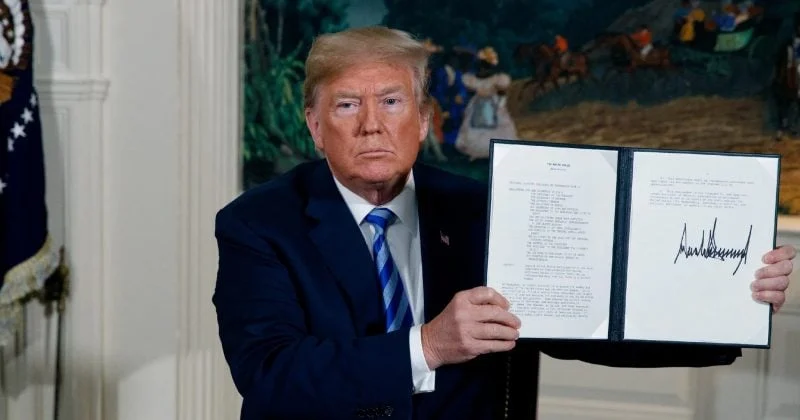
President Donald Trump announced on May 6, 2026, that the Islamic Republic of Iran has tentatively agreed to a framework that would see the nation abandon its efforts to develop or acquire nuclear weapons. This declaration, delivered during a series of public addresses from the White House, marks a significant pivot in a year characterized by heightened military friction and aggressive financial warfare between Washington and Tehran. While the President framed the commitment as a milestone in international diplomacy, he tempered the announcement with the acknowledgment that a formal, signed agreement remains pending, as the Iranian leadership has yet to publicly confirm the final terms of the arrangement.
The announcement comes at a critical juncture in U.S. foreign policy, following months of a "maximum pressure" campaign that has evolved significantly since the 2010s. Unlike previous iterations of diplomatic engagement, the 2026 negotiations are unfolding against a backdrop of unprecedented digital asset enforcement. Central to this strategy has been the seizure and freezing of approximately $1.344 billion in Iranian-linked cryptocurrency assets, a move that analysts suggest has severely hampered Tehran’s ability to bypass traditional banking sanctions.
The Framework of the 2026 Nuclear Negotiations
The proposed agreement described by President Trump focuses on a complete cessation of Iran’s nuclear weapons program. This includes strict limitations on enriched uranium production and enhanced oversight of nuclear facilities. According to the administration, the current framework seeks to rectify what the President has previously described as the "fatal flaws" of the 2015 Joint Comprehensive Plan of Action (JCPOA), which the U.S. withdrew from in 2018.
Key components of the 2026 proposal include:
- A permanent ban on the enrichment of uranium beyond levels required for civilian energy.
- The decommissioning of specific centrifuge arrays.
- Unprecedented access for international inspectors to both declared and suspected military sites.
- A 60-day "cooling off" period or ceasefire in the ongoing regional conflict involving U.S. forces and Iranian-aligned groups.
Despite the President’s optimism, the diplomatic reality remains complex. As of late May 2026, the status of the formal agreement is in a state of flux. While Washington has signaled its readiness to move forward with the 60-day pause in hostilities, the Iranian foreign ministry has remained cautious, neither confirming nor denying the specific terms outlined in Trump’s addresses. This discrepancy suggests that while high-level discussions are occurring, the "deal" is currently a unilateral declaration of progress rather than a bilateral consensus.
A Chronology of Escalation and Diplomacy
The road to the May 2026 announcement has been marked by a series of volatile events that reshaped the geopolitical landscape of the Middle East. To understand the significance of the current negotiations, it is necessary to examine the timeline of the preceding eighteen months.
January – June 2025: Following a series of maritime incidents in the Strait of Hormuz, the U.S. expanded its naval presence in the Persian Gulf. Economic sanctions were tightened, specifically targeting Iran’s emerging digital economy and its use of decentralized finance (DeFi) protocols to facilitate oil exports.
October 2025: U.S. Treasury officials, working in coordination with international law enforcement, announced the freezing of $344 million in digital assets. These assets were allegedly tied to the Iranian Revolutionary Guard Corps (IRGC) and were being used to fund proxy operations across the Levant and Yemen.
February – March 2026: Tensions reached a boiling point as a series of kinetic engagements, including surgical military strikes against drone manufacturing facilities and missile sites within Iranian territory, were conducted. These strikes were described by the Pentagon as "defensive measures" to deter further escalation.
April 2026: In a landmark enforcement action, the U.S. Department of Justice announced the seizure of an additional $1 billion in Iranian-linked cryptocurrency. This seizure represented one of the largest single recoveries of digital assets in history, directly impacting the liquidity of the Iranian shadow economy.
May 6, 2026: President Trump utilized the leverage gained from military and financial pressure to announce the nuclear commitment, proposing a 60-day ceasefire to finalize the terms of a lasting treaty.
The $1.3 Billion Cryptocurrency Enforcement Strategy
The seizure of $1.344 billion in digital assets represents a paradigm shift in how the United States enforces international sanctions. For years, crypto-assets were viewed as a potential "escape valve" for sanctioned regimes to conduct global trade outside the reach of the SWIFT banking system. However, the 2026 enforcement actions demonstrate that the transparency of the blockchain, combined with advanced forensic capabilities, has turned digital assets into a vulnerability for the Iranian state.
The $1 billion seizure in April 2026 was particularly impactful. These funds were reportedly held in a mix of Bitcoin, stablecoins, and privacy-focused tokens, distributed across thousands of individual wallets. By utilizing sophisticated chain-analysis tools and infiltrating the digital "over-the-counter" (OTC) networks used by Iranian intermediaries, U.S. authorities were able to trace the flow of funds from state-controlled entities to international exchanges.
The freezing of the initial $344 million in early 2025 set the stage for this larger action. That earlier move targeted decentralized protocols where Iranian entities had attempted to "wash" funds to obscure their origin. The combined $1.344 billion loss has created a significant budgetary shortfall for Tehran, potentially forcing the leadership to the negotiating table to seek the release of other frozen assets or the lifting of broader oil sanctions.
Geopolitical Implications and Bitcoin’s "Safe Haven" Status
The intersection of nuclear diplomacy and financial seizures has had a profound impact on global markets, particularly the cryptocurrency sector. During the height of the 2026 tensions, Bitcoin (BTC) saw a steady climb, eventually reaching a valuation of approximately $74,000.
Market analysts attribute this price action to a "geopolitical premium." In times of high-intensity conflict and the threat of regional war, investors traditionally flock to gold as a hedge against instability. In 2026, Bitcoin appears to have solidified its role as "digital gold," serving a similar purpose for global capital. The irony of the situation is not lost on observers: while the U.S. government uses the transparency of the blockchain to seize Iranian assets, the global market uses the scarcity of the same technology to protect against the economic fallout of the conflict.
Furthermore, the $1.3 billion seizure has raised questions about the future of state-sponsored crypto usage. If the U.S. can successfully dismantle a nation-state’s digital financial infrastructure, other sanctioned entities may reconsider their reliance on public ledgers. Conversely, the success of these seizures may embolden the U.S. Treasury to expand its "digital sanctions" toolkit, potentially leading to more frequent interventions in the crypto markets.
Regional and International Reactions
The reaction to President Trump’s announcement has been polarized across the international community. European allies, who were instrumental in the original 2015 JCPOA, have expressed cautious optimism but remain skeptical of any deal that lacks a multilateral framework. Leaders in London, Paris, and Berlin have called for a return to the International Atomic Energy Agency (IAEA) protocols as the primary metric for success.
In the Middle East, regional powers are watching the 60-day ceasefire proposal with intense scrutiny. Israel has maintained a stance of "maximum vigilance," with officials suggesting that any deal must include the total dismantling of Iran’s enrichment capabilities, rather than just a pause. Meanwhile, Gulf Arab states have expressed a desire for a comprehensive agreement that also addresses Iran’s ballistic missile program and its support for regional militias.
In Tehran, the internal political climate appears divided. Hardline factions within the Iranian parliament have characterized the U.S. seizures as "digital piracy" and have voiced opposition to any concessions made under duress. However, the pragmatist wing of the government, facing a crippled economy and the loss of over a billion dollars in liquid assets, may view the 60-day ceasefire as a necessary reprieve to prevent total economic collapse.
Analysis of Potential Outcomes
As the 60-day window approaches, the international community faces several potential scenarios.
The first, and most optimistic, is that the 60-day ceasefire leads to a formal, signed treaty. This would involve the U.S. potentially unfreezing some assets in exchange for verifiable Iranian compliance with nuclear restrictions. Such an outcome would be a major diplomatic victory for the Trump administration and could lead to a stabilization of global energy prices.
The second scenario is a continuation of the status quo—a "no deal, no war" stalemate. In this case, the 60-day pause might expire without a formal agreement, leading to a resumption of military tensions and further financial seizures. This would likely keep the "geopolitical premium" on Bitcoin and gold intact, as uncertainty continues to drive market volatility.
The third, and most volatile, scenario involves a breakdown in negotiations. If Iran rejects the terms or is found to be continuing enrichment activities in secret, the U.S. may escalate its military strikes beyond the surgical operations seen in early 2026. This would almost certainly trigger a wider regional conflict, with severe implications for the global economy.
Conclusion: A New Era of Diplomacy and Digital Power
The events of May 2026 represent a landmark moment where traditional nuclear diplomacy intersected with the modern reality of digital finance. President Trump’s announcement highlights a strategy that utilizes every lever of national power—military, diplomatic, and technological. The seizure of $1.344 billion in cryptocurrency has proven to be a potent weapon in the U.S. arsenal, providing the leverage necessary to bring a long-standing adversary to the brink of a historic agreement.
Whether this "deal that isn’t quite a deal yet" matures into a lasting peace remains to be seen. However, the precedent has been set: in the 21st century, the path to a nuclear agreement may very well be paved with seized digital assets and tracked through the immutable records of the blockchain. As the 60-day ceasefire begins, the world waits to see if the "Art of the Deal" can navigate the complex reality of Iranian domestic politics and the high-stakes world of global digital finance.














