



U.S. spot exchange-traded funds (ETFs) for Bitcoin and Ethereum experienced a significant resurgence in capital inflows on July 10, Eastern Time, marking a crucial turnaround after a challenging previous month. According to data compiled by SoSoValue, Bitcoin ETFs collectively attracted $90.44 million in fresh capital, while their Ethereum counterparts added another $18.43 million during the same trading session. This renewed interest propelled Bitcoin back above the $64,000 threshold, trading near $64,149, with Ethereum also finding support around $1,798. The positive flow day signals a potential shift in investor sentiment, following a June that saw approximately $4 billion in withdrawals from Bitcoin ETFs, representing the weakest monthly performance since their inception in January 2024. The rebound is partly attributed to broader macroeconomic factors, including softening oil prices and a weakening U.S. dollar, which tend to favor risk assets. However, Bitcoin faces a formidable resistance level near $65,000, as market participants closely monitor whether this institutional demand can sustain the current upward momentum.
The Genesis and Evolution of Spot Crypto ETFs: A Regulatory Journey
The journey to the approval of spot Bitcoin ETFs in the United States was protracted and often contentious, spanning over a decade of regulatory scrutiny and rejections by the Securities and Exchange Commission (SEC). For years, proponents argued that a spot ETF, which holds actual Bitcoin rather than futures contracts, would offer mainstream investors a regulated, accessible, and secure avenue to gain exposure to the digital asset without the complexities of direct ownership. Major financial institutions, including BlackRock, Fidelity, and VanEck, actively pursued these products, citing growing institutional demand and the need for a more mature investment vehicle.
A watershed moment arrived in January 2024 when the SEC finally approved nearly a dozen spot Bitcoin ETFs, a decision largely influenced by a federal appeals court ruling in August 2023 that found the agency’s rejection of Grayscale’s application to convert its Bitcoin trust into an ETF to be "arbitrary and capricious." The launch of these ETFs was met with unprecedented enthusiasm, attracting billions of dollars in net inflows within the first few weeks of trading. This initial success underscored a profound shift in how traditional finance viewed cryptocurrencies, moving from a niche, speculative asset to a legitimate component of diversified investment portfolios. The subsequent approval of spot Ethereum ETFs further cemented this trend, extending the regulatory embrace to the second-largest cryptocurrency by market capitalization. This regulatory validation was critical in drawing in institutional capital, providing a level of legitimacy and security that was previously absent in direct crypto investments.
A Chronology of Capital Flows: From Euphoria to Correction and Recovery
The period immediately following the January 2024 launch of spot Bitcoin ETFs was characterized by remarkable capital accumulation. Billions flowed into these new vehicles, driving Bitcoin to new all-time highs above $73,000 by mid-March. This initial phase was dominated by a significant rotation of capital, with substantial outflows from Grayscale’s Bitcoin Trust (GBTC) – which converted into an ETF – being absorbed and often exceeded by inflows into the newly launched funds, particularly those from BlackRock and Fidelity. This dynamic demonstrated strong net demand for the new, lower-fee offerings.
However, the exuberance began to wane as the second quarter progressed. June proved to be a particularly challenging month for regulated Bitcoin funds. Investors withdrew approximately $4 billion, marking the weakest monthly performance since the ETFs’ inception. This downturn was exacerbated by a prolonged 10-day outflow streak, during which roughly $2.73 billion was removed from these products. Several factors contributed to this reversal of fortune. Macroeconomic uncertainties, including persistent inflation concerns, the Federal Reserve’s hawkish stance on interest rates, and a strengthening U.S. dollar, prompted a broader risk-off sentiment across global markets. Investors reallocated capital, seeking safer havens or exploring opportunities in other asset classes, such as private credit, which experienced its own significant capital movements. Additionally, some profit-taking likely occurred as early investors locked in gains from Bitcoin’s earlier rallies.

The inflows witnessed on July 10, totaling $90.44 million for Bitcoin ETFs and $18.43 million for Ethereum ETFs, therefore represent a critical inflection point. They signal a potential stabilization of institutional interest and a re-entry of capital as market conditions appear to improve. This positive flow day, following several earlier positive sessions in early July, suggests that the market may be emerging from the corrective phase experienced in June, with investors once again finding value in digital assets.
Deep Dive into ETF Performance: BlackRock’s Dominance and Selective Demand
The recent inflows highlight a distinct pattern of investor preference within the burgeoning spot crypto ETF market. BlackRock’s iShares Bitcoin Trust (IBIT) continues to be the undisputed leader, attracting the vast majority of the daily Bitcoin ETF inflows. On July 10, IBIT alone generated $86.83 million of the total $90.44 million, underscoring its dominant position. Since its launch, IBIT has accumulated approximately $60.29 billion in cumulative inflows, making it one of the most successful ETF launches in history across any asset class. VanEck’s HODL fund also contributed positively, adding $3.61 million on the same day, bringing its cumulative inflows to nearly $1.14 billion.
The concentration of inflows into IBIT is not merely a testament to BlackRock’s brand power and extensive distribution network but also reflects investor preference for liquidity, deep trading activity, and competitive fee structures. Large institutional investors often prioritize funds with high trading volumes to ensure efficient entry and exit points, especially in volatile markets. This "selective demand" suggests that while overall interest in Bitcoin ETFs is returning, capital is consolidating into the most liquid and reputable products, rather than spreading evenly across all offerings. The U.S. spot Bitcoin ETF market now collectively holds about $77.42 billion in total net assets, representing approximately 6.05% of Bitcoin’s total market value, with cumulative net inflows across all products reaching an impressive $51.28 billion since January 2024.
The Ethereum ETF landscape, while newer and smaller in scale, mirrors this trend. The $18.43 million daily addition to spot Ethereum products represented an inflow of approximately 10,550 ETH at prevailing prices. BlackRock’s ETHA, following its Bitcoin counterpart, attracted the lion’s share, pulling in $16.20 million. Fidelity’s FETH also saw positive flows, adding $2.23 million. The relatively recent approval and launch of these Ethereum-focused funds mean they are still in their early growth phase, building momentum as investors familiarize themselves with these new vehicles. The strong performance of BlackRock’s and Fidelity’s Ethereum ETFs signals similar institutional confidence and preference for established financial giants in this emerging asset class.
Macroeconomic Tailwinds and Bitcoin’s Price Action: Navigating Resistance
The recent surge in ETF inflows coincided with favorable macroeconomic developments, providing a supportive backdrop for risk assets like Bitcoin and Ethereum. A key factor has been the softening of crude oil prices, which has helped to ease immediate inflation concerns. Lower energy costs can reduce inflationary pressures, potentially allowing central banks, particularly the U.S. Federal Reserve, to adopt a less hawkish monetary policy stance or even consider interest rate cuts sooner. Such a scenario typically makes non-yielding assets like cryptocurrencies more attractive to investors.
Concurrently, a weakening U.S. dollar has also provided a boost. A weaker dollar makes dollar-denominated assets, including Bitcoin, more affordable for international investors holding other currencies, thereby increasing demand. It can also signal a broader "risk-on" environment where investors are more willing to allocate capital to growth-oriented or speculative assets. These macroeconomic shifts have been instrumental in helping Bitcoin climb back above the $64,000 mark and approach a three-week high.
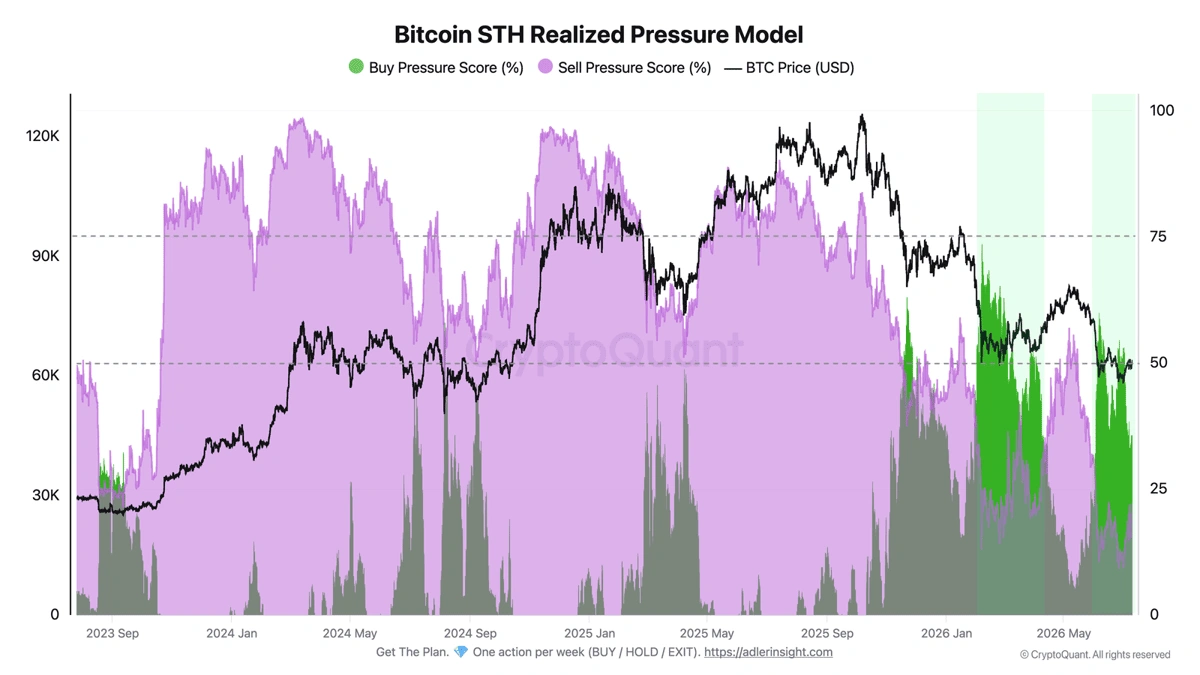
However, the path forward for Bitcoin is not without its challenges. The cryptocurrency faces significant resistance near the $65,000 level, a crucial psychological and technical barrier. Sustaining a break above this threshold requires robust and consistent spot demand, which has been somewhat inconsistent in recent months. Further analysis of on-chain data reveals potential headwinds from existing holders. Short-term holders, defined as those who have held Bitcoin for one to six months, remain approximately 15% underwater on average. The newest cohort of buyers holds a realized price near $61,600, while the three-to-six-month group sits near $74,900. This significant gap implies that a stronger price advance could trigger selling pressure from these holders looking to reduce their losses or break even. A sustained move above $71,000 would significantly improve the market structure, but the area between $73,200 and $77,500 could attract even heavier supply as more holders reach their cost basis or seek to exit positions.
While Bitcoin ETF inflows offer a strong signal of institutional demand, other indicators present a more cautious outlook. "Negative apparent demand" and a "weak Coinbase premium" still point to a degree of hesitation among U.S. spot buyers. A Coinbase premium, which measures the difference between Bitcoin’s price on Coinbase (often favored by institutions) and other exchanges, can indicate strong institutional buying when positive. A weak or negative premium suggests that institutional buying isn’t overwhelmingly aggressive. Moreover, rising leverage in the futures market poses another risk; if Bitcoin loses momentum and falls below $64,000, it could trigger cascading liquidations, exacerbating price declines.
Despite these caveats, some analysts offer a more optimistic perspective. Axel Adler Jr., an on-chain analyst, notes that short-term holder buying pressure has recently exceeded selling pressure. Buying scores ranged from 37% to 46% during June and July, while selling pressure remained near 16%. These conditions, according to Adler, support a possible bounce, though he cautions that older holders who acquired Bitcoin at lower prices remain positioned to sell into higher prices, potentially capping significant upside rallies in the short term.
Implications for the Cryptocurrency Ecosystem and Future Outlook
The return of positive inflows into U.S. spot Bitcoin and Ethereum ETFs carries significant implications for the broader cryptocurrency ecosystem and the ongoing trajectory of institutional adoption. Firstly, it reaffirms the increasing integration of digital assets into traditional finance. The ability of these ETFs to attract substantial capital, even after a period of outflows, solidifies their role as legitimate investment vehicles for a diverse range of investors, from hedge funds and asset managers to financial advisors and retail clients. This institutional validation is crucial for the long-term maturation and stability of the crypto market.
Secondly, the performance of these ETFs, particularly the dominance of BlackRock’s IBIT and ETHA, highlights the competitive dynamics within the asset management industry. Firms that can offer highly liquid products with strong brand recognition and efficient operations are poised to capture the lion’s share of institutional capital. This competition is likely to drive innovation in product offerings, fee structures, and investor education, ultimately benefiting the end consumer.
Thirdly, the success of Bitcoin and Ethereum ETFs could pave the way for the approval of spot ETFs for other major cryptocurrencies. As regulators become more comfortable with the structure and oversight of these products, and as market infrastructure continues to mature, it is plausible that other digital assets could eventually gain similar institutional access. This would further broaden the investable universe for traditional investors and deepen the integration of the crypto market with global financial systems.
In conclusion, the renewed inflows into U.S. spot Bitcoin and Ethereum ETFs on July 10 signal a cautious but discernible return of institutional interest in digital assets. While macroeconomic tailwinds have provided immediate support, Bitcoin’s ability to overcome key resistance levels and navigate the psychological selling pressure from short-term holders will be critical for a sustained rally. The market currently presents a complex interplay of strong institutional demand for regulated products and inherent volatility driven by on-chain dynamics and broader economic sentiment. The trajectory of these capital flows will continue to serve as a vital barometer for the health and maturity of the cryptocurrency market in the months ahead.














