On October 8, the United Kingdom’s Foreign, Commonwealth & Development Office (FCDO) announced a sweeping new round of sanctions targeting 38 entities and individuals accused of providing the financial and logistical backbone for Russia’s ongoing military efforts in Ukraine. This latest diplomatic and economic offensive represents a coordinated effort to dismantle the sophisticated networks that Russia uses to evade international restrictions, fund its wartime economy, and sustain its military-industrial base. The designations strike at the heart of three critical sectors: the burgeoning "illicit-friendly" cryptocurrency ecosystem, the high-value Russian oil industry, and the international supply chains providing essential components for advanced weaponry.
The FCDO’s action underscores a growing recognition among Western regulators that digital assets have become a primary vehicle for sanctions evasion. By targeting crypto payment processors and exchanges, the UK aims to sever the "payment rails" that allow Russian state actors and cybercriminals to move funds across borders with relative anonymity. This move is bolstered by deep-chain analysis showing that the sanctioned entities are not merely peripheral players but are central hubs for a wide array of criminal activities, ranging from North Korean state-sponsored hacking to global ransomware campaigns.

The Crypto Crackdown: Cryptomus, Heleket, and Xeltox Enterprises
At the forefront of the new designations are the cryptocurrency payment processors Cryptomus and Heleket. Both services operate under the umbrella of a parent company known as Xeltox Enterprises LTD. While these platforms marketed themselves as legitimate tools for businesses to accept digital payments, forensic blockchain investigations have revealed a persistent pattern of facilitating illicit finance at a staggering scale.
According to data provided by blockchain intelligence firm Chainalysis, Cryptomus and Heleket have collectively interacted with more than 15,000 distinct illicit actors. These counterparts span every major category of crypto-related crime, including fraud shops, scam operators, and organized criminal syndicates. The sheer volume of illicit traffic passing through these services suggests that their lax Know Your Customer (KYC) and Anti-Money Laundering (AML) protocols were not merely oversights but were a core part of their business model designed to attract high-risk users.
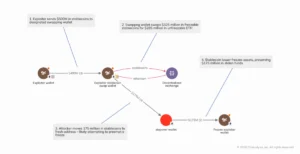
The reach of these processors extends to some of the most notorious actors in the cybercrime world. Analysis indicates that funds derived from the $1.4 billion exploit of the Bybit exchange—an attack widely attributed to the Lazarus Group, North Korea’s state-sponsored hacking collective—eventually reached both Cryptomus and Heleket through a series of intermediary transactions. Furthermore, the services have been identified as primary payment channels for prominent ransomware organizations, such as Black Basta, and illicit marketplaces like Xinbi Guarantee.

The FCDO’s decision to designate these firms follows a landmark enforcement action by Canada’s financial intelligence unit, FINTRAC. In October 2025, FINTRAC leveled a record-breaking CAD 177 million penalty against Cryptomus for systemic AML and Counter-Terrorist Financing (CFT) violations. This penalty, combined with the new UK sanctions, effectively isolates Xeltox Enterprises from the regulated global financial system, signaling to other "gray market" processors that the window for operating without strict compliance is closing.
Marketing Anonymity to the Dark Web
A significant factor in the UK’s designation was the proactive manner in which Cryptomus sought out criminal clientele. Investigations into dark web activity revealed that Cryptomus frequently advertised its services on major Russian-language cybercrime forums, including BHF and Nulled. At its peak, Nulled boasted over 10 million users, providing a massive audience of hackers, fraudsters, and malware developers.
In these advertisements, Cryptomus explicitly touted its ability to process "anonymous" payments without requiring KYC or Know Your Business (KYB) documentation. By positioning itself as a haven from traditional financial oversight, the service became the preferred infrastructure provider for vendors of malicious cyber tools. These included providers of "bulletproof" hosting, proxy services, and Distributed Denial of Service (DDoS)-as-a-service platforms. Several of these infrastructure providers, such as Zservers, Stark Industries, and the Aeza Group, have also faced international sanctions for their roles in enabling global cyberattacks.

The Kyrgyzstan Connection and the A7A5 Network
The sanctions also shine a light on a specialized network of cryptocurrency exchanges based in Kyrgyzstan that have become essential for Russian sanctions evasion. Central to this is TokenSpot CJSC, a Kyrgyzstani exchange that the FCDO has now designated for its role in facilitating the movement of Russian capital.
TokenSpot is identified as a key node in a broader network that includes other previously sanctioned exchanges, such as Grinex and Meer.kg. Forensic comparisons of these platforms reveal nearly identical website architectures and visual assets, suggesting they share common operators or underlying technical infrastructure. While Meer.kg focused on crypto-to-fiat pairs, TokenSpot catered specifically to "business growth," offering ruble-denominated cryptocurrency purchases for both individuals and legal entities.
The primary function of this network appears to be the management and liquidation of the A7A5 token. A7A5 is a specialized digital asset that functions as an "instant swapper," allowing users to trade ruble-backed tokens for dollar-backed stablecoins like USDT. This mechanism provides a vital bridge for Russian entities to convert their domestic currency into globally liquid assets, bypassing the traditional banking system.

Blockchain tracing has revealed that funds from TokenSpot, Grinex, and Meer.kg frequently converged at the same deposit addresses on major exchanges, including HTX (formerly Huobi). One specific HTX address linked to this network reportedly received over $308 million. HTX itself was sanctioned by the UK in May 2026 after it was discovered to have funneled more than $1.5 billion to Russia through flows originating from sanctioned entities. Furthermore, the network shows direct ties to AnyKey LLC, a company affiliated with the controversial Moldovan-Russian politician Ilan Shor, who has been repeatedly linked to efforts to destabilize regional governments in favor of Russian interests.
Targeting the Lifeblood of the War Economy: Oil and Shipping
While the crypto designations address the digital front, the UK has also moved to tighten the noose around Russia’s primary source of hard currency: its oil industry. The October 8 announcement included sanctions against two major Russian oil entities, Zarubezhneft and INK Capital. With these new additions, the UK’s sanctions regime now covers more than 90% of Russia’s total oil production capacity.
In addition to the producers themselves, the FCDO designated 12 new vessels identified as part of Russia’s "shadow fleet." These are typically older tankers with obscured ownership and insufficient insurance that are used to transport Russian oil above the G7-mandated price cap. By targeting these specific vessels, the UK aims to increase the operational costs and risks associated with Russia’s maritime exports. This brings the total number of sanctioned vessels in the global effort to over 600, reflecting a persistent "cat-and-mouse" game between Western authorities and Russian shipping interests.

Dismantling Military Supply Chains
The final pillar of the new sanctions package targets the physical components required for modern warfare. Seventeen individuals and entities were designated for their involvement in the procurement of machine tools, electronics, and specialized materials used in the production of ballistic missiles and unmanned aerial vehicles (drones).
The FCDO noted that these procurement networks are increasingly leveraging cryptocurrency to fund their operations. Earlier research into pro-Russian volunteer organizations and paramilitary groups revealed that they had successfully raised over $8.3 million in crypto through open crowdfunding campaigns. These funds were used to bypass traditional export controls and purchase drones, thermal imaging equipment, and other tactical gear from third-party suppliers in Asia and the Middle East. By sanctioning the middlemen in these supply chains, the UK hopes to degrade the quality and quantity of hardware reaching the front lines.
Analysis of Implications and Future Outlook
The designation of 38 entities marks a strategic shift in how the UK and its allies approach the problem of Russian sanctions evasion. Rather than merely targeting the end-users of illicit funds, authorities are now aggressively pursuing the service providers—the exchanges, payment processors, and shipping firms—that make evasion possible at scale.

The data suggests that as primary exchanges like Garantex were dismantled by law enforcement in 2025, illicit users did not stop their activity; they simply migrated to "illicit-friendly" alternatives like Cryptomus and Heleket. The FCDO’s move to preemptively shutter these alternative venues indicates a more proactive stance.
For the global financial and cryptocurrency industries, the message is clear: "lax compliance" will no longer be tolerated as a business strategy. The record fine from FINTRAC and the UK’s sweeping sanctions demonstrate that payment processors will be held to the same AML/CFT standards as traditional banks. As Russia continues to seek out new loopholes, from Kyrgyzstani "swappers" to shadow fleet tankers, the international community appears committed to a policy of "constant surveillance and rapid designation" to ensure that the economic cost of the war continues to rise for the Kremlin.