


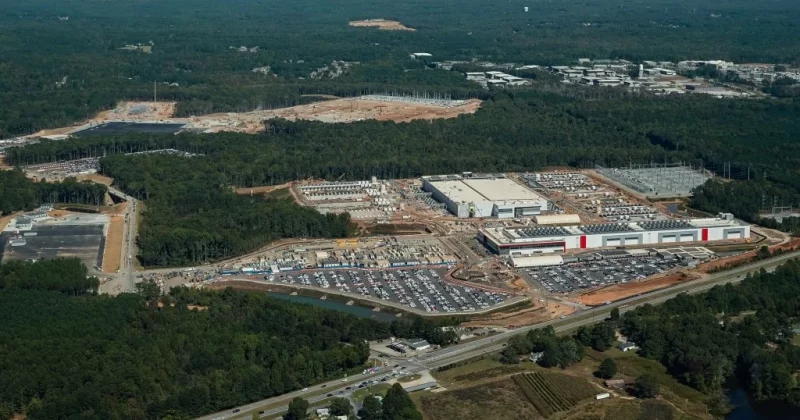
The revelation that Quality Technology Services (QTS), one of the most prominent data center operators in the United States, consumed nearly 30 million gallons of water over a 15-month period without initial billing has ignited a firestorm of controversy in Douglas County, Georgia. The discrepancy, which occurred between January 2025 and April 2026, came to public light on May 8, 2026, triggering immediate backlash from local residents and environmental advocates. The situation is particularly sensitive given that the region has been grappling with stringent drought-related water restrictions, forcing homeowners to curtail their own usage while industrial giants seemingly operated outside the standard oversight of municipal billing systems.
The retroactive bill issued to QTS totaled $147,000. While this figure may appear substantial in a vacuum, a closer analysis reveals a startling disparity: the company paid approximately half a penny per gallon for a resource that the local community has been instructed to ration as a matter of civic survival. This pricing structure and the administrative failure to track such massive consumption have raised fundamental questions about the sustainability of Georgia’s rapid transformation into a global data hub.
The Douglas County Incident: A Breakdown of the Oversight
Douglas County has aggressively positioned itself as a premier destination for data-intensive industries, offering a combination of favorable tax incentives and robust infrastructure. However, the QTS incident suggests that the administrative capacity to monitor these facilities may not be keeping pace with the physical construction.
The 30 million gallons in question were utilized during the construction phase of a new QTS facility. This is a critical distinction; data centers are notoriously water-intensive during their operational phase due to the massive cooling requirements of high-density server racks. The fact that such a significant volume was consumed merely for dust suppression, concrete mixing, and site preparation—before a single server was even powered on—has alarmed environmental monitors.
On March 13, 2026, QTS announced an ambitious expansion plan for the region, detailing the construction of 16 buildings across 615 acres. This project, comprising two massive campuses totaling 6.6 million square feet, represents one of the largest industrial developments in the state’s history. The scale of this project highlights the sheer volume of resources required to maintain Georgia’s status as a leader in the digital economy, yet it also exposes the vulnerability of local utilities when faced with unprecedented industrial demand.
The Chronology of Consumption and Public Reaction
The timeline of the QTS billing oversight provides a clear picture of the growing friction between corporate expansion and public resource management:
- January 2025: QTS begins the initial phases of site preparation and construction in Douglas County. Water usage commences but is not captured by the standard municipal billing cycles for the specific project accounts.
- December 2025: The Atlanta Regional Commission (ARC) releases a seminal report flagging the unsustainable trajectory of water and energy demands from data centers and cryptocurrency mining operations across the state.
- January 2026: Environmental experts and industry analysts warn of a "looming backlash" against AI and crypto infrastructure. These warnings specifically cite the potential for community-led opposition driven by ecological concerns.
- March 13, 2026: QTS officially announces its 6.6-million-square-foot campus expansion, emphasizing the economic benefits and job creation associated with the project.
- April 2026: The period of unbilled water usage concludes as the construction phase transitions and internal audits begin to surface the discrepancy.
- May 8, 2026: The public discovery of the 30-million-gallon oversight leads to the issuance of a $147,000 retroactive bill. Local news outlets and community forums erupt with criticism regarding the "half-penny per gallon" rate.
For Douglas County residents, the timing of the discovery could not have been worse. Throughout the duration of QTS’s unbilled usage, the county was under Level 2 drought restrictions, which prohibited residents from watering lawns during daylight hours and imposed fines for excessive water use. The perception of a "double standard"—where a multi-billion-dollar corporation consumes millions of gallons for a nominal fee while residents face penalties for maintaining their properties—has become a focal point for local political organizing.
Georgia’s Growing Data Footprint and the Crypto Connection
The QTS incident does not exist in isolation. Georgia has become a magnet for both traditional data centers and cryptocurrency mining facilities, largely due to the state’s historically low energy costs and a regulatory environment that has been, until recently, highly accommodating.
The state currently hosts over a dozen large-scale crypto mining operations. Unlike traditional data centers that may serve a variety of enterprise and cloud functions, crypto mining is almost exclusively dedicated to high-intensity computational processing. This requires constant, high-volume cooling. The December 2025 ARC report estimated that data centers in Georgia could eventually consume up to 10% of local water supplies if current growth trends continue unabated.
The global context is even more daunting. A 2025 study on the environmental footprint of digital assets estimated that Bitcoin mining alone consumes between 591 billion and 2 trillion gallons of water annually, depending on the cooling technologies employed and the source of the electricity used. In Georgia, where much of the power is generated from thermoelectric plants that require their own water for cooling, the "water-energy nexus" creates a compounding effect on the state’s aquifers and river systems.
Institutional and Regulatory Responses
While QTS has moved to settle the outstanding bill, the reputational damage and the precedent set by this incident are likely to have long-lasting effects on state policy. Local officials in Douglas County have faced intense questioning regarding how 30 million gallons—equivalent to approximately 45 Olympic-sized swimming pools—could be diverted without triggering an automated alert in the billing system.
In response to the growing public outcry, several state legislators have begun drafting proposals to tighten the reporting requirements for high-volume industrial water users. Potential measures include:
- Real-Time Metering Requirements: Mandating that any facility over a certain square footage install smart meters that provide real-time data to municipal water authorities.
- Tiered Industrial Pricing: Adjusting the cost of water for data centers so that it more accurately reflects the strain placed on the infrastructure, potentially removing the "bulk discount" that currently exists.
- Mandatory Recirculation Systems: Requiring new data center developments to utilize closed-loop cooling systems or non-potable "gray water" to preserve the local drinking water supply.
These proposed shifts mirror actions taken in other jurisdictions. North Carolina has already implemented moratoriums on new data center and crypto mining permits in certain counties to allow for comprehensive environmental impact studies. If Georgia follows suit, the era of frictionless expansion for the data industry in the Southeast may be coming to an end.
Strategic Implications for Investors and Operators
For investors in the data center and cryptocurrency mining sectors, the Douglas County incident serves as a stark reminder that "social license to operate" is as critical as power and fiber connectivity. The $147,000 fee paid by QTS is a negligible expense for a company of its size, but the resulting delays in permitting and the surge in community opposition represent significant financial risks.
If Georgia implements more rigorous regulations, operational costs will inevitably rise. These costs will ripple through the entire mining and data processing chain. For cryptocurrency miners, higher overhead translates directly into lower profit margins and a less competitive hashrate. This may force a migration of operations to regions with even fewer regulations or more abundant, un-tapped resources, though such regions are becoming increasingly scarce.
Furthermore, the "AI boom" is placing even greater pressure on these facilities. Generative AI models require significantly more computational power—and thus more cooling—than traditional cloud storage. As companies like QTS expand to meet the demand for AI infrastructure, they will find themselves under a microscope. Every gallon of water and every megawatt of power will be scrutinized by a public that is increasingly aware of the trade-offs between digital progress and environmental stability.
Conclusion: A Turning Point for Georgia’s Infrastructure
The unbilled 30 million gallons in Douglas County may eventually be remembered as the catalyst for a fundamental shift in how Georgia manages its digital infrastructure growth. The incident has exposed a gap between the state’s economic ambitions and its administrative oversight.
As QTS continues its massive 6.6-million-square-foot build-out, the eyes of the community and the industry will be on its water meters. The challenge moving forward will be to find a balance that allows for technological innovation without compromising the basic resource needs of the population. For the data center industry, the lesson is clear: transparency and proactive resource management are no longer optional "green" initiatives—they are essential components of long-term operational viability in a world of increasing resource scarcity. The "half a penny per gallon" era is likely nearing its conclusion, replaced by a more complex landscape where the true cost of data is finally being calculated.














