


Uniswap, the leading decentralized exchange (DEX), is poised to significantly expand its protocol’s fee-and-burn mechanism, targeting integration across the BNB Chain, Polygon, and Celo ecosystems. This strategic move, currently undergoing a "temp check" governance vote, aims to bolster the UNI token’s deflationary mechanics and solidify Uniswap’s presence in the rapidly evolving multi-chain decentralized finance (DeFi) landscape. If approved, the expansion would bring the total number of networks utilizing Uniswap’s value accrual system to thirteen, marking a critical step in the protocol’s quest for ubiquitous liquidity and market share. The proposal has garnered overwhelming support from the community, signaling a collective endorsement of a more robust and widespread tokenomics model for UNI.
The core of this initiative lies in extending Uniswap’s innovative fee-and-burn system, which was initially activated on the Ethereum mainnet and subsequently rolled out to nine other networks in December. Under this mechanism, a portion of the protocol fees generated from every swap executed on the integrated networks is programmatically bridged back to Ethereum. Upon arrival, these collected fees are then used to acquire UNI tokens, which are subsequently sent to a designated "dead address," permanently removing them from circulation. This process introduces a deflationary pressure on the UNI supply, theoretically enhancing the token’s scarcity and long-term value proposition for holders and stakers. The current proposal specifically addresses the integration of BNB Chain, Polygon, and Celo, with the former two slated to connect via Wormhole’s robust Native Token Transfer setup. Celo’s inclusion is a re-attempt, addressing a previous configuration error that prevented its successful activation despite an earlier governance approval, underscoring the technical complexities inherent in cross-chain deployments.
The Strategic Imperative: Expanding Across Key DeFi Ecosystems
Uniswap’s decision to target BNB Chain, Polygon, and Celo is a calculated move to capture a larger share of the burgeoning multi-chain DeFi market. Each of these networks represents a significant segment of the crypto ecosystem, characterized by distinct user bases, transaction volumes, and strategic focuses.
BNB Chain, backed by Binance, is one of the largest smart contract platforms by daily active users and transaction count. It boasts a vibrant ecosystem of decentralized applications (dApps), often attracting users seeking lower transaction fees and faster confirmation times compared to Ethereum’s mainnet. Integrating Uniswap’s fee-and-burn mechanism here allows the protocol to tap into this massive user base, generating substantial protocol fees from the high volume of swaps typical on BNB Chain. This move is not merely about expanding reach but also about cementing Uniswap’s position as a foundational liquidity layer across diverse blockchain architectures, acknowledging the reality that many users operate primarily within alternative Layer-1 ecosystems due to cost and speed considerations.
Polygon (formerly Matic Network), a prominent Layer-2 scaling solution for Ethereum, has gained significant traction due to its ability to offer high throughput and low transaction costs while maintaining a strong connection to Ethereum’s security model. It has become a hub for various dApps, including gaming, NFTs, and enterprise solutions. For Uniswap, integrating Polygon means extending its fee-and-burn mechanism to a chain that processes millions of transactions daily and hosts a growing number of DeFi protocols. This integration reinforces Uniswap’s commitment to Ethereum’s broader ecosystem by supporting its scaling solutions, ensuring that liquidity and value accrual are not confined to the mainnet but flow seamlessly across its most critical extensions. The strategic alignment with Polygon also positions Uniswap to benefit from Polygon’s aggressive expansion plans, including its advancements in zero-knowledge (ZK) rollups and further enterprise adoption.
Celo, while perhaps smaller in market capitalization than BNB Chain or Polygon, holds a unique and crucial position within the DeFi landscape due to its mobile-first approach and focus on real-world assets (RWAs) and financial inclusion. Its design prioritizes accessibility for smartphone users, particularly in emerging markets, aiming to bring DeFi to the unbanked and underbanked populations globally. The re-introduction of Celo into the fee-and-burn proposal, after a previous technical glitch, highlights Uniswap’s recognition of Celo’s long-term potential in bridging traditional finance with decentralized applications. For Uniswap, integrating Celo is about tapping into a potentially massive, untapped user base and contributing to a more inclusive global financial system, while simultaneously creating new avenues for UNI value accrual from a distinct demographic and use-case perspective.
The overall strategy reflects a pragmatic understanding of the current blockchain environment, where a single dominant chain is increasingly unlikely. Instead, an interconnected web of specialized and generalized chains is emerging, and Uniswap aims to be a central pillar in this multi-chain future, providing universal liquidity.
The Mechanics of Value Accrual: Fee-and-Burn Explained

The fee-and-burn mechanism is a sophisticated tokenomics model designed to create a direct link between protocol usage and token value. When a user performs a swap on Uniswap V3 (or V2, where applicable) on an integrated chain, a small percentage of the swap fee is collected as a "protocol fee." This fee, typically a fraction of a percentage point, is then earmarked for the burn mechanism.
For cross-chain integrations like BNB Chain and Polygon, the collected fees are not burned directly on their native chains. Instead, they are transferred back to the Ethereum mainnet. This inter-chain transfer is facilitated by secure bridging solutions, such as Wormhole’s Native Token Transfer setup, which ensures the reliable and secure movement of assets between disparate blockchain environments. Once these fees arrive on Ethereum, they are used to purchase UNI tokens from the open market. These acquired UNI tokens are then sent to a pre-determined "dead address"—a wallet address with no known private key, making any tokens sent there permanently inaccessible and effectively removed from the circulating supply.
This process has several significant implications. Firstly, it creates a continuous demand for UNI tokens, as protocol fees are constantly being used to buy them off the market. Secondly, by permanently removing UNI from circulation, it reduces the total supply over time, which, under constant or increasing demand, can lead to upward price pressure due to scarcity. This mechanism directly aligns the success and usage of the Uniswap protocol across all integrated chains with the long-term value of the UNI token, creating a powerful incentive for token holders and fostering a more sustainable economic model for the decentralized exchange.
Governance and Community Endorsement: A Unified Front
The current proposal is a "temp check" vote, a preliminary stage in Uniswap’s governance process conducted via Snapshot.eth. This type of vote is non-binding but serves as a crucial signal of community sentiment before a formal, on-chain governance proposal is put forth. The overwhelming support observed, with 100% of the 18.1 million UNI votes cast (from 258 wallets) in favor and the 10 million UNI quorum already cleared, underscores the strong consensus within the Uniswap DAO for this expansion.
This level of unified support reflects a maturation of the Uniswap governance model and a clear vision for the protocol’s future. Community members and delegates have voiced their strong endorsement, recognizing the strategic importance of this move. Abel189, a prominent forum member, articulated this sentiment by describing the expansion as "a coherent next step" in Uniswap’s journey toward an "increasingly multi-chain reality." He further noted that while he supports an incremental, chain-by-chain expansion, the growing complexity of cross-chain messaging will be a key factor to monitor, highlighting the ongoing technical challenges inherent in such ambitious integrations.
Key governance participants, including L2BEAT’s governance team (comprising members like Kaereste and Manugotsuka), have also cast their votes in favor. Their support comes after a thorough verification process by their research team, which scrutinized the implementation details, smart contracts, and expected governance payloads. Their rationale for approval hinged on the unchanged fee structure and the continuity with the previously approved framework for the fee-and-burn mechanism, indicating a consistent and well-understood approach to protocol evolution. This meticulous review by respected entities like L2BEAT adds a layer of credibility and robustness to the proposal, reassuring the community of its technical soundness and adherence to established governance principles. The rapid quorum clearance and unanimous support indicate that the community sees this as a natural and beneficial progression for the protocol and its token holders.
On-Chain Data Signals Accumulation: A Market Perspective
Beyond the governance discussions, market activity for the UNI token has also been drawing attention, particularly from on-chain analytics platforms like CryptoQuant. Data from the Uniswap Exchange Netflow chart for Binance reveals a significant trend: as UNI’s price corrected deeply, net outflow bars grew denser and more frequent. This pattern, characterized by large net outflows, is typically interpreted by market analysts as a strong indicator of accumulation activity, particularly from longer-term holders and "smart money" participants.
Net outflows from exchanges signify that UNI tokens are being withdrawn from centralized trading platforms like Binance and moved into personal, self-custodial wallets. This action is usually taken by investors who intend to hold their assets for an extended period, rather than trading them actively. The immediate effect of this trend is a reduction in the available supply of UNI on exchanges, which in turn diminishes direct selling pressure. Analyst Rei Researcher from CryptoQuant specifically highlighted this trend as a potential setup for an accumulation zone near the bottom of UNI’s recent price correction.
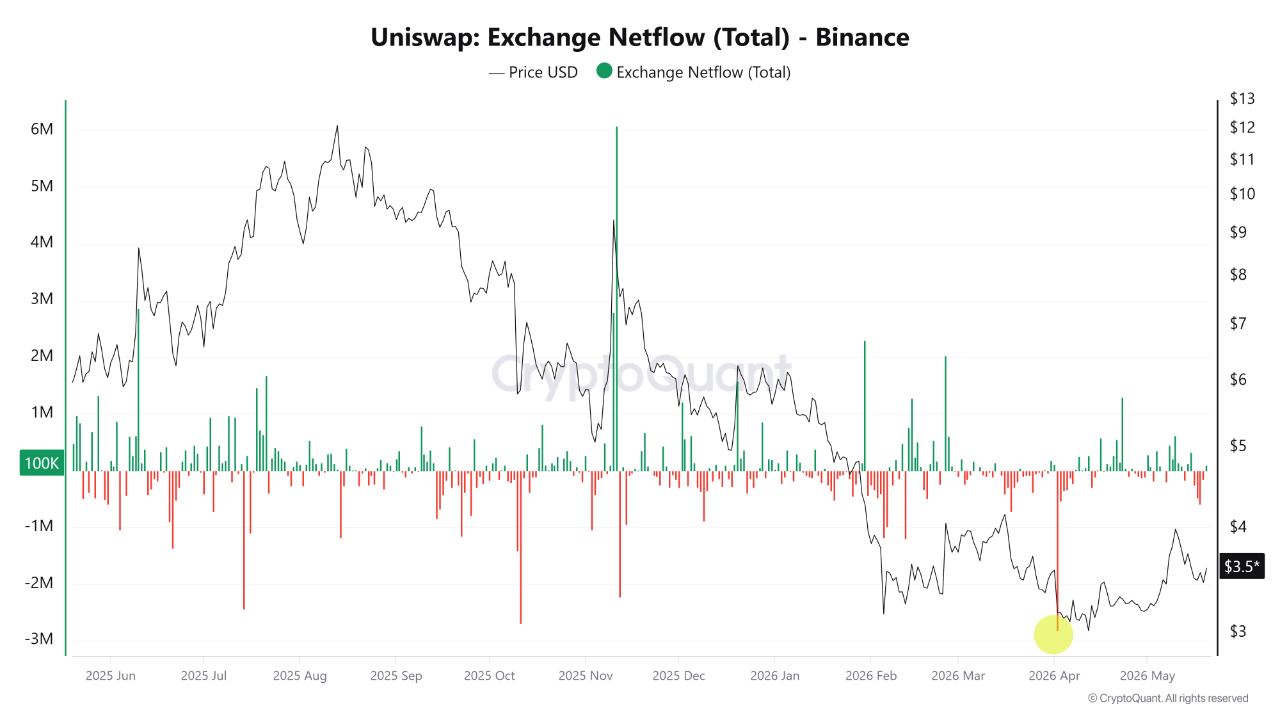
Historically, reduced exchange supply, coupled with sustained or increasing demand, has often preceded upward price movements. The current mild price recovery for UNI could be a preliminary reflection of this dynamic. If the outflow trend persists and exchange supply continues to tighten, any significant buying demand could exert considerable upward pressure on the UNI price. This market dynamic, when combined with the structural utility enhancement provided by the expanded fee-and-burn mechanism, paints a potentially bullish picture for UNI’s near-term and long-term outlook. The burning of UNI tokens, driven by protocol usage, introduces a constant, albeit gradual, reduction in supply, adding another layer of scarcity to the market’s fundamental equation.
Implications and the Road Ahead for Uniswap
The successful passage and implementation of this proposal will have profound implications for Uniswap and the broader DeFi ecosystem.
Enhanced Tokenomics for UNI: The most direct impact will be on UNI’s tokenomics. By extending the fee-and-burn mechanism to three additional, high-volume chains, the protocol will significantly increase the rate at which UNI tokens are removed from circulation. This heightened deflationary pressure aims to make UNI a more attractive asset for long-term holding, potentially increasing its scarcity value. It strengthens the direct link between the utility and success of the Uniswap protocol across multiple blockchains and the intrinsic value of its native token, providing a clearer value accrual path for UNI holders who also participate in governance.
Strengthened Competitive Position: In the increasingly competitive DEX landscape, multi-chain presence is no longer optional but essential for market leadership. By integrating with BNB Chain, Polygon, and Celo, Uniswap reinforces its position as the premier decentralized exchange, offering ubiquitous liquidity across a wider array of blockchain environments. This expansion helps Uniswap defend its market share against emerging DEXs native to these chains and attracts new users and liquidity providers who might primarily operate outside the Ethereum mainnet. It demonstrates Uniswap’s adaptability and commitment to serving the entire decentralized finance community, regardless of their preferred blockchain.
Challenges of Cross-Chain Interoperability: While highly beneficial, expanding across multiple chains introduces complexities, particularly concerning cross-chain messaging and security. The reliance on bridges like Wormhole, while robust, still presents potential points of vulnerability that require continuous monitoring and upgrades. As Abel189 noted, managing the "cross-chain messaging complexity" will be a key watch item. Ensuring the integrity and security of the fee transfer mechanism across different chains is paramount to maintaining user trust and protocol stability. Uniswap and its governance community must remain vigilant in auditing and securing these critical cross-chain infrastructures.
Paving the Way for Future Expansion: This proposal is likely not the final step in Uniswap’s multi-chain strategy. A successful rollout to BNB Chain, Polygon, and Celo could serve as a blueprint for integrating with even more Layer-1s and Layer-2s in the future, further cementing Uniswap’s status as a foundational piece of the global DeFi infrastructure. The modularity and success of this expansion will inform future governance decisions regarding protocol growth and tokenomics adjustments.
The governance vote is scheduled to close on May 21st at 5:30 PM UTC. Given the current unanimous support and the cleared quorum, the passage of this "temp check" is all but certain, paving the way for a formal on-chain proposal and eventual implementation. This strategic expansion of the fee-and-burn mechanism represents a significant milestone in Uniswap’s evolution, underscoring its commitment to innovation, multi-chain dominance, and a more robust economic model for the UNI token in the years to come. The crypto community will be watching closely as Uniswap continues to adapt and lead in the dynamic world of decentralized finance.














