The United States Department of the Treasury’s Office of Foreign Assets Control (OFAC) announced a comprehensive set of sanctions on June 22, 2026, targeting a sophisticated international network of financial facilitators providing critical support to the Islamic State of Iraq and Syria (ISIS). This enforcement action, which designates three individuals and six entities across several continents, represents a significant escalation in the U.S. government’s efforts to dismantle the digital and traditional financial infrastructure that sustains global terrorism. By targeting nodes in Syria, Turkey, Nigeria, and Western Europe, the Treasury Department aims to sever the lifelines that allow ISIS to move capital through the global financial system using a hybrid of cryptocurrency and traditional money services.
The June 2026 designations underscore the evolving nature of terrorist financing, which has increasingly migrated toward virtual assets to bypass conventional banking surveillance. The targeted network facilitated the movement of funds from supporters in Europe, Africa, and the Middle East, utilizing both the TRON and Bitcoin blockchains, as well as traditional "hawala" systems and formal Money Service Businesses (MSBs). This action not only freezes the U.S.-based assets of the designated parties but also serves as a warning to global financial institutions and Virtual Asset Service Providers (VASPs) about the risks of secondary sanctions associated with these illicit actors.
The Evolution of ISIS Financial Infrastructure
Since the collapse of its territorial caliphate in 2019, ISIS has transitioned from a state-like entity funded by local taxation and oil smuggling to a decentralized, clandestine network. This shift necessitated a more robust and technologically advanced financial strategy. The 2026 OFAC designations reveal a mature ecosystem where professional money launderers and financial facilitators use a mix of legal business fronts and digital currencies to maintain the group’s operational readiness.
Central to this network is the use of MSBs that operate in a "gray zone" between legitimate commerce and illicit activity. These businesses often provide essential services to migrant populations and unbanked regions but are co-opted by extremist elements to move "blood money." The Treasury’s latest action highlights how ISIS has successfully recruited individuals with technical expertise to manage these transactions, ensuring that funds can be moved across borders with speed and relative anonymity.
Profiles of the Designated Individuals and Entities
The June 22 enforcement action identifies key facilitators who acted as bridges between ISIS leadership and its global donor base. Each individual and entity played a specific role in the logistics of terror finance, ranging from technical instruction to large-scale currency exchange.
Abdelhakim Boukich and Bitcoin Xchange
Abdelhakim Boukich, a former Dutch national and a long-standing extremist financial facilitator, is a primary target of these sanctions. Based in Syria, Boukich established "Bitcoin Xchange" in late 2020. This entity functioned as a specialized money services business that integrated cryptocurrency into the traditional Syrian financial landscape. According to Treasury reports, Bitcoin Xchange was a critical conduit for ISIS associates located in Norway, Belgium, the Netherlands, South Africa, and the United States. By leveraging Bitcoin, Boukich was able to receive international donations and convert them into local currency or other assets to fund ISIS operations on the ground.
The Turkish Connection: Spider and Alkaram
The designation also strikes at the heart of the ISIS financial transit corridor in Turkey. OFAC sanctioned two Turkish-based MSBs: Spider Gayrimenkul Ve Genel Ticaret Limited Sirketi (Spider) and Alkaram Danismanlik Gayrimenkul Ic Ve Dis Genel Ticaret Limited Sirketi (Alkaram). Both entities are owned or controlled by Mohamad Alhmidan, an individual previously designated by OFAC in March 2016 for his role in ISIS logistics.
Spider, which originally functioned as a hawala operator in Syria, was instrumental in moving capital from former ISIS-controlled territories into the broader Middle East and Europe. The persistence of Alhmidan’s network, despite prior sanctions, illustrates the challenges faced by regulators in permanently disabling these financial nodes. These entities often rebrand or use shell companies to continue operations, necessitating ongoing and aggressive monitoring by international authorities.
Miloud Abderrahmane and the TRON Blockchain
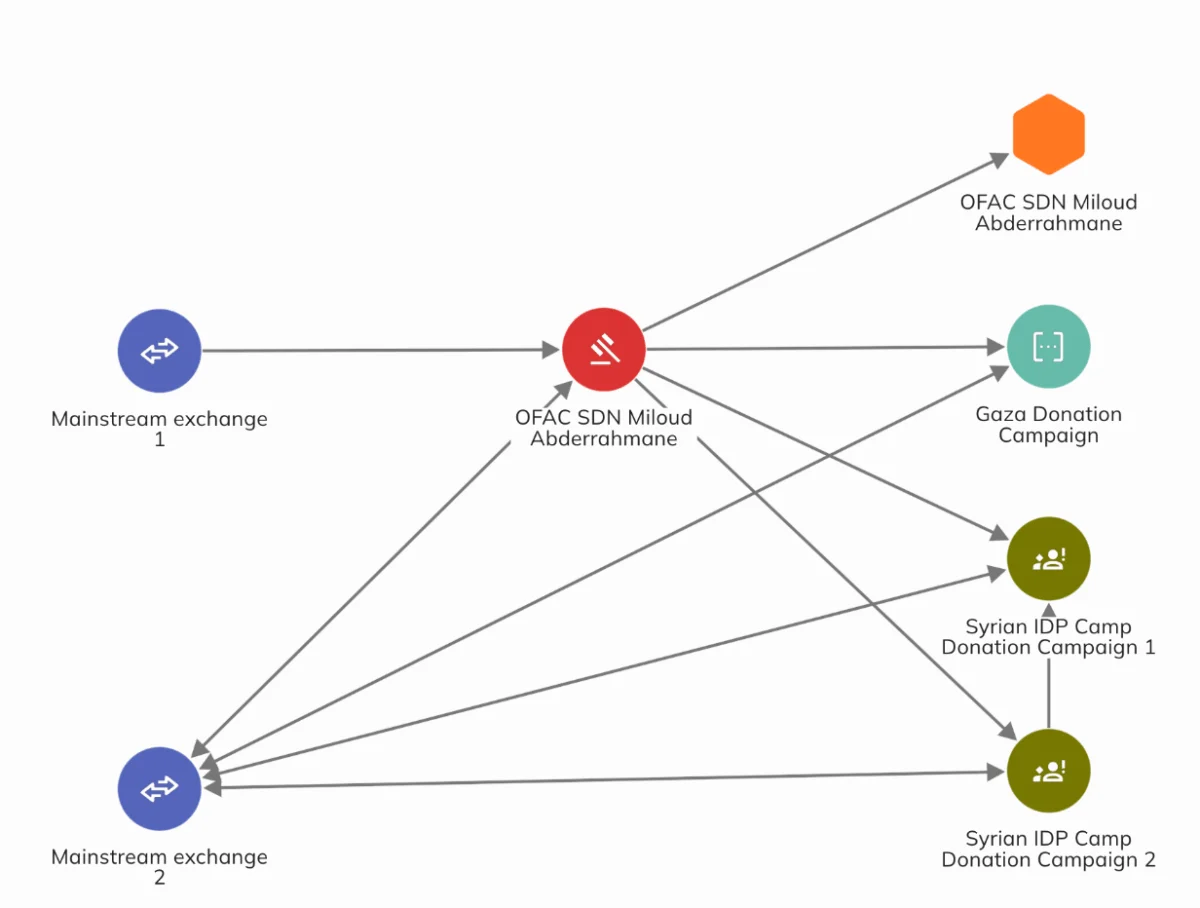
Miloud Abderrahmane, a French national, represents the intersection of operational militancy and financial facilitation. Beyond his role in conducting transactions for ISIS affiliates, Abderrahmane reportedly provided technical instructions to ISIS supporters on the construction of explosive devices. OFAC specifically identified two TRON blockchain addresses linked to Abderrahmane.
The choice of the TRON network is significant. In recent years, TRON has surpassed Bitcoin as a preferred network for illicit financing due to its lower transaction fees, faster processing times, and the high liquidity of stablecoins like USDT (Tether) on its platform. Blockchain analytics have revealed transfers from Abderrahmane’s wallets to campaigns supporting ISIS-linked activities in both Syria and Gaza, demonstrating the geographical breadth of his influence.

The West African Node: Mukhtar Adamu Muhammad
The sanctions also expand the focus to West Africa, a region where ISIS-West Africa (ISIS-WA) has seen significant growth. Mukhtar Adamu Muhammad, a Nigeria-based facilitator, was designated alongside three MSBs he owns: Nine to Nine Exchange Bureau de Change Limited, Manhattan Bureau de Change Limited, and Generation Currency Bureau de Change Limited. These entities provided the necessary infrastructure for ISIS-WA to process funds within the Nigerian financial system and move money across the Sahel, highlighting the group’s intent to professionalize its financial operations in Africa.
Chronology of Financial Counter-Terrorism Efforts
The June 2026 action is the latest in a decade-long campaign by the U.S. and its allies to bankrupt ISIS. The timeline of these efforts shows a clear progression in sophistication:
- 2014–2016: Focus was primarily on disrupting oil sales and physical bulk cash movements within Iraq and Syria.
- 2017–2019: Sanctions began targeting the "Rawi Network," a massive hawala system that ISIS used to move money internationally after losing its physical territory.
- 2020–2023: Regulators began identifying the first wave of cryptocurrency addresses linked to ISIS, primarily focusing on Bitcoin-based donation campaigns.
- 2024–2026: Enforcement has shifted toward "hybrid" facilitators like those designated today—actors who use a combination of MSBs, stablecoins, and decentralized finance (DeFi) to obfuscate the trail of funds.
Technical Analysis of the Financial Methods
The use of cryptocurrency in this specific network provides a case study for modern compliance challenges. Unlike traditional banking, where a "gatekeeper" can stop a transaction before it happens, blockchain transactions are peer-to-peer and immutable. However, they are also transparent.
Blockchain intelligence firms played a pivotal role in this designation by mapping the flow of funds from Abderrahmane’s TRON wallets. These analytics show a pattern of "layering," where funds are moved through multiple intermediate wallets to hide their origin. The data shows that despite these efforts, the permanent nature of the ledger allowed investigators to link European donors to Syrian and West African militants.
The reliance on TRON addresses is particularly noteworthy for the 2026 landscape. As Bitcoin’s "ordinals" and high fees made it less practical for small-to-medium transfers, the terrorist financing ecosystem pivoted toward TRON. This shift has forced VASPs to enhance their monitoring of TRON-based assets, which were previously considered lower risk than Bitcoin or Ethereum.
Global Implications for Financial Compliance
The U.S. Treasury’s action carries immediate and heavy consequences for the global financial sector. Under U.S. law, all property and interests in property of the designated individuals and entities that are in the United States or in the possession or control of U.S. persons must be blocked and reported to OFAC.
For international banks and cryptocurrency exchanges, the stakes are even higher. The "secondary sanctions" risk means that any foreign financial institution that knowingly facilitates a significant transaction for these designated parties could itself be sanctioned or barred from the U.S. financial system. This creates a "chilling effect" that effectively de-platforms these facilitators from the legitimate global economy.
Financial institutions are now required to:
- Update Sanctions Screening: Immediately integrate the newly identified TRON and Bitcoin addresses into automated screening tools.
- Conduct Look-Back Reviews: Analyze historical transaction data to identify if any existing customers have had direct or indirect exposure to the designated wallets or MSBs.
- Enhance Due Diligence in High-Risk Jurisdictions: Increase scrutiny on transactions involving MSBs in Turkey, Nigeria, and Syria, particularly those involving cryptocurrency-to-fiat off-ramps.
Official Responses and Strategic Outlook
While the Treasury Department maintains a policy of not commenting on specific ongoing investigations, officials have emphasized that this action is part of a broader "whole-of-government" approach. In a statement following the designations, Treasury spokespeople noted that the U.S. remains committed to working with the Counter-ISIS Finance Group (CIFG) of the Global Coalition to Defeat ISIS.
"ISIS continues to rely on key nodes in the global financial system to generate and move funds," the statement noted. "Today’s action demonstrates our resolve to expose and disrupt these facilitators, regardless of the technology or the geography they use. We will continue to leverage our authorities to ensure that the international financial system is not a safe haven for those who support terrorism."
The 2026 designations suggest that the battle against ISIS financing has entered a new phase of "precision strikes" against technical facilitators. As the group attempts to rebuild its influence in Africa and maintain its presence in the Middle East, the ability of the U.S. and its partners to track digital assets in real-time will remain the most critical tool in the counter-terrorism arsenal. For the global crypto industry, this serves as a stark reminder that regulatory oversight is not an option but a necessity for survival in the modern financial landscape.