


The United States Department of the Treasury’s Office of Foreign Assets Control (OFAC) announced a significant expansion of its sanctions list on July 1, 2026, targeting the financial infrastructure of the Islamic State’s Khorasan Province (ISIS-K) and the Brazilian transnational criminal organization Primeiro Comando da Capital (PCC). This latest regulatory action underscores the increasing reliance of both terrorist organizations and organized crime syndicates on digital assets to bypass the traditional global financial system. The update specifically identifies 134 cryptocurrency wallets associated with ISIS-K and marks the third major enforcement action against the PCC’s laundering operations in recent years. By targeting these specific digital identifiers, the U.S. government aims to choke off the liquidity of groups responsible for high-profile terrorist attacks and large-scale narcotics trafficking across several continents.
The Financial Architecture of ISIS-K
ISIS-K, the Afghan and Pakistani affiliate of the Islamic State, has emerged as one of the most lethal branches of the global terrorist network. Since its formal designation as a Specially Designated Terrorist Group in September 2015, the group has expanded its operations across Central Asia, frequently targeting civilians in Afghanistan, Pakistan, and Russia. A critical component of its survival and operational capacity is the al-Azaim Media Foundation, which serves as the group’s primary propaganda arm. Through its flagship publication, Voice of Khorasan, ISIS-K has historically solicited funds from a global audience, moving away from traditional hawala systems toward the pseudonymous realm of blockchain technology.
The July 2026 update added 131 TRON (TRX) addresses and three Monero (XMR) addresses to the OFAC Specially Designated Nationals (SDN) list. The inclusion of Monero is particularly notable for investigators; as a privacy-focused coin, Monero utilizes ring signatures and stealth addresses to obfuscate transaction details, making it a preferred tool for actors seeking maximum anonymity. Conversely, the heavy use of the TRON network reflects a broader trend in illicit finance where stablecoins, particularly Tether (USDT) on the TRON blockchain, are favored for their low transaction fees and high liquidity.
In a swift response to the OFAC announcement, Tether, the issuer of the world’s largest stablecoin, confirmed that it has frozen the balances on all 131 TRON-based addresses identified in the update. This proactive measure prevents the terrorist affiliate from moving or cashing out their digital holdings through centralized exchanges, effectively neutralizing those specific financial nodes.
On-Chain Analysis: Mapping the Flow of Terrorist Funds
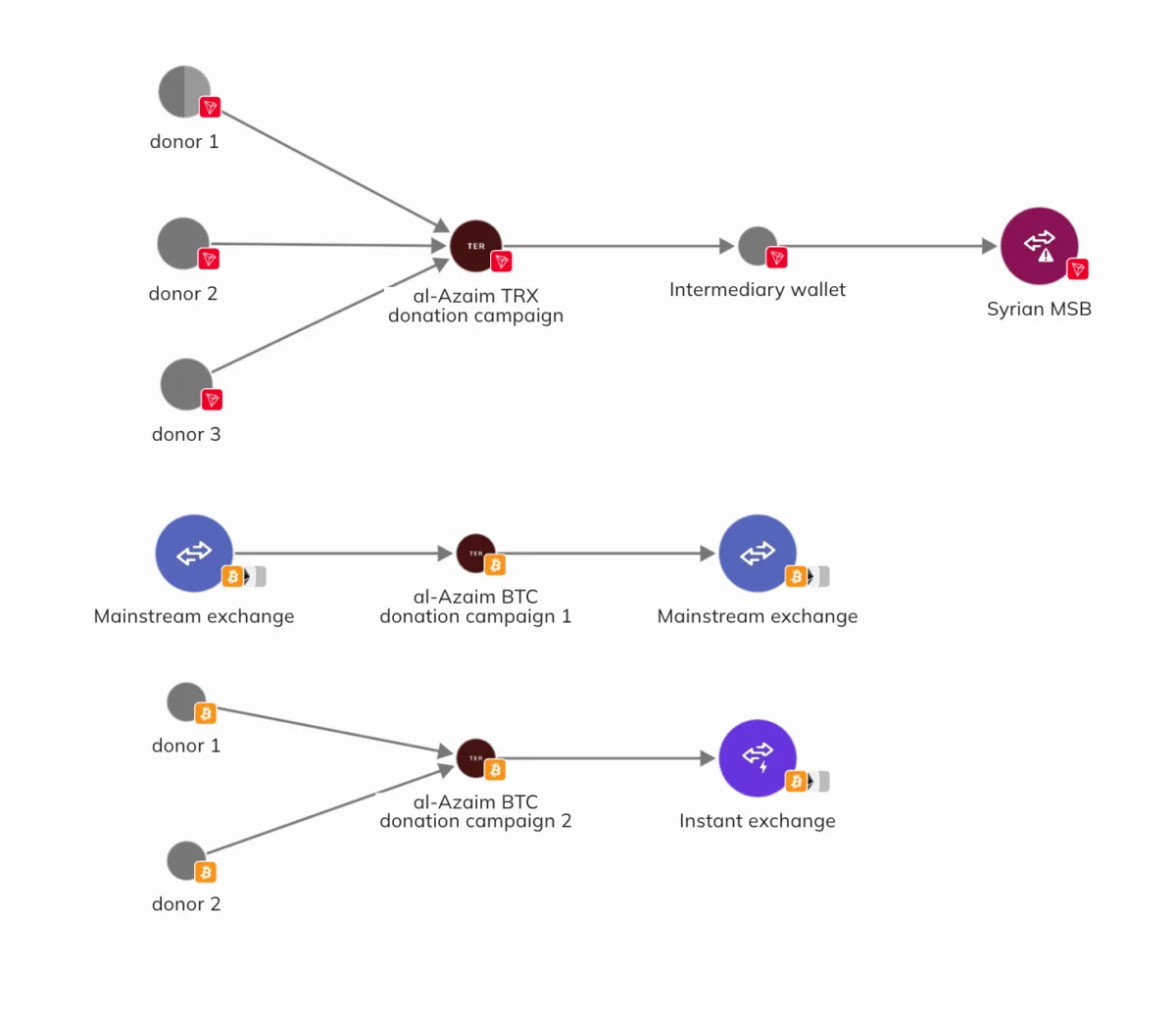
Blockchain forensic data provided by firms like Chainalysis reveals a sophisticated, if fragmented, financial network. Since early 2023, the 131 TRON wallets controlled by ISIS-K have received more than $1.4 million in various digital assets. While individual donations are often modest—reflecting the contributions of grassroots supporters with limited means—the aggregate volume demonstrates the group’s ability to maintain a steady stream of revenue.

The analysis indicates that these wallets have sent over $880,000 to various destinations, including Syria-based cryptocurrency exchangers. These Middle Eastern entities often act as "cash-out" points where digital assets are converted into local fiat currency to pay for weapons, logistics, and fighter salaries. The "shuttling" of funds from mainstream, high-volume exchanges to these specialized donation campaigns suggests that ISIS-K operatives are adept at using intermediary wallets to mask the origin of their funds before they reach their final destination.
Chronology of U.S. Enforcement Against ISIS Financial Networks
The July 2026 action is the latest in a series of strategic strikes by the U.S. Treasury against the Islamic State’s financial facilitators. The timeline of these actions illustrates the evolving nature of the threat:
- September 2015: ISIS-K is first designated as a Specially Designated Global Terrorist (SDGT) entity, initiating the blocking of its assets under U.S. jurisdiction.
- December 2021: The U.S. intensifies its focus on the group’s leadership and logistical supporters following the withdrawal of U.S. forces from Afghanistan.
- August 2023: OFAC sanctions Ali Shafiu, an ISIS-K operative based in the Maldives. Investigation revealed that Shafiu’s TRON wallets interacted with deposit addresses linked to Iranian exchanges, highlighting the cross-border complexity of the network.
- June 2026: Just weeks prior to the current update, OFAC sanctioned a network of Syrian money service businesses. These businesses served as the primary financial conduit for Miloud Abderrahmane, a facilitator who moved funds from global exchanges to Middle Eastern insurgent campaigns.
- July 1, 2026: The current designation adds 134 wallets, representing the most significant single-day expansion of crypto-related identifiers for ISIS-K to date.
Dismantling the PCC’s $30 Million Laundering Scheme
In a parallel but separate action, the U.S. Treasury targeted the Primeiro Comando da Capital (PCC), Brazil’s most powerful organized crime syndicate. Unlike ISIS-K, which uses crypto for operational funding and propaganda, the PCC utilizes digital assets as a sophisticated laundering tool for its multi-billion dollar narcotics empire.
OFAC designated two Brazilian nationals, Victor Henrique de Oliveira Shimada and Stella Stefanie Nunes Henrique de Oliveira, for their roles in a massive money laundering conspiracy. The network also included four corporate entities: Victory Trading, Pixwave, and Wave (based in Brazil), and Avenidas Flutuantes (based in Portugal). According to federal investigators, this syndicate laundered more than $30 million in illicit proceeds generated from drug trafficking operations within the United States.
The PCC network utilized cryptocurrency to move these funds across borders, eventually repatriating the wealth to the group’s home base in São Paulo. By converting "street cash" from U.S. drug sales into digital assets, the group attempted to bypass the reporting requirements of the traditional banking sector. This marks the third major action against the PCC, following the 2021 designation of the group as a whole and the March 2024 sanctioning of Diego Macedo Gonçalves do Carmo, another high-level money launderer for the organization.
Official Responses and Strategic Implications
The U.S. Treasury’s actions have drawn reactions from both the public and private sectors, emphasizing the need for a unified front against illicit finance. While OFAC officials have not issued a formal press statement beyond the registry update, the move is seen as a clear signal that the U.S. will continue to pursue "secondary sanctions" against any foreign financial institutions or virtual asset service providers (VASPs) that facilitate transactions for these designated parties.

Compliance experts suggest that these designations create an immediate "red flag" for global banks. Under U.S. law, all property and interests in property of the designated individuals and entities that are in the United States or in the possession of U.S. persons must be blocked and reported to OFAC. Furthermore, foreign financial institutions that knowingly facilitate significant transactions for these groups risk being cut off from the U.S. dollar clearing system, a move that could be fatal for any international bank.
The role of private blockchain analytics firms has become indispensable in this environment. By labeling these 134 addresses in real-time, firms allow exchanges to automatically block incoming or outgoing transfers associated with the terrorist network. This public-private partnership is currently the primary defense against the "crypto-ization" of terror finance.
Broader Impact on Cryptocurrency Compliance and Global Security
The July 1 designations serve as a watershed moment for the cryptocurrency industry, particularly for the TRON and Monero ecosystems. For TRON, the sheer volume of addresses identified highlights the network’s unintended status as a hub for high-velocity, low-cost illicit transfers. For Monero, the designation reinforces the regulatory pressure on "privacy coins," which many exchanges have already delisted to comply with Anti-Money Laundering (AML) and Counter-Terrorism Financing (CTF) regulations.
The broader implications of these sanctions include:
- Enhanced Screening Protocols: VASPs must now update their automated screening tools to include the 134 new identifiers. Any failure to do so could result in massive regulatory fines or criminal charges for the exchange operators.
- Geopolitical Pressure: The identification of Syrian and Iranian exchange links puts diplomatic pressure on regional governments to tighten their domestic crypto regulations and crack down on unlicensed money transmitters.
- The "Cat and Mouse" Dynamic: As OFAC identifies more wallets, illicit actors are likely to shift toward "chain-hopping" (moving funds across different blockchains) or using decentralized mixers. This necessitates even more advanced forensic tools for law enforcement.
- Impact on Organized Crime: By targeting the PCC’s Brazilian and Portuguese corporate fronts, the U.S. is signaling that it will pursue the corporate infrastructure of crime, not just the individual traffickers.
As ISIS-K continues to leverage its digital presence through the Voice of Khorasan and the PCC expands its footprint in the Western Hemisphere, the U.S. Treasury’s reliance on blockchain-based sanctions is expected to grow. The July 1, 2026, update reflects a mature understanding of how modern adversaries utilize the digital economy, providing a roadmap for how international regulators might coordinate to disrupt the financial lifelines of global terror and organized crime.














