


The United States Department of the Treasury’s Office of Foreign Assets Control (OFAC) enacted a significant expansion of its sanctions regime on July 1, 2026, targeting the financial infrastructure of the Islamic State’s Khorasan Province (ISIS-K) and a sophisticated money-laundering network tied to the Brazilian criminal organization Primeiro Comando da Capital (PCC). This latest regulatory action underscores the increasing focus of U.S. federal authorities on the intersection of global terrorism, organized crime, and the cryptocurrency ecosystem. By designating 134 specific cryptocurrency wallets as identifiers associated with these illicit actors, the Treasury Department aims to sever the digital lifelines that facilitate terror attacks and the movement of narcotics proceeds across international borders.
The primary focus of the update involves ISIS-K, the Islamic State’s affiliate operating predominantly in Afghanistan and Pakistan. While the group has been a Specially Designated Global Terrorist (SDGT) entity since September 2015, the 2026 update reflects a modernization of enforcement tactics. OFAC added 131 TRON (TRX) addresses and three Monero (XMR) addresses to the group’s designation. In a swift response to the federal action, Tether, the issuer of the world’s largest stablecoin (USDT), moved to freeze the balances on all 131 TRON addresses identified by the Treasury, effectively neutralizing hundreds of thousands of dollars in digital assets.
The Evolution of ISIS-K and the Digital Funding Frontier
ISIS-K, or ISIL-Khorasan, emerged in late 2014 and early 2015 as a regional branch of the Islamic State. Its area of operation, historically referred to as "Khorasan," encompasses parts of modern-day Afghanistan, Pakistan, and several former Soviet republics in Central Asia. Over the last decade, the group has gained notoriety for its extreme brutality, targeting civilian populations, minority groups, and government installations. Notable atrocities attributed to the group include the 2021 suicide bombing at Kabul International Airport and various high-profile attacks in Russia and Pakistan.
A critical component of ISIS-K’s survival and expansion has been its sophisticated propaganda and recruitment arm, the al-Azaim Media Foundation. Through its flagship English-language publication, Voice of Khorasan, the group has consistently solicited financial support from a global audience. Historically, these fundraising campaigns relied on traditional hawala systems or direct cash transfers. However, blockchain analysis reveals a clear pivot toward cryptocurrency.
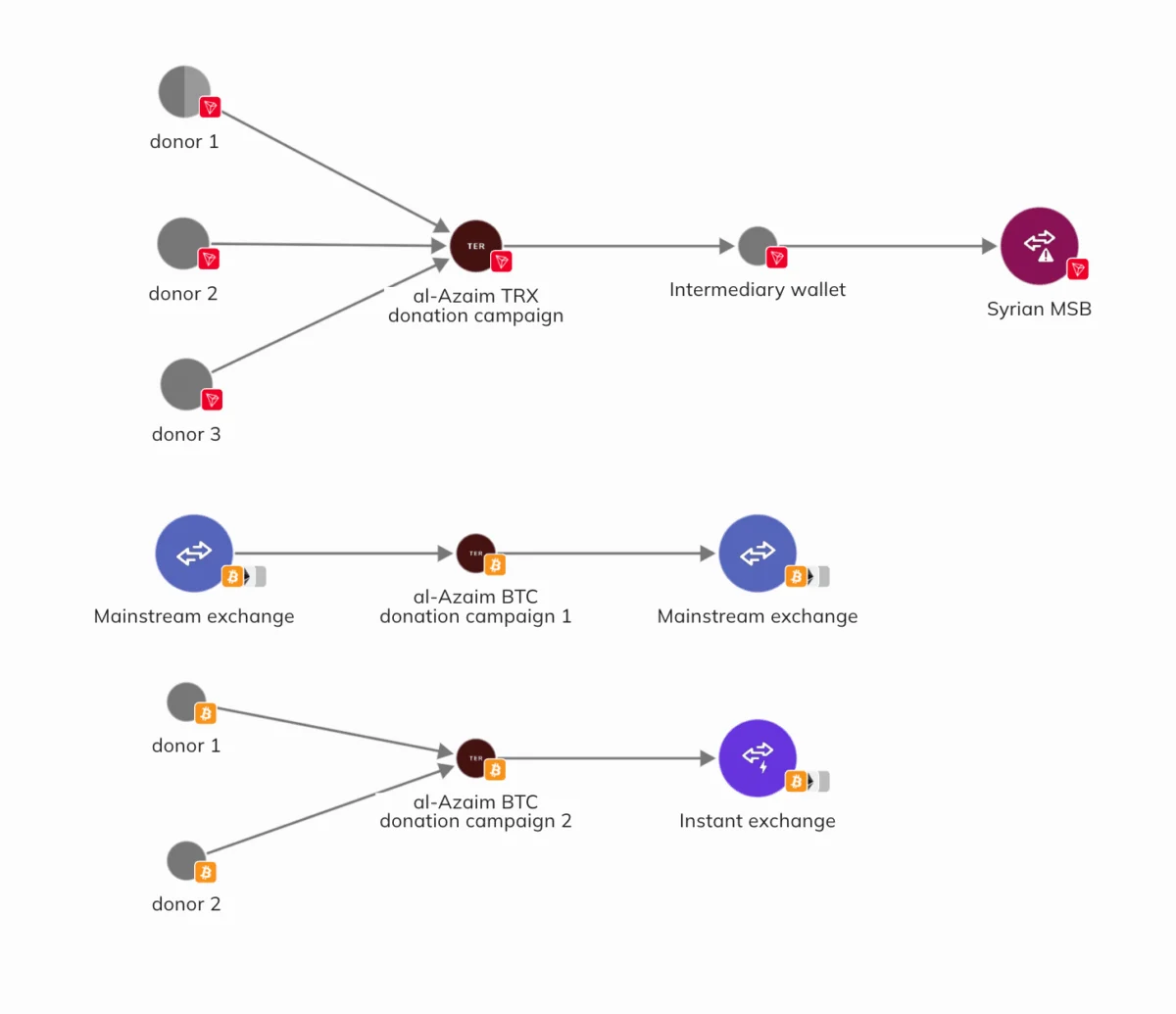
According to data provided by Chainalysis, the al-Azaim Media Foundation has utilized a variety of blockchains, including Bitcoin, TRON, and the privacy-focused Monero, to collect donations. While individual contributions often appear modest—reflecting the limited means of grassroots supporters—the aggregate volume is substantial. Since 2023, the 131 TRON wallets identified in the latest OFAC update have received more than $1.4 million in digital assets and facilitated the transfer of over $880,000. These funds are often funneled through Syria-based cryptocurrency exchangers, which act as "cash-out" points or intermediary hubs for distributing funds to operatives in the field.
Technical Analysis: Why TRON and Monero?
The Treasury’s specific targeting of TRON and Monero addresses highlights a strategic shift in how illicit actors utilize blockchain technology. The TRON network has increasingly become a preferred medium for illicit finance, particularly for groups operating in the Middle East and Central Asia. The reasons for this shift are twofold: low transaction fees and high liquidity for stablecoins like USDT. Unlike the Bitcoin network, where transaction fees can fluctuate significantly, TRON offers a cost-effective environment for moving large volumes of small-to-mid-sized donations.

Furthermore, the inclusion of Monero (XMR) addresses reflects the group’s attempt to evade the transparency of public ledgers. Monero is a privacy coin that utilizes "ring signatures" and "stealth addresses" to obfuscate the sender, receiver, and amount of every transaction. While Monero remains a challenge for investigators, the designation of these specific addresses by OFAC serves as a "poison pill," making it illegal for any U.S. person or entity—including exchanges—to interact with them, thereby degrading the group’s ability to convert these assets into fiat currency.
Chronology of U.S. Actions Against ISIS Financial Networks
The July 2026 sanctions are part of a broader, multi-year campaign by the U.S. government to dismantle the financial architecture of the Islamic State. This effort has evolved from targeting physical oil refineries and cash stockpiles in Iraq and Syria to monitoring complex digital transactions.
In 2023, OFAC sanctioned Ali Shafiu, a Maldives-based operative for ISIS-K. Investigation into Shafiu’s financial activities revealed that his TRON wallets were interacting with exchange deposit addresses linked to Iranian cryptocurrency exchanges, demonstrating the cross-border complexity of these networks. More recently, in June 2026, the Treasury targeted a network of Syrian money service businesses (MSBs). This network, led by Miloud Abderrahmane, was found to be shuttling money from mainstream global exchanges to donation campaigns in the Middle East, serving as a vital bridge between the legitimate financial system and terrorist treasuries.
The July 1 update represents the most comprehensive addition of cryptocurrency identifiers to the ISIS-K file to date, signaling that the U.S. government is now capable of tracking these assets with a high degree of precision despite the group’s attempts at obfuscation.
Targeting the Primeiro Comando da Capital (PCC)
In a concurrent but separate action, OFAC also targeted the financial operations of the Primeiro Comando da Capital (PCC), Brazil’s most powerful organized crime syndicate. The PCC, which originated in the São Paulo prison system in the 1990s, has grown into a multi-national criminal enterprise with a near-monopoly on drug trafficking routes in South America and significant operations in Europe and the United States.
The July 2026 action designated two Brazilian nationals, Victor Henrique de Oliveira Shimada and Stella Stefanie Nunes Henrique de Oliveira, along with four corporate entities: Victory Trading, Pixwave, and Wave (based in Brazil), and Avenidas Flutuantes (based in Portugal). According to the Treasury, this specific network was responsible for laundering more than $30 million in illicit proceeds generated from drug trafficking activities in several U.S. cities.
The PCC network utilized cryptocurrency to move these funds back to Brazil, bypassing traditional banking safeguards. By using a series of shell companies and digital asset intermediaries, the group attempted to "clean" the money before integrating it into the legitimate Brazilian economy. This marks the third major OFAC action against the PCC in recent years, following the 2021 designation of the group as a whole and the 2024 sanctioning of Diego Macedo Gonçalves do Carmo, another key figure in the group’s laundering operations.

Implications for Global Cryptocurrency Compliance
The designation of 134 new wallets has immediate and far-reaching implications for Virtual Asset Service Providers (VASPs), including exchanges, wallet providers, and payment processors. Under U.S. law, all "U.S. persons"—a term that includes U.S. citizens, permanent residents, and entities organized under U.S. law—are prohibited from engaging in any transactions with the designated addresses. Furthermore, any assets belonging to these entities that are within U.S. jurisdiction must be blocked and reported to OFAC.
For global financial institutions, the stakes are even higher due to "secondary sanctions" risks. Foreign financial institutions that knowingly facilitate significant transactions for designated terrorist groups or criminal syndicates risk losing their access to the U.S. financial system. This "death penalty" for banks ensures that even non-U.S. entities have a powerful incentive to implement rigorous blockchain monitoring and KYC (Know Your Customer) protocols.
Industry leaders, such as Chainalysis, have already integrated these new designations into their transaction monitoring suites. This allows compliance officers to flag any incoming or outgoing transfers associated with the 134 addresses in real-time. The rapid response from Tether to freeze the TRX addresses further illustrates a growing trend of cooperation between private-sector stablecoin issuers and federal law enforcement.
Fact-Based Analysis of Broader Impacts
The July 1, 2026, sanctions update highlights several critical trends in international security and finance. First, it demonstrates that the "anonymity" of cryptocurrency is increasingly a myth for major illicit actors. The ability of OFAC to identify 131 specific TRON wallets suggests that federal investigators, aided by private-sector analytics, have achieved deep visibility into the TRON blockchain, which was previously perceived by some as a safer haven for illicit transfers than Bitcoin.
Second, the dual focus on ISIS-K and the PCC shows that the Treasury Department is viewing "illicit finance" as a unified front. Whether the motive is religious extremism or organized greed, the mechanisms for moving money—stablecoins, privacy coins, and offshore exchanges—remain remarkably similar. By attacking these shared financial "choke points," the U.S. government is attempting to raise the cost of doing business for all criminal enterprises.
Finally, the action signals a new era of proactive enforcement. Rather than waiting for a major terror attack to occur, authorities are using financial data to map out networks and neutralize their funding before those resources can be converted into weapons or operational logistics. While groups like ISIS-K will undoubtedly continue to seek new ways to circumvent these barriers—likely leaning further into decentralized exchanges (DEXs) or more obscure privacy technologies—the July 2026 designations represent a significant tactical victory for global counter-terrorism and anti-money laundering efforts.
As the digital asset landscape continues to evolve, the U.S. Treasury’s Office of Foreign Assets Control remains the primary architect of the financial "noose" tightening around those who seek to use technology to fund violence and instability. The 134 wallets added today are not just strings of alphanumeric characters; they are recognized by the international community as the digital footprints of global threats, and their neutralization is a cornerstone of modern national security.














