


On July 1, 2026, the United States Department of the Treasury’s Office of Foreign Assets Control (OFAC) announced a significant expansion of its sanctions regime against the Islamic State’s Pakistani and Afghan affiliate, ISIL-Khorasan (ISIS-K). In a move designed to sever the group’s digital financial lifelines, OFAC updated its existing designation of the terrorist organization to include 134 specific cryptocurrency wallets as identified identifiers. This latest enforcement action underscores the increasing sophistication of terrorist financing and the proactive measures being taken by the U.S. government to mitigate the risks posed by decentralized finance and virtual assets.
The update includes a diverse array of digital assets, specifically targeting 131 TRON (TRX) addresses and three Monero (XMR) addresses. In a swift response to the government’s findings, Tether, the issuer of the world’s largest stablecoin (USDT), moved to freeze the balances on all 131 TRON-based addresses, effectively neutralizing hundreds of thousands of dollars in potential operational funds. This collaborative effort between the public sector and private industry highlights a growing trend in the battle against illicit finance: the utilization of blockchain transparency to cripple the logistics of global terrorism.
The Rise of ISIS-K and the Evolution of Terrorist Financing
ISIS-K, the regional branch of the Islamic State active throughout Afghanistan, Pakistan, and several former Soviet Union countries in Central Asia, has emerged as one of the most lethal iterations of the ISIL network. First designated as a Specially Designated Terrorist Group in September 2015, the group’s origins trace back to disaffected members of the Pakistani Taliban and Afghan Taliban who sought a more globalist and radical jihadist agenda.
Over the last decade, ISIS-K has been responsible for a string of devastating attacks. These include the 2021 bombing at Kabul International Airport during the U.S. withdrawal from Afghanistan and the 2024 attack on the Crocus City Hall in Moscow. To fund these operations, the group has increasingly relied on its media arm, the al-Azaim Media Foundation. Through its flagship publication, Voice of Khorasan, the group has conducted sophisticated crowdfunding campaigns. These campaigns solicit donations from a global audience, often framing the contributions as "zakat" or charitable giving, while funneling the proceeds into the procurement of weaponry, propaganda production, and the maintenance of sleeper cells.
Historically, ISIS-K utilized traditional hawala systems and physical cash transfers. However, as global anti-money laundering (AML) and countering the financing of terrorism (CFT) standards tightened, the group pivoted toward cryptocurrencies. Analysis by blockchain intelligence firms like Chainalysis has revealed a long-standing pattern of ISIS-K utilizing Bitcoin, TRON, and privacy-centric coins like Monero to bypass the traditional banking system.
Detailed On-Chain Analysis: The TRON and Monero Networks
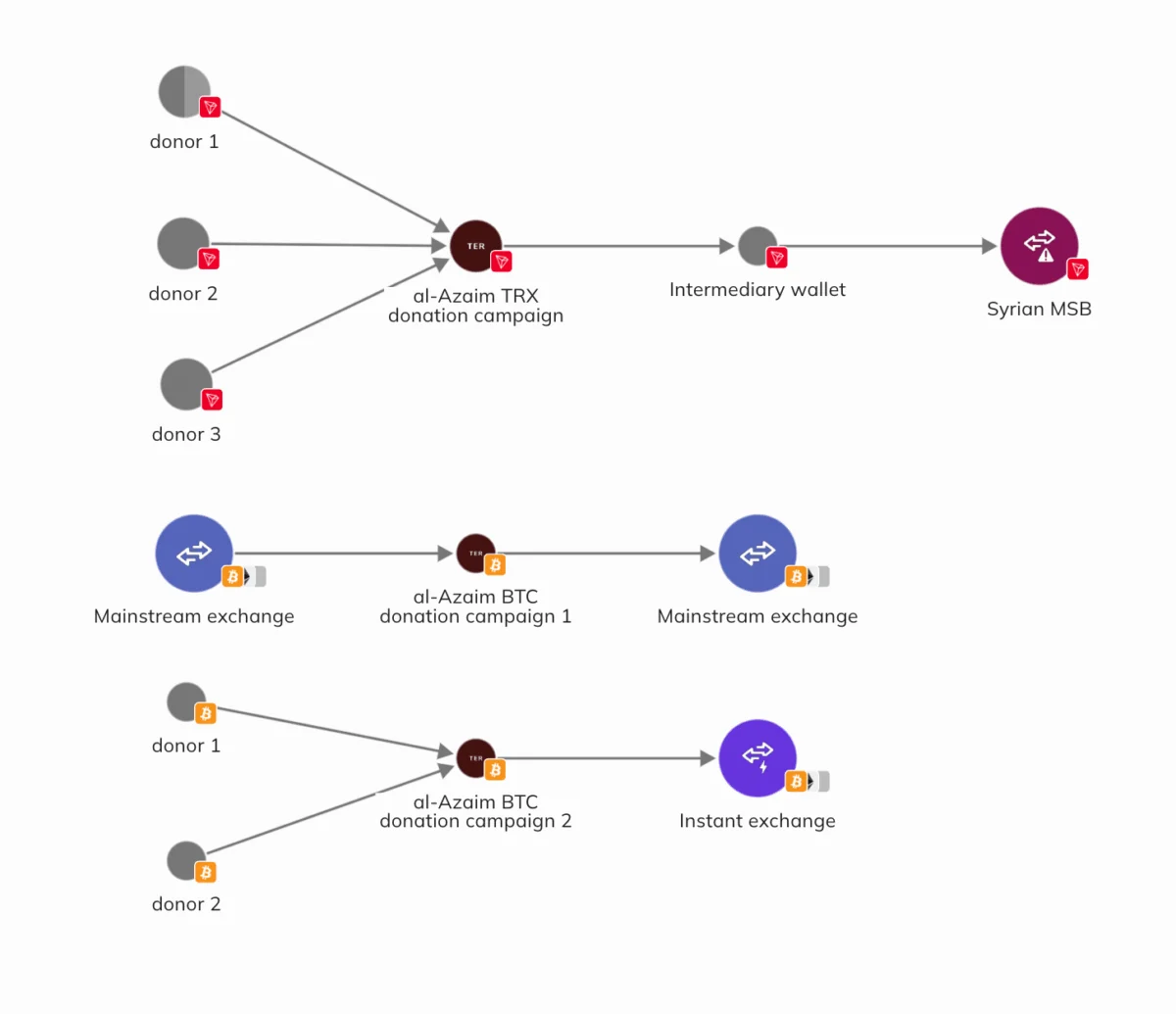
The July 2026 sanctions focus heavily on the TRON network, a blockchain that has become a preferred medium for illicit actors due to its low transaction fees and high liquidity of the Tether (USDT) stablecoin. According to data provided by on-chain investigators, the 131 TRX addresses designated by OFAC have received more than $1.4 million since early 2023. During that same period, the group successfully moved over $880,000 through these wallets to various intermediaries and service providers.

The flow of funds reveals a complex web of transactions. Many of the designated wallets showed heavy exposure to mainstream, high-volume cryptocurrency exchanges, suggesting that the group attempted to "off-ramp" digital assets into local fiat currencies or move them through legitimate financial gateways to obscure their origin. Furthermore, several of these wallets were linked to Syria-based cryptocurrency exchangers, which have long served as financial hubs for ISIS operatives in the Levant and beyond.
In addition to the TRON addresses, the inclusion of three Monero (XMR) addresses highlights the group’s pursuit of anonymity. Unlike Bitcoin or TRON, which operate on public ledgers where transaction amounts and addresses are visible, Monero utilizes privacy-enhancing technologies like ring signatures and stealth addresses to hide the details of every transaction. While the volume of Monero transactions is often lower due to the complexity of the network, its use by ISIS-K signifies a deliberate attempt to evade the surveillance capabilities of Western intelligence agencies and blockchain analytics firms.
Strategic Interventions: Tether and the Role of Private Industry
One of the most impactful outcomes of the July 1 action was the immediate intervention by Tether. Because the USDT token on the TRON network is a centralized asset, Tether maintains the ability to "blacklist" or freeze specific addresses upon receiving a lawful request from law enforcement or identifying sanctioned entities. By freezing the 131 TRON addresses, Tether prevented the group from accessing their liquidity, effectively rendering the digital tokens useless within the ecosystem.
This move marks a significant milestone in the cooperation between virtual asset service providers (VASPs) and regulatory bodies. For years, critics argued that cryptocurrency would provide a permanent "dark channel" for terror finance. However, the centralization of major stablecoins and the transparency of the TRON and Bitcoin blockchains have turned these tools into double-edged swords for terrorist organizations. Every transaction leaves a digital footprint that, once identified, can lead to the total collapse of a financial network.
The Brazil Connection: Dismantling the PCC Syndicate
In a parallel but distinct enforcement action on the same day, OFAC targeted a massive money laundering network in South America. The agency designated two Brazilian nationals, Victor Henrique de Oliveira Shimada and Stella Stefanie Nunes Henrique de Oliveira, along with four associated companies: Victory Trading, Pixwave, and Wave (based in Brazil), and Avenidas Flutuantes (based in Portugal).
These individuals and entities are allegedly linked to the Primeiro Comando da Capital (PCC), one of the most powerful and organized criminal syndicates in Latin America. The PCC, which originated in the prison systems of São Paulo, has grown into a multi-national conglomerate involved in drug trafficking, human smuggling, and large-scale money laundering. According to OFAC, the Shimada network laundered more than $30 million in illicit proceeds generated from drug sales in various U.S. cities.
The PCC network utilized cryptocurrency as a primary vehicle for repatriating funds to Brazil. By converting cash from drug sales into digital assets, the group was able to bypass cross-border reporting requirements and traditional banking scrutiny. This marks OFAC’s third major action against the PCC since 2021, illustrating the U.S. government’s commitment to combating the convergence of organized crime and digital asset misuse.

Chronology of Sanctions and Financial Enforcement (2015–2026)
The July 2026 action is part of a broader, decade-long strategy to dismantle the financial infrastructure of ISIS and its affiliates. The following timeline outlines key milestones in this ongoing effort:
- September 2015: ISIS-K is officially designated as a Specially Designated Global Terrorist (SDGT) entity under Executive Order 13224.
- December 2021: The PCC is designated as a transnational criminal organization, setting the stage for targeted sanctions against its financial facilitators.
- Early 2023: Intelligence reports identify a surge in crypto-based donations to the al-Azaim Media Foundation, prompting increased monitoring of TRON and Bitcoin addresses.
- August 2023: OFAC sanctions Ali Shafiu, a Maldives-based ISIS-K operative. Chainalysis discovers Shafiu’s TRON wallets interacted with exchange addresses linked to Iranian financial networks.
- March 2024: Diego Macedo Gonçalves do Carmo is sanctioned for laundering millions on behalf of the PCC, highlighting the group’s reliance on digital assets.
- June 2026: A network of Syrian money service businesses is sanctioned for acting as a "cash-out" point for ISIS financiers, including Miloud Abderrahmane.
- July 1, 2026: The current action adds 134 wallets to the ISIS-K designation and targets the Shimada money laundering network in Brazil.
Implications for Global Compliance and Financial Institutions
The designation of these 134 wallets has immediate and far-reaching implications for the global financial sector. Under U.S. law, all property and interests in property of the designated individuals and entities that are in the United States or in the possession or control of U.S. persons must be blocked and reported to OFAC.
For cryptocurrency exchanges, wallet providers, and traditional financial institutions, these updates necessitate an immediate overhaul of their sanctions screening and transaction monitoring protocols. The "secondary sanctions" risk is particularly high; foreign financial institutions that knowingly facilitate significant transactions for ISIS-K or the PCC risk being cut off from the U.S. financial system entirely.
Industry experts suggest that this action will likely lead to:
- Enhanced KYC/AML for Stablecoin Users: Exchanges may implement stricter "Know Your Customer" (KYC) requirements for users transacting in USDT on the TRON network.
- Increased Scrutiny of High-Risk Jurisdictions: Financial flows involving Afghanistan, Pakistan, and parts of Central Asia will face unprecedented levels of "red-flag" monitoring.
- Pressure on Privacy Coins: The inclusion of Monero addresses in a high-profile ISIS-K designation may lead to further delistings of privacy coins from major global exchanges as they seek to avoid regulatory friction.
Conclusion: The Future of Digital Warfare
The U.S. Treasury’s latest action is a clear signal that the digital frontier is no longer a safe haven for terrorist organizations or criminal syndicates. By mapping the on-chain footprints of ISIS-K and the PCC, the U.S. government has demonstrated that while cryptocurrency offers speed and borderless reach, it also offers a permanent and traceable record of illicit activity.
As ISIS-K continues to seek new ways to fund its regional and global ambitions, the battle will likely move deeper into the realms of decentralized finance (DeFi) and unhosted wallets. However, with the precedent set by Tether’s asset freeze and the increasing sophistication of blockchain analytics, the financial "walls" are closing in on those who use technology to facilitate violence and instability. The July 1, 2026, sanctions are not merely an update to a list; they represent a fundamental shift in the strategy of modern economic warfare.














