


In a decisive move to disrupt the digital and physical financial arteries of the Islamic State of Iraq and Syria (ISIS), the United States Department of the Treasury’s Office of Foreign Assets Control (OFAC) announced comprehensive sanctions on June 22, 2026, targeting a sophisticated network of money facilitators. The enforcement action, which designates three individuals and six entities, exposes a complex web of financial infrastructure spanning Europe, the Middle East, and Africa. This network was instrumental in moving cryptocurrency and traditional funds to support ISIS operations, highlighting the group’s continued reliance on a hybrid of legacy financial systems and emerging blockchain technologies.
The Treasury’s latest action underscores the evolving nature of terrorist financing. While ISIS has lost its physical caliphate, its financial operatives remain active, utilizing Money Services Businesses (MSBs), traditional hawala networks, and virtual asset service providers (VASPs) to bypass international banking regulations. By identifying specific cryptocurrency addresses on the TRON blockchain, the U.S. government is signaling an increased capability to track and intercept illicit digital flows that were once thought to be anonymous.
The Architecture of Terrorist Financing: Key Individuals and Entities
The June 2026 designations focus on the logistical backbone of ISIS’s financial operations. At the center of the Syrian operations is Bitcoin Xchange, an MSB established in late 2020. Based in Syria, this entity was founded by Abdelhakim Boukich, a former Dutch national and a known extremist financial facilitator. According to OFAC, Boukich and Bitcoin Xchange served as a primary conduit for ISIS associates across the globe.
Investigations revealed that Bitcoin Xchange facilitated the transfer of funds originating from a diverse array of countries, including Norway, Belgium, the Netherlands, South Africa, and the United States. This international reach demonstrates that ISIS continues to draw financial support from sympathizers in Western and emerging economies alike. Boukich’s Dutch background likely provided him with the linguistic and cultural nuances necessary to navigate European financial circles before establishing his operations in the conflict zones of the Middle East.
In Turkey, the sanctions hit two major MSBs: Spider Gayrimenkul Ve Genel Ticaret Limited Sirketi (Spider) and Alkaram Danismanlik Gayrimenkul Ic Ve Dis Genel Ticaret Limited Sirketi (Alkaram). Both entities are owned or controlled by Mohamad Alhmidan, an individual with a long history of illicit activity who was previously designated by OFAC in March 2016. Spider originally operated as a hawala—a traditional, trust-based money transfer system—in Syria. Under Alhmidan’s direction, these companies were repurposed to funnel capital from ISIS-controlled territories to other regions, effectively laundering the proceeds of the group’s extortion and smuggling activities into the legitimate Turkish economy.
The Digital Frontier: TRON and the Role of Crypto-Facilitators
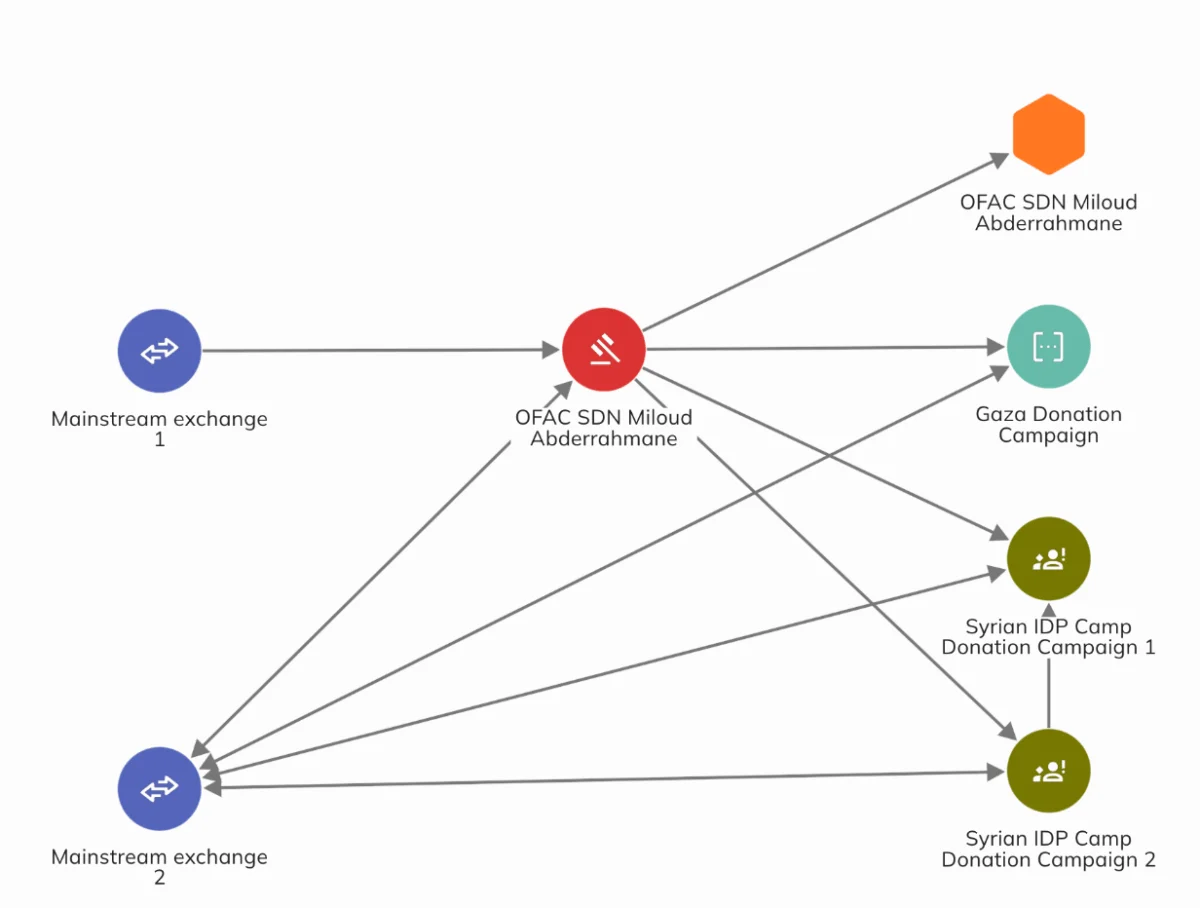
Perhaps the most significant aspect of the June 22 enforcement action is the naming of Miloud Abderrahmane, a French national. Abderrahmane is not merely a financial clerk; he is a dual-threat operative who provided technical instructions to ISIS supporters on the construction of explosives while simultaneously managing financial transactions for the group’s affiliates.
OFAC’s designation of Abderrahmane is notable for its inclusion of two specific TRON blockchain addresses. TRON has increasingly become a preferred network for illicit actors due to its low transaction fees and high throughput compared to Bitcoin or Ethereum. Blockchain analytics, specifically data provided by Chainalysis Reactor, shows a direct link between Abderrahmane’s digital wallets and donation campaigns based in Syria and Gaza. These transfers suggest a highly coordinated effort to redistribute wealth among various extremist factions, moving funds from European-based facilitators to active combat and logistics cells in the Levant.
The identification of these addresses provides a critical data point for global cryptocurrency exchanges. It forces these platforms to enhance their transaction monitoring systems to detect "downstream exposure"—where funds from a sanctioned wallet are mixed or hopped through multiple addresses to obscure their origin.
Expanding the Net: The African Connection
The U.S. Treasury’s action also sheds light on the growing financial influence of ISIS-West Africa (ISIS-WA). The sanctions include three Nigeria-based MSBs: Nine to Nine Exchange Bureau de Change Limited, Manhattan Bureau de Change Limited, and Generation Currency Bureau de Change Limited. All three are owned by Mukhtar Adamu Muhammad, a prominent ISIS-WA financial facilitator.
The inclusion of these Nigerian entities highlights the shift of ISIS’s operational focus toward the African continent. As the group faces pressure in Iraq and Syria, its provincial affiliates, particularly in West Africa and the Sahel, have become increasingly autonomous and well-funded. Muhammad’s network provided the necessary liquidity for ISIS-WA to purchase weaponry, pay fighters, and sustain its insurgency against regional governments. By targeting the bureau de change sector in Nigeria, the U.S. is aiming to choke off the group’s ability to convert illicit gains into local currency and vice versa.

A Chronology of Financial Enforcement
To understand the significance of these sanctions, one must view them within the broader timeline of the global fight against ISIS financing:
- March 2016: OFAC designates Mohamad Alhmidan for his role in supporting ISIS, marking him as a high-priority target in the Syrian financial landscape.
- Late 2020: Abdelhakim Boukich establishes Bitcoin Xchange in Syria, capitalizing on the rising popularity of cryptocurrency to create a new avenue for terrorist funding.
- 2021–2025: ISIS-WA intensifies its use of Nigerian bureau de change entities to launder ransom money and local "taxation" proceeds. During this period, Miloud Abderrahmane begins utilizing the TRON network to facilitate cross-border transfers.
- June 22, 2026: The U.S. Treasury issues the current designations, linking these disparate geographical cells into a single, cohesive enforcement action.
Global Impact and Compliance Implications
The implications of these sanctions for the global financial sector are profound. Under U.S. law, all property and interests in property of the designated individuals and entities that are in the United States or in the possession or control of U.S. persons must be blocked and reported to OFAC. However, the impact extends far beyond American borders.
For Virtual Asset Service Providers (VASPs) and traditional banks worldwide, this action triggers an immediate requirement to update sanctions screening protocols. Because these designations carry "secondary sanctions" risks, any foreign financial institution that knowingly facilitates a significant transaction for these sanctioned parties could itself be cut off from the U.S. financial system. This "financial death penalty" ensures that even banks in jurisdictions with laxer regulations are incentivized to comply with U.S. standards.
The focus on TRON addresses also highlights the necessity for robust blockchain forensics. Financial institutions can no longer rely solely on name-based screening; they must employ sophisticated tools to analyze the movement of digital assets in real-time. The ability to trace funds from a French national’s wallet to a Syrian donation campaign proves that the "pseudonymity" of the blockchain is an increasingly fragile shield for illicit actors.
Analysis: The Shifting Tactics of ISIS Finance
This enforcement action reveals several key trends in how ISIS maintains its financial viability. First, the group is leveraging "dual-use" facilitators—individuals like Abderrahmane who provide both tactical expertise (explosives) and financial services. This integration of logistics and finance makes the network more resilient and harder to dismantle.
Second, the reliance on Turkish and Nigerian MSBs indicates that ISIS continues to exploit regions with high volumes of informal trade and cash-based economies. These "hubs" allow the group to move large sums of money under the guise of legitimate business transactions, such as real estate (as seen with Spider and Alkaram) or currency exchange.
Finally, the move toward cryptocurrency is not an abandonment of traditional methods but an augmentation of them. The "Hawala-to-Crypto" bridge allows facilitators to move value across borders instantly via the blockchain and then "cash out" through traditional money changers in regions where digital assets are not yet widely accepted for everyday purchases.
Official Responses and Strategic Outlook
While the Treasury Department has been the primary driver of this action, the move is seen as part of a broader multilateral effort involving the Counter ISIS Finance Group (CIFG), which includes dozens of countries dedicated to disrupting the group’s economic lifeblood.
"Today’s action serves as a reminder that the United States remains vigilant in its mission to deny ISIS the resources it needs to carry out attacks," a Treasury spokesperson stated following the announcement. "By targeting these facilitators, we are not only disrupting their current operations but also sending a clear message to the global financial community: there is no corner of the world, and no digital platform, where terrorist financing will go undetected."
Industry experts suggest that while these sanctions are a significant blow, the battle is far from over. As the U.S. and its allies close off TRON and Bitcoin channels, facilitators are likely to explore privacy-centric coins or more obscure decentralized finance (DeFi) protocols. The June 22 designations represent a critical victory in an ongoing game of cat-and-mouse, requiring constant innovation from regulators and financial intelligence units to keep pace with the digital evolution of terror.
In conclusion, the U.S. Treasury’s designation of this global ISIS network marks a pivotal moment in counter-terrorism financing. By bridging the gap between traditional MSBs in Nigeria and Turkey and modern crypto-facilitators in France and Syria, OFAC has provided a comprehensive map of the group’s current financial strategy. For the global financial sector, the message is clear: the integration of blockchain analytics into standard compliance frameworks is no longer optional—it is a frontline necessity in the defense against global extremism.














