


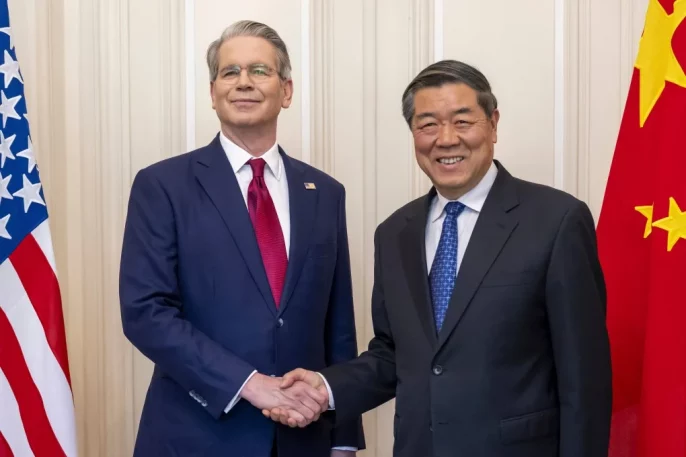
In a significant escalation of diplomatic and economic engagement between the world’s two largest economies, Chinese Vice Premier He Lifeng and United States Treasury Secretary Scott Bessent are scheduled to convene in Seoul, South Korea, for high-stakes trade negotiations on May 12 and 13. These discussions serve as a critical prelude to an upcoming state visit by President Donald Trump to Beijing, where he is slated to participate in a comprehensive summit with President Xi Jinping on May 14 and 15. The Seoul meetings represent a strategic effort to stabilize the bilateral economic relationship and establish a framework for the presidential-level dialogue that follows, marking a pivotal moment in global trade policy and geopolitical alignment.
High-Level Representation and the Seoul Framework
The choice of negotiators underscores the gravity with which both Beijing and Washington are approaching this round of talks. Vice Premier He Lifeng, who assumed his role in March 2023, is widely recognized as a central figure in China’s economic hierarchy. As a long-standing confidant of President Xi Jinping and a former head of the National Development and Reform Commission (NDRC), He Lifeng wields significant influence over China’s industrial policy, infrastructure investment, and macroeconomic strategy. His presence in Seoul signals that the Chinese leadership is prepared to engage on substantive structural issues rather than merely ceremonial platitudes.
On the American side, Treasury Secretary Scott Bessent brings a background steeped in global finance and investment strategy. His arrival in Seoul follows a series of high-level meetings in Tokyo with the Japanese Prime Minister and Finance Minister, suggesting a coordinated effort to align economic priorities with key Asian allies before engaging directly with Chinese counterparts. The Seoul discussions are intended to build upon the "Busan Consensus," a preliminary agreement reached during the recent Busan summit, which aimed to establish "guardrails" for economic competition while identifying areas of potential cooperation in global financial stability.
A Chronology of Diplomatic Engagement
The trajectory leading to the Seoul negotiations and the subsequent Beijing summit has been characterized by a series of incremental steps designed to de-escalate trade tensions that have persisted for several years.
- March 2023: He Lifeng is appointed Vice Premier, consolidating his role as China’s primary economic interlocutor with the West.
- Late 2023 – Early 2024: Preliminary "working group" meetings take place in Washington and Beijing, focusing on technical aspects of financial regulation and anti-money laundering efforts.
- The Busan Summit: Leaders and finance ministers meet in Busan, South Korea, reaching a tentative consensus on the need for predictable trade environments and the avoidance of "de-coupling" in favor of "de-risking."
- Early May: Secretary Bessent conducts a diplomatic circuit in Tokyo, reinforcing the U.S.-Japan economic alliance and discussing currency stability.
- May 12-13: The Seoul Negotiations. He Lifeng and Bessent meet to finalize the agenda for the presidential summit.
- May 14-15: President Trump arrives in Beijing for a state visit and a direct summit with President Xi Jinping.
This timeline illustrates a deliberate "bottom-up" approach to diplomacy, where technical experts and cabinet-level officials resolve smaller disputes to clear the path for major breakthroughs at the executive level.
Core Economic Priorities and the Trade Agenda
The agenda for the Seoul talks is expected to be broad, covering the most contentious aspects of the U.S.-China economic relationship. Central to the discussions will be the persistent trade deficit and the implementation of tariffs. The U.S. delegation is likely to press for increased market access for American firms, particularly in the financial services and agricultural sectors, while raising concerns over China’s state-led industrial subsidies in "new three" industries: electric vehicles (EVs), lithium-ion batteries, and solar products.
Conversely, the Chinese delegation is expected to seek clarity on U.S. export controls, particularly those targeting advanced semiconductors and artificial intelligence technology. Beijing has frequently characterized these restrictions as "discriminatory" and an impediment to global technological progress. The negotiations in Seoul will attempt to find a middle ground—perhaps through the establishment of "transparency mechanisms" or "fast-track" approvals for non-sensitive commercial technologies.
Notably, the discussions are expected to remain focused on traditional economic metrics:
- Currency Stability: Ensuring that the Renminbi (RMB) and the U.S. Dollar (USD) remain stable to prevent competitive devaluations.
- Debt Management: Addressing the debt distress in emerging markets where both nations hold significant interests.
- Supply Chain Resilience: Negotiating the flow of critical minerals and essential components to prevent global manufacturing bottlenecks.
Despite the rapid evolution of the digital economy, official sources have confirmed that the Seoul agenda does not include discussions on digital currencies, blockchain regulation, or cryptocurrency-adjacent assets. This omission is consistent with the priorities of both administrations, which currently view these issues as domestic regulatory matters rather than central pillars of bilateral trade diplomacy.
The Stance on Digital Assets and Crypto Regulation
The exclusion of cryptocurrency from the Seoul negotiations is a reflection of the entrenched positions held by both nations’ economic leaders. Vice Premier He Lifeng’s track record is one of strict adherence to centralized financial control. Under his influence and the broader direction of the Xi administration, China implemented a comprehensive ban on cryptocurrency trading and mining in 2021. This move was driven by concerns over capital flight, financial instability, and the environmental impact of energy-intensive mining operations.
From Beijing’s perspective, the focus remains on the development of the Digital Yuan (e-CNY), a central bank digital currency (CBDC) that allows for state-monitored transactions. There is no indication that the Chinese delegation has any appetite to revisit the 2021 ban or to discuss international standards for decentralized finance (DeFi).
Secretary Bessent, while coming from a private sector background where digital assets are more widely integrated, is tasked with representing an administration focused on "America First" economic policies and the primacy of the U.S. dollar. While the U.S. regulatory environment for crypto is more permissive than China’s, it remains a secondary priority in the context of multi-billion dollar trade imbalances and national security concerns regarding high-tech manufacturing.
Analysis of Implications for Global Markets
The Seoul negotiations carry immense weight for international investors and market analysts. The fact that both nations have dispatched their top economic officials suggests that there is "pre-negotiated groundwork" already in place. In diplomatic parlance, this typically means that the two sides have already agreed on the broad strokes of a deal and are meeting to iron out the final details before the heads of state provide their formal endorsement.
1. Market Volatility and Sentiment:
The successful conclusion of the Seoul talks could lead to a significant "thaw" in market sentiment. Global equities, particularly those with heavy exposure to Chinese manufacturing or American consumer demand, may see a reduction in the "geopolitical risk premium" that has weighed on valuations.
2. Supply Chain Reconfiguration:
Investors will be watching for any signals regarding the easing of trade barriers. If He Lifeng and Bessent can agree on a framework for "fair competition" in the green energy sector, it could stabilize the global supply chain for EVs and renewable energy components, which has been fractured by recent tariff hikes.
3. Regional Stability:
The choice of Seoul as a venue highlights the importance of South Korea as a strategic bridge. As a major economy that maintains deep ties with both the U.S. and China, South Korea stands to benefit significantly from a reduction in trade friction. Similarly, Bessent’s preliminary stop in Tokyo suggests that the U.S. is seeking to ensure that any deal with China does not come at the expense of its key regional allies.
Statements and Anticipated Reactions
While official communiqués are rarely released before the conclusion of such meetings, the anticipated rhetoric from both sides is expected to emphasize "pragmatism" and "mutual respect."
A spokesperson for the Chinese Ministry of Foreign Affairs recently noted that "economic and trade cooperation is the ballast of the China-U.S. relationship," echoing a sentiment often shared by He Lifeng. On the U.S. side, Treasury officials have emphasized that Secretary Bessent is focused on "protecting American workers and ensuring a level playing field."
Regional analysts suggest that the Seoul talks are as much about "optics" as they are about "outcomes." By holding these meetings in a third-party democratic nation, both sides demonstrate a willingness to engage in a transparent, multilateral context, even as they prepare for a more intense bilateral summit in Beijing.
Looking Ahead to the Beijing Summit
The May 12-13 negotiations in Seoul are the final hurdle before President Trump’s arrival in Beijing. The success of the He-Bessent talks will likely dictate the tone of the Trump-Xi summit. If the negotiators can reach an agreement on specific trade targets or a roadmap for tariff reduction, the Beijing summit could result in the signing of a "Phase Two" trade deal or a similar high-level memorandum of understanding.
However, should the Seoul talks stall over issues such as technology transfers or industrial subsidies, the Beijing summit may shift from a "celebration of progress" to a "crisis management" session. Given the seniority of the negotiators involved—particularly He Lifeng’s status as a top-tier policymaker—the probability of a productive outcome remains high. Both nations currently face domestic economic pressures—China with its property sector challenges and the U.S. with its focus on maintaining growth and controlling inflation—that provide a strong incentive for a period of relative trade stability.
As the international community turns its attention to Seoul, the outcome of these two days of intensive dialogue will provide the most definitive signal yet of the future direction of the world’s most consequential economic relationship. The "Seoul Framework" may well become the blueprint for U.S.-China relations for the remainder of the decade, defining the boundaries of competition and the possibilities for cooperation in an increasingly complex global economy.














