



The global cryptocurrency market is currently navigating a pivotal transition as Bitcoin, the industry’s primary benchmark, demonstrates signs of structural exhaustion after a period of intense dominance. Market analysts, including the prominent observer Justcryptopays, have identified a significant technical shift: Bitcoin has recently broken below a critical multi-month trendline, a move that historically precedes a redistribution of liquidity across the broader digital asset ecosystem. This development has ignited discussions among institutional and retail investors regarding the onset of "Alt-Season," a market phase characterized by altcoins—cryptocurrencies other than Bitcoin—outperforming the market leader in terms of percentage gains and trading volume.
The Technical Catalyst: Bitcoin’s Trendline Breach
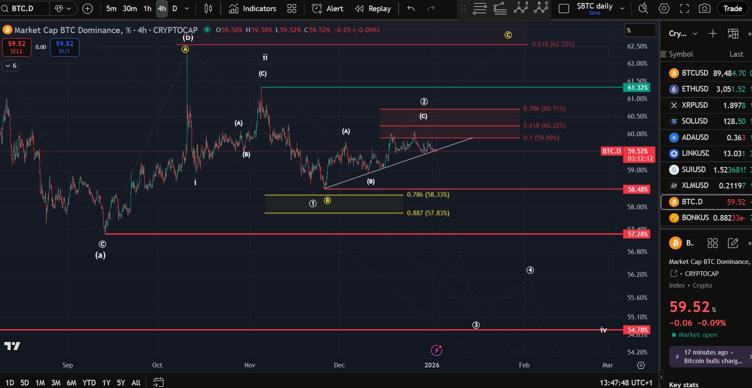
For much of the preceding cycle, Bitcoin has served as the primary vehicle for capital entry into the crypto space. However, the recent technical breakdown suggests that the momentum which propelled Bitcoin toward the six-figure territory is cooling. According to technical analysis, the breach of a primary ascending trendline often signals a transition from a trending market to a consolidatory or corrective phase. When Bitcoin enters a period of sideways movement or "range-bound" trading, the "dominance" metric—which measures Bitcoin’s share of the total crypto market capitalization—typically begins to erode.
As of early 2026, Bitcoin has struggled to maintain its footing above the psychological $90,000 threshold. While it was recently observed trading at approximately $90,525, the inability to decisively clear and hold higher resistance levels has led to a cautious sentiment among day traders and swing investors. This stagnation in the flagship asset often creates a "liquidity vacuum" that is filled by high-utility or high-speculation altcoins. The current market structure suggests that capital is not necessarily exiting the crypto ecosystem entirely; rather, it is rotating into assets with lower market caps that offer higher potential for short-term ROI.
The Chronology of Market Cycles: From Bitcoin to Altcoins
To understand the current shift, one must examine the historical chronology of cryptocurrency bull markets. Traditionally, these cycles follow a four-stage progression. First, Bitcoin leads the charge as institutional "smart money" enters the space, seeking a store of value. Second, Ethereum begins to outperform as investors look for "beta" exposure to the market leader. Third, large-cap assets such as Solana, XRP, and Cardano see massive inflows as the "wealth effect" from Bitcoin gains trickles down. Finally, the cycle concludes with a surge in small-cap tokens and memecoins, driven by retail euphoria.
The transition observed in early 2026 follows a challenging 2025, which was marked by significant bearish pressure and regulatory scrutiny. The "bearish momentum of 2025" saw many altcoins lose 70% to 90% of their value against Bitcoin. However, the start of the new year has seen a divergence. While Bitcoin’s growth has slowed, the "Altcoin Season Index"—a metric that tracks the performance of the top 50 altcoins against Bitcoin over a 90-day period—has begun to climb from its historical lows. This shift indicates that the market is entering the second and third stages of the capital rotation cycle.

Key Players in the Emerging Rally: Ethereum, Solana, and Beyond
As capital rotates, several key assets are positioned to lead the charge. Ethereum (ETH), the largest altcoin by market cap, remains the primary beneficiary of Bitcoin’s consolidation. With the continued maturation of Layer-2 scaling solutions and the integration of institutional-grade staking products, Ethereum is viewed by many as the "index fund" for the decentralized economy. A move by Ethereum to reclaim its historical ratio against Bitcoin is often the strongest signal that an altcoin rally is in full swing.
Solana (SOL) has also emerged as a formidable contender for market leadership. Known for its high throughput and low transaction costs, Solana has become the preferred hub for retail-driven activities, including decentralized exchange (DEX) trading and the creation of memecoins. The "Solana ecosystem" often moves independently of Bitcoin, driven by its own internal liquidity and developer activity.
Furthermore, legacy assets like XRP and Cardano (ADA) are seeing renewed interest. XRP’s performance is frequently tied to developments in the legal and regulatory landscape regarding cross-border payments, while Cardano’s community remains focused on long-term governance and academic-led upgrades. Even the memecoin sector, led by assets like Dogecoin and Pepe, is seeing a resurgence in trading volume, reflecting a return of retail risk appetite that was largely absent during the 2025 downturn.
Supporting Data: On-Chain Metrics and Exchange Flows
Data from Binance Research and other on-chain analytics platforms provide a quantitative foundation for the "Alt-Season" hypothesis. Recent reports indicate a decrease in Bitcoin "exchange reserves," suggesting that long-term holders are moving their coins to cold storage, effectively reducing sell pressure. Simultaneously, there has been a notable increase in the "stablecoin supply ratio." When the supply of stablecoins like USDT and USDC on exchanges increases relative to the market cap of Bitcoin, it represents "dry powder" waiting to be deployed into the market.
Furthermore, the Decentralized Finance (DeFi) sector has seen a rebound in Total Value Locked (TVL). As of early 2026, TVL across major protocols has surpassed 2025 levels, indicating that users are putting their assets to work in yield-bearing activities rather than simply holding Bitcoin. This increase in on-chain activity is a prerequisite for a sustained altcoin rally, as it demonstrates actual utility and demand for the underlying networks.
Institutional Reactions and Market Sentiment
While retail investors often drive the volatility of altcoins, institutional sentiment is shifting toward a more diversified approach. Large-scale asset managers who entered the space via Bitcoin ETFs are now exploring "multi-asset" crypto funds. This institutional "rebalancing" acts as a tailwind for large-cap altcoins that possess sufficient liquidity and regulatory clarity.
Market analysts suggest that the $90,000 level for Bitcoin is more than just a number; it is a sentiment anchor. "The struggle to hold $90,000 suggests that the market is looking for a new narrative," noted one senior analyst from a leading digital asset firm. "We are seeing a transition from a ‘Bitcoin-only’ market to a ‘Crypto-economy’ market, where the underlying technology and use cases of different protocols are being valued more accurately."
Implications and Future Outlook
The potential for an altcoin resurgence carries significant implications for the broader financial landscape. A successful "Alt-Season" would validate the long-term viability of decentralized applications (dApps), Web3 infrastructure, and the tokenization of real-world assets (RWA). However, this phase is also characterized by increased volatility. Unlike Bitcoin, which has established itself as a relatively stable "digital gold," altcoins are subject to rapid price swings that can liquidate over-leveraged traders.
For investors, the current market dynamics demand a strategic approach. The shift toward a more "balanced market" means that correlation between assets may decrease, allowing for better portfolio diversification. However, the challenge remains in identifying which assets will lead the rally and which are merely experiencing a "dead cat bounce" from 2025 lows.
As 2026 progresses, the ability of altcoins to shake off the bearish sentiment of the previous year will depend on macroeconomic factors, including interest rate decisions by central banks and the global regulatory environment. If Bitcoin continues to stabilize around the $90,000 mark without significant breakdowns, the stage is set for a prolonged period of altcoin outperformance. Vigilant investors and traders are now closely monitoring the "BTC Dominance" chart and the "ETH/BTC" pair for the ultimate confirmation that the long-awaited Alt-Season has officially arrived.
In conclusion, the break below the Bitcoin trendline identified by Justcryptopays is more than a technical fluke; it is a signal of a maturing market. As capital rotates from the benchmark asset into the diverse world of altcoins, the cryptocurrency landscape is preparing for a new chapter of growth, innovation, and volatility. Whether this leads to a sustained bull market for the entire sector or a localized rally for specific ecosystems remains to be seen, but the indicators currently point toward a significant shift in market leadership.














