


XRP, the digital asset associated with Ripple Labs, has seen its funding rates on major derivatives platforms plummet to profoundly negative levels, signaling an entrenched bearish consensus among traders. This development unfolds against a backdrop of widespread weakness in the broader altcoin market, where a significant portion of digital assets are trading near their all-time lows. While XRP has managed to avoid that extreme fate, it has nevertheless suffered a substantial depreciation, losing approximately 70% of its value since reaching a peak of $2.45 in July 2025. Data from Binance, a leading cryptocurrency exchange, indicates that a growing number of traders are actively positioning for further price declines, with this pessimism extending across multiple market metrics.
Derivatives Data Unveils Profound Pessimism
The derivatives market, often considered a forward-looking indicator of market sentiment, currently reflects an overwhelming bearish outlook for XRP. Funding rates on platforms like Binance, which represent the cost of holding long or short positions in perpetual futures contracts, have consistently remained in deeply negative territory. When aggregated over a 30-day period to provide a clearer picture of sustained trader sentiment, these rates underscore an extreme level of pessimism. A negative funding rate signifies that short position holders are paying long position holders, indicating a higher demand for shorting the asset and a general expectation of price decline. Conversely, a positive funding rate means long holders pay shorts, reflecting bullish sentiment. The current sustained negativity points to a market dominated by sellers and those betting against XRP’s immediate recovery.
Market analyst Darkfost recently highlighted this intensifying bearish sentiment, noting that it has evolved into a clear consensus among derivatives traders. According to Darkfost’s analysis, XRP’s funding rates have exhibited a bearish bias consistently since the beginning of the current year. This multi-month trend is particularly significant, as it suggests that the skepticism surrounding XRP’s near-term price direction is not merely a transient phenomenon but a deeply ingrained market belief. The persistence of negative funding rates over such an extended period is often interpreted as a strong signal of conviction among short sellers, who are willing to pay a premium to maintain their positions, anticipating further downside.
Historically, periods of extreme negative funding rates, particularly those following steep price corrections, have occasionally preceded market reversals. Darkfost referenced April 2025 as a relevant precedent, when XRP experienced a significant drop to $1.25 before initiating a robust recovery. That particular rebound saw XRP stage an impressive 126% rally, illustrating how severely oversold conditions, coupled with extreme bearish sentiment, can sometimes create fertile ground for a swift price reversal, often driven by short squeezes as short sellers are forced to cover their positions. However, the current market environment, while sharing some superficial similarities with past bottoming phases, presents unique characteristics and macroeconomic factors that differentiate it from previous cycles. Traders and analysts are therefore monitoring the situation closely for any signs that the persistent selling pressure might be nearing exhaustion, which could potentially trigger a similar contrarian bounce.
Broader Altcoin Market Under Siege
XRP’s current struggles are not isolated but are part of a larger trend impacting the altcoin market. Data indicates that approximately 40% of altcoins are presently trading very close to their all-time lows, reflecting a broad-based capitulation across the sector. This widespread weakness can be attributed to several factors, including lingering macroeconomic uncertainties, persistent inflation concerns, and a general shift in investor preference towards lower-risk assets or established large-cap cryptocurrencies like Bitcoin and Ethereum. The prolonged "crypto winter" that began in late 2021 and extended through 2022 has given way to a period of consolidation and cautious sentiment, with speculative capital largely retreating from riskier, smaller-cap altcoins.

Even larger altcoins, including those with significant market capitalization and established ecosystems, have struggled to regain momentum. Many have seen substantial corrections from their bull market peaks, leading to reduced liquidity, diminished trading volumes, and a noticeable lack of fresh capital inflows. This environment makes it challenging for any single altcoin, including XRP, to defy the broader market gravitational pull. The narrative of institutional adoption, which once fueled much of the altcoin rally, has become more selective, with institutional funds primarily flowing into Bitcoin and, to a lesser extent, Ethereum, particularly through new investment vehicles like spot Exchange-Traded Funds (ETFs). The absence of similar, widely accessible institutional products for XRP, coupled with its unique regulatory challenges, further exacerbates its vulnerability in a weak market.
XRP’s Price Trajectory and Historical Context
XRP’s journey from its July 2025 peak of $2.45 to its current significantly lower valuation represents a substantial loss of capital for many investors. The 70% correction underscores the volatile nature of cryptocurrency markets and the specific challenges faced by XRP. This particular peak in July 2025 followed a period of renewed optimism, partly fueled by broader market recovery trends and intermittent positive developments related to its ongoing legal battle with the U.S. Securities and Exchange Commission (SEC). At that time, many analysts speculated on a potential sustained breakout, with some price targets even extending beyond previous all-time highs. However, this momentum proved unsustainable, and a combination of profit-taking, renewed market skepticism, and broader macro headwinds led to a steady decline.
The persistent legal dispute with the SEC, which commenced in December 2020, has cast a long shadow over XRP’s price performance and market perception. The SEC’s assertion that XRP constitutes an unregistered security has led to delistings from some U.S. exchanges, deterred institutional interest, and created significant regulatory uncertainty. While Ripple has achieved some partial legal victories, notably a ruling in July 2023 that XRP itself is not a security when sold to the public on exchanges, the overarching lawsuit regarding institutional sales and the programmatically sold XRP continues. This ongoing legal saga, with its potential for appeals and protracted litigation, continues to act as a significant overhang, preventing XRP from fully participating in broader market rallies or attracting substantial new investment. The uncertainty surrounding its regulatory classification in key markets remains a primary concern for both retail and institutional investors.
Underlying Market Metrics Paint a Cautious Picture
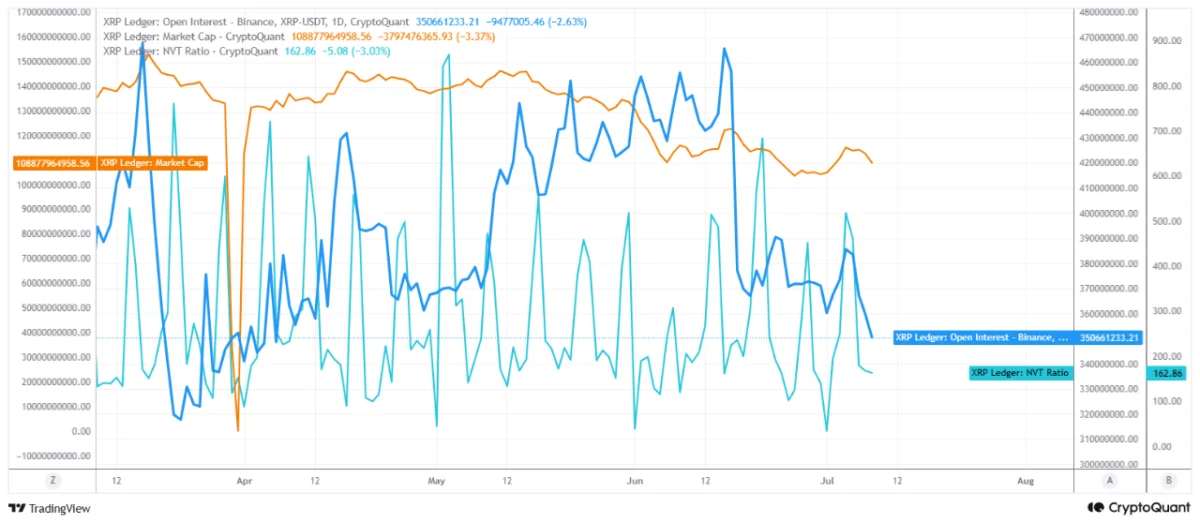
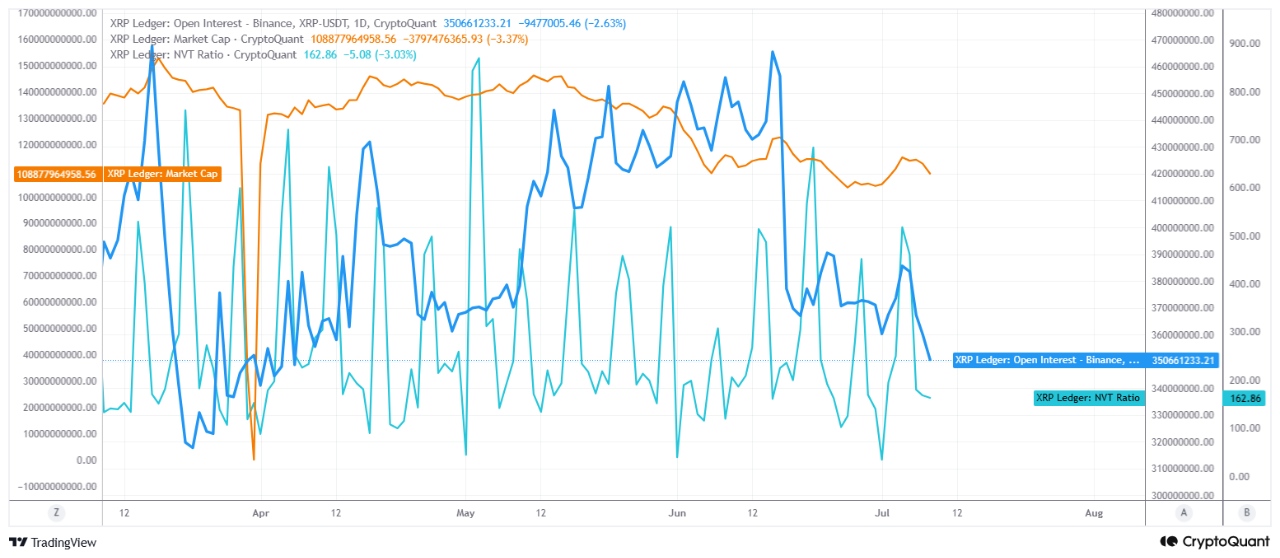
Beyond funding rates, other critical on-chain and derivatives metrics corroborate the cautious sentiment surrounding XRP. Open Interest (OI) in XRP futures has recently declined to $350.6 million, marking one of its lowest readings in recent months. Open Interest represents the total number of outstanding derivatives contracts that have not yet been settled. A decrease in OI, especially when coupled with a falling price, typically suggests that leveraged traders are actively closing out existing positions rather than initiating new ones. This trend indicates a reduction in speculative activity and a general withdrawal of risk capital from the XRP derivatives market, reflecting diminished confidence in future price movements. Low OI can also imply reduced liquidity in the futures market, potentially making the asset more susceptible to price swings if significant orders are placed.
Analyst Pelinay further observed that XRP’s market capitalization has also contracted significantly, reaching approximately $10.89 billion. Market capitalization, calculated by multiplying the current price by the total circulating supply, directly reflects the total value of an asset. A shrinking market cap, in conjunction with declining Open Interest, strongly suggests that capital is actively exiting the XRP ecosystem. This outflow is a clear indicator of reduced buying interest in the spot market and a preference among investors to allocate their funds elsewhere, either into more stable assets or out of the crypto market entirely. The combined effect of reduced leverage and shrinking market value signals a broad lack of demand at current price levels.
Another crucial metric, the Network Value to Transaction (NVT) ratio, remains elevated at 162.86. The NVT ratio compares an asset’s market capitalization (network value) to the total value of transactions processed on its underlying blockchain (transaction volume). A high NVT ratio, such as XRP’s current reading, typically implies that the asset’s valuation is growing faster than its actual on-chain utility or transaction volume. In simpler terms, it suggests that the market capitalization is not adequately supported by fundamental network activity. This "gap" between valuation and usage can be a bearish signal, indicating that the asset might be overvalued relative to its real-world adoption and utility. For XRP, which is designed for cross-border payments, a high NVT ratio suggests that while there might be speculative interest, the actual transactional throughput and adoption on the XRP Ledger have not kept pace with its market valuation, thus failing to provide a strong fundamental basis for a meaningful price recovery.
Analyst Perspectives and Potential Scenarios
The confluence of these indicators—extreme negative funding rates, declining Open Interest, a shrinking market cap, and an elevated NVT ratio—paints a picture of a market where risk appetite for XRP has substantially cooled. Futures positioning continues to shrink, while spot market capitalization contracts in parallel, suggesting a broad retreat of capital and speculative interest. Sellers appear to retain firm control of price action for now, consistently pushing the asset lower or preventing significant rebounds.
However, the historical precedent cited by Darkfost regarding past instances of extreme negative funding rates preceding sharp reversals introduces a nuanced perspective. While current market conditions differ, the concept of "oversold" markets eventually finding a bottom remains a fundamental principle of technical analysis. A scenario where deeply entrenched short positions become vulnerable to a sudden shift in sentiment, perhaps triggered by an unexpected positive development (e.g., a definitive resolution of the SEC lawsuit in Ripple’s favor, or a broader crypto market rally), could lead to a rapid short squeeze. In such an event, short sellers would be forced to buy back XRP to close their positions, exacerbating upward price pressure.
Conversely, without a significant catalyst, the prevailing bearish sentiment and weak demand could persist, leading to further consolidation or even continued downside. The lack of fresh buying interest, coupled with ongoing macroeconomic headwinds and the lingering regulatory uncertainty, suggests that any recovery might be gradual and heavily dependent on external factors. Institutional investors, who often drive significant market movements, are likely to remain on the sidelines until greater clarity emerges regarding XRP’s regulatory status and its potential for widespread enterprise adoption.
Conclusion: A Waiting Game Amidst Uncertainty
In summary, XRP finds itself at a critical juncture, caught between deeply entrenched bearish sentiment in the derivatives market and broader weakness across the altcoin sector. While its funding rates signal extreme pessimism, reminiscent of past pre-reversal phases, other metrics like Open Interest, market capitalization, and the NVT ratio point to a fundamental lack of demand and underlying network activity supporting its current valuation. The persistent shadow of the SEC lawsuit continues to weigh heavily on investor confidence, making any sustained recovery challenging without a clear resolution.
Traders and investors are currently engaged in a waiting game, closely monitoring key indicators for signs of exhaustion in selling pressure or the emergence of a definitive catalyst that could shift market dynamics. The path forward for XRP remains uncertain, heavily reliant on both internal developments within the Ripple ecosystem and broader external factors shaping the cryptocurrency landscape. For now, the consensus points towards continued caution, with sellers firmly in control, even as the possibility of a contrarian bounce from oversold conditions remains a speculative, albeit increasingly discussed, scenario.














