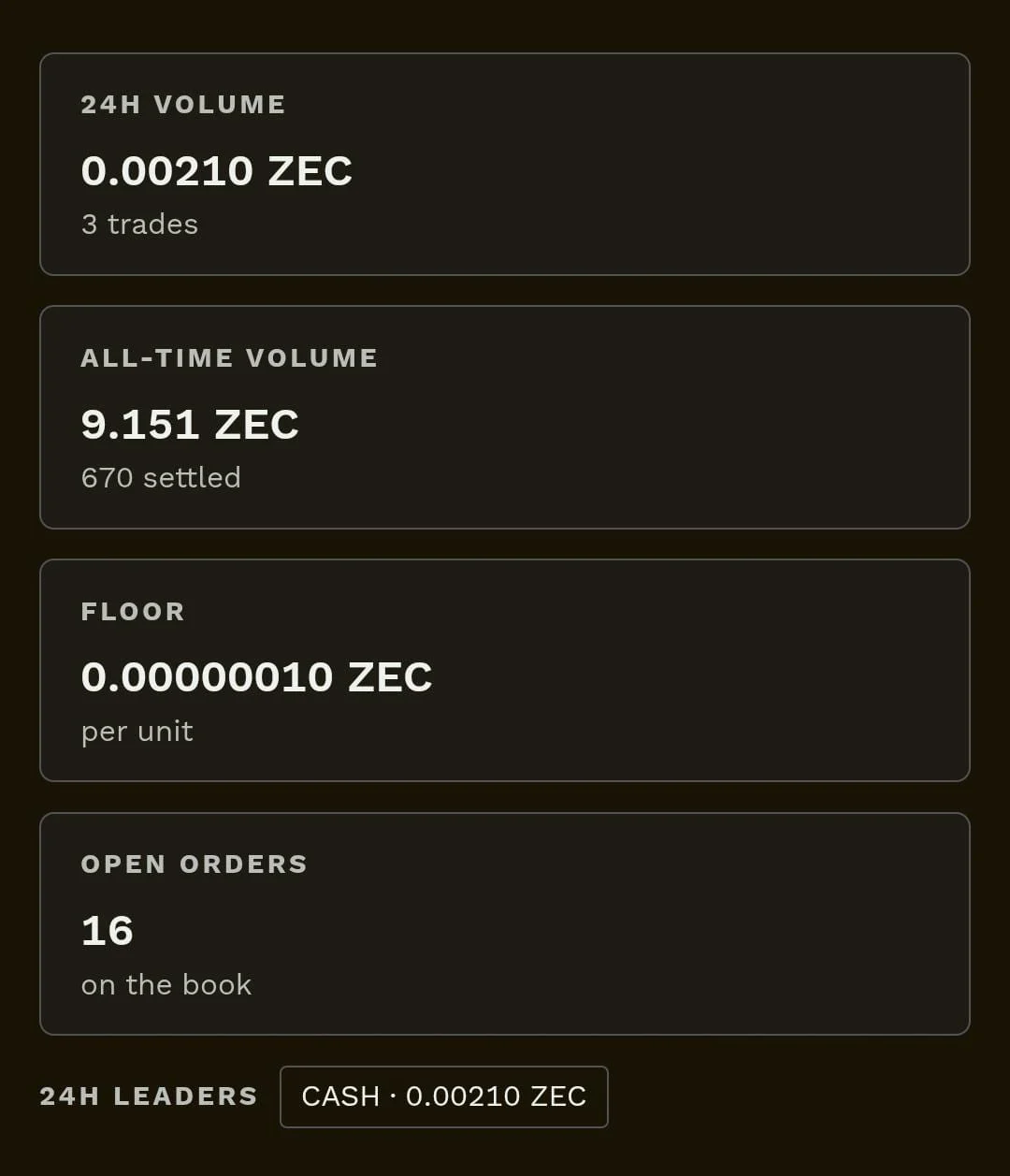
A decentralized marketplace designed to demonstrate the capabilities of Zcash’s shielded network for its own token economy has recently reopened, yet its initial 24 hours of renewed operation recorded a mere three trades. This starkly low level of activity, registering a cumulative volume of just 0.00210 ZEC, stands in significant contrast to the anticipation that often accompanies such platform re-launches in the cryptocurrency space. The discrepancy between the announcement of its return and the subsequent market engagement prompts a deeper examination into the ZRC-20 protocol, its unique privacy-focused design, and the challenges it faces in fostering a vibrant, trustless token economy on the Zcash blockchain.
Understanding ZRC-20: A Privacy-Centric Token Standard
ZRC-20 is a novel fungible token standard developed for the Zcash blockchain, drawing conceptual parallels to the BRC-20 standard pioneered on Bitcoin. Unlike traditional token standards that rely on smart contracts for state management, ZRC-20 operates by embedding simple JSON (JavaScript Object Notation) instructions—specifically ‘deploy,’ ‘mint,’ and ‘transfer’ commands—directly into Zcash transactions. Wallets and indexers then process and replay these instructions sequentially, in block order, to accurately determine token ownership and balances. This design eschews the need for a central custodian or a single, consolidated ledger, ensuring that every operation is verifiable on-chain by any participant, aligning with the core tenets of decentralization.
The defining characteristic that sets ZRC-20 apart from its Bitcoin counterpart, BRC-20, is its profound commitment to privacy. While BRC-20 inscribes data into Bitcoin’s Taproot witness, which becomes publicly visible upon confirmation, ZRC-20 utilizes the memo field within a Zcash shielded note. This memo field is inherently encrypted, rendering its contents readable only by those possessing the appropriate viewing key. This architectural choice is not merely a technical detail; it is a fundamental design decision that leverages Zcash’s foundational privacy features, aiming to extend the network’s renowned transactional anonymity to its token economy. This privacy-by-design approach has garnered attention beyond the immediate community of inscription token enthusiasts, appealing to those who prioritize confidentiality in their digital asset interactions.
The inaugural token launched under the ZRC-20 standard is ‘$CASH,’ which adheres to a strict supply cap of 21 million units. A significant portion, 90%, of this supply was distributed through a public, first-come, first-served minting process, where participants paid a nominal fee of 0.005 ZEC per mint transaction. The choice of 21 million as the maximum supply for $CASH is a deliberate echo of Zcash’s own maximum supply, a symbolic linkage that, while not explicitly elaborated upon by the project team regarding its deeper implications, clearly aims to draw a connection to Zcash’s scarcity and value proposition.
The Marketplace Mechanism: Trustless Atomic Swaps
One of the most innovative aspects of the ZRC-20 ecosystem is its marketplace design, engineered for trustless settlement. The core principle allows buyers and sellers to execute token transfers and ZEC payments simultaneously and atomically within a single Zcash transaction. This eliminates the need for an intermediary escrow account to hold funds or tokens during the exchange, a common feature in many centralized and even some decentralized exchanges. The entire process is auditable and verifiable on the Zcash explorer, reinforcing the marketplace’s value proposition: a truly peer-to-peer token trading environment devoid of custodial risks. To facilitate these trustless exchanges, the marketplace imposes a modest flat trading fee of 0.0003 ZEC, levied on top of the standard Zcash network transaction fee. This minimal cost suggests that transaction expenses are unlikely to be a significant deterrent to activity.
It is crucial to note the independent nature of the ZRC-20 project. The Zcash Foundation has publicly distanced itself from ZRC-20, issuing a clarification after earlier reports suggested a connection. In response, the ZRC-20 team acknowledged the Foundation’s statement, unequivocally affirming the project’s experimental status, its independence, and explicitly stating that it carries no inherent promise of value. This context is vital for understanding ZRC-20 not as an officially endorsed Zcash feature, but as a third-party experiment leveraging the Zcash infrastructure.
A Chronology of Development and Disclaimers

The journey of ZRC-20 began with its conceptualization and subsequent implementation, aiming to bring a new dimension of utility to the Zcash network. The initial launch saw the introduction of the $CASH token and its public minting phase, which, typical of "first-come, first-served" distribution models, generated an initial flurry of activity. Following the mint, the ZRC-20 marketplace was established, providing a platform for trading these newly minted tokens. However, the marketplace subsequently underwent a period of dormancy or maintenance, leading to its recent "reopening."
The Zcash Foundation’s public statement clarifying its non-affiliation was a notable event in the project’s timeline. This official distancing, while common for foundational entities in decentralized ecosystems, can sometimes temper speculative enthusiasm. The ZRC-20 team’s subsequent reaffirmation of the project’s experimental and independent status was a necessary step in managing community expectations, underscoring the high-risk, high-reward nature often associated with nascent blockchain innovations. The recent announcement on platforms like X (formerly Twitter) signaling the marketplace’s return to online operation was intended to reignite user engagement, setting the stage for the current observations of limited activity.
Dissecting the Current Market Data
The current state of the ZRC-20 marketplace, as observed immediately following its reopening, presents a clear picture of muted activity. According to the live dashboard on zrc20.io/marketplace, the 24-hour trading volume registered an anemic 0.00210 ZEC, distributed across just three distinct trades. This figure represents a dramatic deceleration when compared to the all-time statistics: a cumulative volume of 9.151 ZEC across 670 settled trades since the marketplace’s initial inception. The recent 24-hour window, therefore, signifies a substantial drop-off from the pace that contributed to the lifetime trading volume.
Further analysis of the marketplace’s order book and activity feed reinforces this narrative. The floor price for tokens currently sits at 0.00000010 ZEC per unit, indicating a very low valuation. There are 16 open orders awaiting fulfillment, suggesting that sellers are prepared to list their tokens, but a corresponding lack of buyers is evident. The 24-hour leaderboard exclusively features $CASH as the only active ticker, with its associated 0.00210 ZEC volume, confirming that all recent trading activity revolved around this single token.
A detailed review of the recent activity log on the marketplace dashboard reveals the extent of the quiet period. The three most recent trades, all involving $CASH, were timestamped approximately 21 hours prior to the observation. These transactions were notably small, ranging from 0.00010 ZEC to 0.00100 ZEC. Before these, the activity log jumps back abruptly to five days prior, where a batch of trades included a ‘NEAR’ ticker token alongside more $CASH activity. These older trades varied in size, from 0.00067 ZEC up to a substantial 347,000-unit $CASH trade valued at 0.21 ZEC. This conspicuous five-day gap in trading activity preceding the three recent transactions serves as the most compelling visual evidence of the thin trading volumes since the marketplace’s return.
Broader Context: The Inscription Token Phenomenon
The emergence of ZRC-20 is part of a larger trend in the cryptocurrency space, catalyzed by the success of the BRC-20 standard on Bitcoin. BRC-20, introduced in early 2023, allowed for the creation of fungible tokens on Bitcoin by inscribing data directly onto satoshis using the Ordinals protocol. This innovation unlocked new speculative and experimental use cases on a network traditionally viewed as a store of value, leading to a surge in network activity, transaction fees, and the proliferation of various "inscription" tokens.
The phenomenon quickly spread to other blockchain networks, with developers adapting similar inscription-based token standards to their respective ecosystems. These tokens often attract interest due to their novelty, the "fair launch" mechanisms (like first-come, first-served mints), and the potential for rapid speculative gains. However, they also carry inherent risks due to their experimental nature, lack of established utility, and reliance on community interest for value.
For Zcash, the adoption of an inscription token standard like ZRC-20 presents a unique proposition. Zcash is fundamentally built around privacy, offering both transparent and shielded transactions. While BRC-20 thrived on Bitcoin’s transparent ledger, ZRC-20’s choice to leverage Zcash’s shielded memo fields for privacy introduces a layer of complexity and a distinct value proposition. It attempts to merge the speculative allure of inscription tokens with Zcash’s core promise of confidentiality, aiming to demonstrate that a token economy can flourish even when its underlying data remains private. This ambitious goal, however, also introduces challenges, as market transparency (which can drive speculative interest) is inherently limited when transactions are shielded.

Analyzing the Implications of Low Engagement
The observation of only three trades within a 24-hour period following a marketplace reopening is a significant data point that warrants careful interpretation. It suggests that while the ZRC-20 experiment has not necessarily failed, the reopening did not ignite the anticipated burst of pent-up activity from users who might have been awaiting its return. The presence of 16 open orders clearly indicates a supply side willing to transact, but the absence of significant buyer volume creates a market imbalance.
Implications for ZRC-20:
- Sustainability Challenges: Low trading volume translates to limited liquidity, which can deter potential traders and reduce the attractiveness of the platform. For a project in its experimental phase, bootstrapping liquidity and fostering consistent activity are crucial for long-term viability.
- Impact of Disclaimers: The team’s consistent emphasis on ZRC-20’s experimental nature and the Zcash Foundation’s public distancing likely play a role in managing, and perhaps tempering, speculative interest. While honesty is commendable, it can inadvertently slow adoption in a market often driven by hype.
- Post-Mint Lull: The pattern observed—an initial surge of activity during a first-come, first-served mint, followed by a lull—is common. Without continuous innovation, utility, or a strong community push, these initial bursts often dissipate, leaving behind a quieter market. The challenge for ZRC-20 is to transition from a speculative minting event to a functioning, liquid marketplace.
- Niche Appeal: While privacy is a core tenet of Zcash, the market for privacy-preserving fungible tokens might still be niche. Balancing the desire for privacy with the need for market visibility and liquidity is a complex endeavor.
Implications for Zcash:
- Ecosystem Development: ZRC-20 represents an independent, third-party effort to expand Zcash’s ecosystem functionality. Its performance, while not directly reflecting on the Zcash protocol itself, offers insights into the broader challenges and opportunities for fostering innovation on a privacy-focused chain.
- Privacy vs. Transparency: The ZRC-20 experiment highlights the ongoing tension between Zcash’s commitment to privacy and the market’s general demand for transparency, especially in trading and asset valuation. While individual transactions are private, aggregate market activity (like volume and price discovery) benefits from some degree of transparency.
- Innovation Potential: Despite the current low activity, ZRC-20 demonstrates the technical feasibility of building complex token standards that leverage Zcash’s shielded capabilities. Should ZRC-20 or similar future projects overcome adoption hurdles, they could serve as powerful demonstrations of Zcash’s potential beyond simple private transactions.
Implications for the Broader Crypto Market:
- Inscription Token Saturation: The rapid proliferation of inscription tokens across various chains might be leading to market saturation. Investors and users may be becoming more discerning, looking for projects with genuine utility or stronger community backing rather than just novel technical implementations.
- The Value of Privacy: The ZRC-20 experience offers a real-world test case for the market’s demand for privacy in fungible token economies. While privacy is highly valued for direct payments, its appeal for speculative assets might be different, particularly if it introduces barriers to market analysis or liquidity.
Potential Future Trajectories and Outlook
For ZRC-20 to move beyond its current experimental, low-activity phase, several factors will likely need to align. Sustained developer support and ongoing improvements to the protocol and marketplace user experience are paramount. Expanding the variety of tokens available beyond just $CASH, perhaps through community-driven deployments of new ZRC-20 assets, could also stimulate interest and diversify trading activity.
More critically, ZRC-20 needs to build a robust and engaged community of users and traders. This involves fostering understanding of its unique privacy benefits and demonstrating practical utility beyond pure speculation. The long-term vision of a truly private, decentralized token economy on Zcash remains compelling, but achieving it will require significant effort in terms of adoption, liquidity generation, and integration with broader Zcash ecosystem tools.
The current situation is not necessarily indicative of failure, but rather a snapshot of an early-stage, experimental project navigating the complexities of market dynamics and user adoption. The "story worth unpacking" continues to unfold, with ZRC-20 serving as a crucial litmus test for the viability of privacy-preserving token standards within the broader decentralized finance landscape. Its unique approach to privacy, built on Zcash’s foundational technology, sets it apart, but also presents distinct challenges in a market that often values visibility and rapid growth.
Disclosure: This is not trading or investment advice. Always do your research before buying any cryptocurrency or investing in any services.