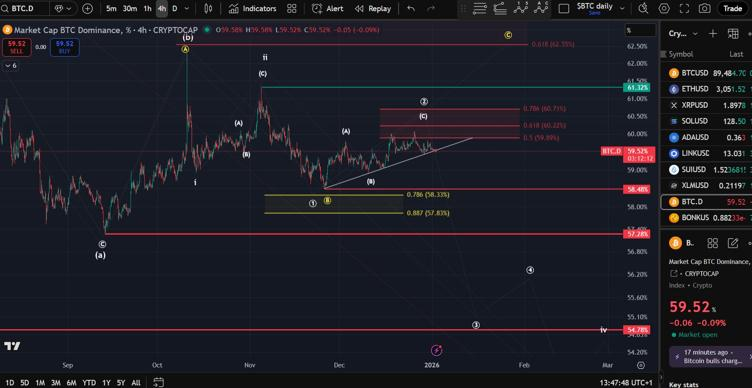
The cryptocurrency market is currently navigating a pivotal transition as Bitcoin, the industry’s primary bellwether, demonstrates signs of technical exhaustion following a period of prolonged dominance. Market analyst Justcryptopays recently highlighted that Bitcoin’s breach of a critical multi-month trendline serves as a precursor to a broader shift in market dynamics, potentially ushering in the long-awaited "Alt-Season." This phenomenon, characterized by a significant rotation of capital from Bitcoin into alternative digital assets, suggests that investor appetite is evolving beyond the safety of the flagship cryptocurrency toward higher-beta opportunities within the broader ecosystem.
As of early 2026, the digital asset landscape is attempting to decouple from the bearish headwinds that defined much of 2025. While Bitcoin remains the primary gateway for institutional liquidity, its recent inability to sustain the psychological $90,000 threshold has triggered a re-evaluation of portfolio allocations. With Bitcoin trading at approximately $90,525, the market is witnessing a tug-of-war between bullish accumulation and distributive selling, a scenario that historically benefits established altcoins like Ethereum, Solana, and XRP, as well as emerging sectors within Decentralized Finance (DeFi) and Web3.
Technical Analysis: The Significance of the Trendline Breach
In technical analysis, a trendline represents the path of least resistance for an asset’s price. For Bitcoin, the trendline in question had served as a foundation for its ascent throughout the previous fiscal cycles. When an asset falls below such a line, it often indicates a loss of momentum and a shift in the supply-demand equilibrium. According to analysts, this breach is not necessarily a harbinger of a market-wide crash, but rather a signal of "sideways consolidation" for Bitcoin while capital seeks more volatile, high-reward environments.
The $90,000 level has emerged as a formidable psychological and technical barrier. In the world of high-frequency trading and institutional algorithms, round numbers often act as "magnetic" zones where significant sell orders are clustered. Bitcoin’s struggle to maintain a foothold above this level suggests that the "smart money" may be taking profits and redistributing that liquidity into laggard assets—specifically altcoins that have underperformed relative to Bitcoin over the past twelve months.
A Chronology of the Market Shift
To understand the current market structure, one must look at the timeline of the 2024-2026 cycle. Following the Bitcoin halving in 2024, the market saw an initial surge in BTC price, fueled largely by the success of Spot Bitcoin Exchange-Traded Funds (ETFs) in the United States. This institutional inflow created a "Bitcoin-only" rally for several months, leaving the majority of altcoins in a state of stagnation.
Throughout 2025, the market faced several macroeconomic challenges, including fluctuating interest rate policies from the Federal Reserve and a tightening of global liquidity. This resulted in a "risk-off" sentiment where investors clung to Bitcoin’s perceived stability. However, as 2025 drew to a close, the narrative began to shift. The "Bitcoin Dominance Index"—a metric measuring Bitcoin’s share of the total crypto market cap—reached a local peak, historically a signal that an altcoin reversal is imminent.

By the start of 2026, the technical breakdown mentioned by Justcryptopays provided the spark. As Bitcoin’s volatility began to compress at the $90,000 range, the "overflow" of capital began trickling into Ethereum and Solana, which have shown resilient development activity despite price suppression.
The Role of Bitcoin Dominance and Capital Rotation
The concept of "Alt-Season" is inextricably linked to Bitcoin Dominance (BTC.D). When Bitcoin’s price stabilizes or enters a slight downtrend while its dominance drops, it indicates that investors are moving their BTC profits into "alts." This rotation typically follows a specific hierarchy:
- Bitcoin Phase: BTC leads the market, drawing in new fiat currency.
- Large-Cap Phase: Capital flows into Ethereum (ETH) and other "Blue Chip" altcoins like Solana (SOL) and Cardano (ADA).
- Mid-Cap and Sector Phase: Liquidity spreads to specialized sectors such as Oracle networks (Chainlink), Layer-2 solutions, and AI-focused tokens.
- Speculative Phase: The final stage often involves a surge in memecoins and micro-cap projects, driven by retail FOMO (Fear Of Missing Out).
Current data suggests we are entering the second phase of this cycle. Ethereum, which has faced criticism for its sluggish price action compared to Bitcoin, is beginning to show strength on the ETH/BTC pair. Similarly, Solana’s ecosystem has seen a surge in Decentralized Exchange (DEX) volume, suggesting that users are moving back into on-chain activities that require native altcoin tokens for gas and governance.
Reactions from Market Participants and Institutional Perspectives
While retail traders often view Alt-Season as a time for rapid gains, institutional players view it through the lens of portfolio diversification. Reports from Binance Research suggest that the maturation of the market has led to a more "discerning" altcoin rally. Unlike the 2017 bubble, where almost any Initial Coin Offering (ICO) would see gains, the 2026 landscape is focused on utility and institutional integration.
Analysts from major crypto exchanges note that the launch of Ethereum and potentially Solana ETFs has changed the game. "We are no longer looking at a monolithic market," stated one senior researcher. "Investors are beginning to treat Ethereum as a yield-bearing technology asset and Bitcoin as a sovereign store of value. This differentiation allows altcoins to rally even when Bitcoin is stagnant."
Furthermore, the "trapped liquidity" in stablecoins—currently at record highs—is another factor cited by analysts. When Bitcoin’s price action becomes range-bound, the massive reserves of USDT and USDC held on exchanges are often deployed into altcoins to seek "alpha" or returns that exceed the market average.
Broader Implications and the Road Ahead
The potential for a sustained altcoin resurgence carries significant implications for the broader blockchain industry. A thriving altcoin market typically correlates with increased developer activity and venture capital funding. When tokens associated with specific projects (such as Polkadot, Avalanche, or Chainlink) increase in value, the treasuries of these projects expand, allowing for more aggressive R&D and ecosystem grants.
However, the path forward is not without risks. Shaking off the bearish momentum of 2025 requires a sustained increase in global liquidity. If central banks pivot toward more restrictive monetary policies, the "risk-on" appetite required for a massive altcoin rally could be dampened. Investors must also contend with the regulatory environment, which remains a patchwork of different standards across the US, EU, and Asia.
For the "Alt-Season" to truly materialize, several key indicators must be met:
- Sustained ETH/BTC Strength: Ethereum must consistently outperform Bitcoin to provide a "green light" for the rest of the market.
- Decline in BTC Dominance: A drop below the 50% mark is often cited by traders as the official start of Alt-Season.
- Retail Re-entry: Increased search volume for "crypto" and "altcoins" on platforms like Google and social media often precedes the final, most explosive leg of a rally.
Fact-Based Analysis of the Current Market Sentiment
Objectively, the market is at a crossroads. Bitcoin’s struggle at $90,000 is a sign of a maturing asset finding its fair market value in a post-ETF world. For altcoins, the challenge is proving long-term viability beyond mere speculation. The "rotation" noted by Justcryptopays is a natural part of the market cycle, reflecting the ebb and flow of liquidity.
The inclusion of assets like XRP and Cardano in the conversation is also notable. These "legacy" altcoins have maintained large communities and significant market caps through multiple cycles. Their ability to attract capital during this rotation will be a litmus test for whether the market favors "proven" projects or prefers the high-growth potential of newer, "shiny" protocols in the Web3 and AI niches.
In conclusion, while the break below the Bitcoin trendline may seem like a negative development for BTC maximalists, it represents a broadening of the market’s horizons. As capital rotates and market dynamics evolve, the potential for an altcoin awakening becomes increasingly tangible. Vigilant investors and traders who monitor these shifts in liquidity and technical structures may find strategic opportunities in an environment where the "flagship" takes a breather, allowing the rest of the fleet to surge forward. The coming months will determine if this shift is a temporary deviation or the start of a transformative era for alternative digital assets in 2026.