The global cryptocurrency landscape has undergone a profound transformation between July 2025 and June 2026, transitioning from a speculative investment vehicle into a resilient financial infrastructure driven by utility and cross-border necessity. According to the seventh annual Geographies of Cryptocurrency report, the digital asset economy demonstrated remarkable stability despite a historic market contraction. While the total cryptocurrency market capitalization suffered a staggering 50% drawdown—representing a $2.1 trillion loss in value—the actual economic activity on-chain remained nearly flat, shrinking by a marginal 1.6%. This stability, recorded during one of the most volatile periods in the history of the asset class, suggests that cryptocurrency has successfully diversified its use cases beyond mere price speculation, finding a permanent home in the realms of international trade, inflation hedging, and retail payments.
The 2025-2026 Crypto Winter: A Chronology of Resilience
The period beginning July 1, 2025, was initially marked by exuberant growth, with Bitcoin reaching a new all-time high in late 2025. However, this peak was followed by the largest dollar-value retreat ever recorded for the leading cryptocurrency, as Bitcoin plummeted $67,000 from its zenith. By June 30, 2026, the broader market had contracted significantly, echoing the cascading collapses of the 2022 bear market. Yet, the data reveals a fundamental difference in how the ecosystem responded to this latest downturn.

In the 2022-2023 bear market, a smaller contraction in market cap led to a massive 23% drop in global transaction volume. In contrast, the 2025-2026 period saw a massive $2.1 trillion wipeout in market value, yet transaction volume only dipped from $9.5 trillion to $9.4 trillion. This discrepancy highlights a maturing market where users are no longer exiting the ecosystem during price drops; instead, they are utilizing stablecoins and peer-to-peer (P2P) networks to maintain economic continuity.
The resilience of the 2026 period is particularly impressive when considering the "value-effort" ratio. Because assets were worth half as much as they were during the peak, market participants had to move twice the volume of tokens to maintain the same dollar-denominated economic activity. The fact that the global crypto economy nearly matched its 2025 performance indicates a significant increase in the underlying frequency and volume of transactions.
Brazil Emerges as the Global Leader in Grassroots Adoption
A significant highlight of the 2026 report is the crowning of Brazil as the world leader in grassroots crypto adoption. Brazil’s ascent to the number one spot on the Global Crypto Adoption Index is the result of a balanced and robust digital asset ecosystem. Unlike other nations that might dominate in a single category, such as institutional trading or P2P volume, Brazil performed consistently well across all tracked metrics.

The South American powerhouse recorded a $252.5 billion crypto economy, ranking second globally in cross-border flows and third in both total service flows and domestic P2P activity. Analysts attribute Brazil’s success to a combination of proactive regulatory clarity and a population that increasingly views cryptocurrency as a viable alternative to traditional banking. While the United States followed in second place and Nigeria in third, Brazil’s ability to maintain high engagement across retail and institutional levels during a bear market underscores its position as a blueprint for sustainable adoption.
The Stablecoin Pivot: From Speculation to Settlement
The primary engine behind the global economy’s resilience has been the explosive growth of stablecoins. Pegged to the U.S. dollar, these assets provided a safe harbor for capital during the 2026 market crash. While the value of volatile assets like Bitcoin and Ethereum fell by more than 55%, stablecoin balances remained remarkably steady, fluctuating between $98 billion and $109 billion throughout the nine-month drawdown.
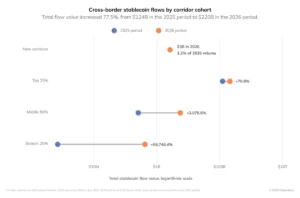
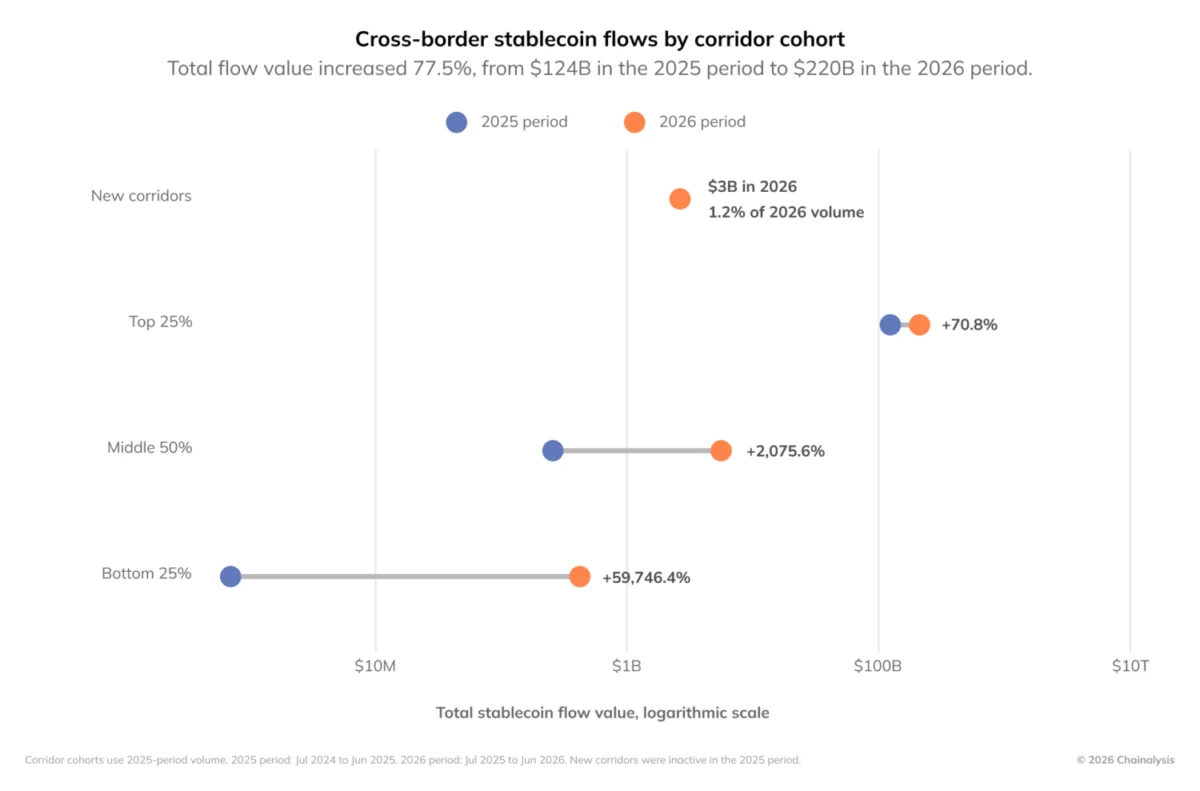
Stablecoins have evolved into the "anchor" of the crypto economy. By June 2026, their share of global on-chain balances reached 22.5%. More importantly, their role in cross-border payments has moved from a niche use case to a pillar of global commerce. Monthly cross-border stablecoin value more than doubled, rising from $11 billion in January 2025 to $24 billion by June 2026. Total cross-border stablecoin flows for the period reached $220.3 billion, a 77.5% increase year-over-year.

Philip Gradwell, Vice President of Economics at Tether, noted that the nature of these transactions has shifted. "Activity has become consistent, routed through wallets in a steady rhythm rather than in bursts," Gradwell stated. "That is the signature of trade and business activity, not speculation." He further emphasized that USDT (Tether) is increasingly serving the "long tail" of the global economy—small businesses and individuals in regions where traditional financial technology is either too expensive or restricted by heavy-handed capital controls.
Regulatory Catalysts: MiCA and the GENIUS Act
The surge in stablecoin utility is not occurring in a vacuum. The 2025-2026 period saw the implementation and maturation of several key regulatory frameworks that provided the legal certainty required for businesses to integrate stablecoins into their operations.
In the European Union, the Markets in Crypto-Assets (MiCA) regulation has standardized requirements for stablecoin issuers, fostering a safer environment for retail and institutional users alike. In the United States, the passage of the GENIUS Act (Global Electronic Network Infrastructure and Universal Standards) has clarified the status of digital dollar equivalents, allowing American firms to compete more effectively in the cross-border payments space. Similar legislative actions in Japan, Hong Kong, Singapore, and the United Kingdom have created a "compliance corridor" that facilitates the seamless flow of digital value between major financial hubs.

The Retail and Institutional Paradox
Despite the bearish price action, retail-level participation—defined as transfers under $1,000—showed the sharpest growth in terms of transaction count. Transfers under $100 surged by 78.4%, while transfers between $100 and $1,000 rose by 58.6%. Although these small-dollar inflows accounted for only $273 billion of the nearly $10 trillion in total activity, they represent a growing "grassroots" layer of users who are using crypto for everyday needs rather than portfolio growth.
Institutional activity also remained surprisingly durable. Transfers of $1 million or more dropped by only 7.2% period-over-period. In previous cycles, institutional capital was often the first to flee during a 50% market drawdown. The retention of institutional flows in 2026 suggests that large-scale allocators now view cryptocurrency—specifically tokenized assets and stablecoins—as essential infrastructure rather than speculative experiments.
Regional Trends: Latin America and Sub-Saharan Africa
The report identifies Latin America and Sub-Saharan Africa as the two most dynamic regions for crypto growth. Latin America bucked the global trend entirely, growing its crypto economy by 9.8% year-over-year. This growth was driven by a collective pivot toward stablecoins as a hedge against local currency volatility in nations like Argentina and Venezuela.

In Sub-Saharan Africa, the story was defined by peer-to-peer (P2P) activity. While value flowing into centralized exchanges and DeFi protocols fell globally by 4.3%, direct wallet-to-wallet transfers within countries skyrocketed by 302.9%. P2P activity now accounts for 96% of stablecoin movements in several African markets, as users bypass traditional banking hurdles to facilitate domestic trade and remittances.
Methodology: A New Way to Measure Adoption
The 2026 report introduced a refined methodology for the Global Crypto Adoption Index to better reflect the changing nature of the market. The index now weighs four primary factors:
- Service Inflows: The total value received by centralized exchanges and DeFi protocols.
- On-chain Balances: The total value held in wallets, providing a measure of "store of value" utility.
- P2P Economy: Domestic transfers between personal wallets, capturing grassroots economic activity.
- Cross-border Flows: Transfers between wallets located in different countries, highlighting crypto’s role in international trade.
To ensure fairness, the report weights these values by Purchasing Power Parity (PPP) and GDP per capita. This ensures that a $1,000 transaction in a low-income country like Vietnam carries more weight in the adoption index than a $1,000 transaction in a high-income country like Germany, as it represents a larger share of the local user’s economic capacity.

Conclusion and Implications
The data from the 2026 Geographies of Cryptocurrency report suggests that the "speculative era" of digital assets is giving way to the "utility era." The fact that the on-chain economy remained stable while market prices collapsed is a watershed moment for the industry. It proves that cryptocurrency provides tangible value that is independent of market sentiment.
As stablecoins continue to integrate into global commerce and P2P networks expand in emerging markets, the traditional boundaries of finance are being redrawn. For capital allocators in the West, crypto has become a sophisticated tech upgrade for asset trading. For the Global South, it has become a vital lifeline for preserving wealth and moving value. As the world moves into the latter half of the decade, the question is no longer whether cryptocurrency will be adopted, but how quickly traditional financial systems will adapt to the new reality of a resilient, on-chain global economy.