
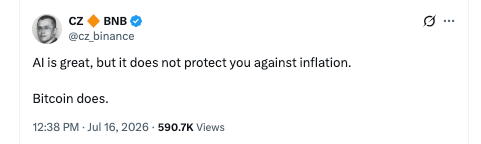
Binance founder Changpeng Zhao, widely known as "CZ," has recently ignited a discussion regarding the economic implications of artificial intelligence (AI) and its potential impact on inflation, contrasting it with the long-standing proposition of Bitcoin as an inflation hedge. In a series of public statements, Zhao articulated his perspective that while AI is a transformative force with profound societal benefits, it may inadvertently exacerbate inflationary pressures in the short to medium term. Conversely, he posited that Bitcoin, with its inherent scarcity and decentralized nature, remains a potent tool for individuals seeking to preserve wealth against rising prices.
This assertion from a prominent figure in the cryptocurrency space, particularly one who led the world’s largest crypto exchange, inevitably draws attention and sparks debate. The comparison between AI, a technological paradigm shift, and Bitcoin, a decentralized peer-to-peer monetary system, might initially seem disparate. However, both are characterized by their technical complexity and their capacity to disrupt established economic and social structures. This shared characteristic often positions them as subjects of parallel discourse, especially when considering their macroeconomic effects.
The Economic Ripple Effects of Artificial Intelligence
The rapid advancement and widespread adoption of AI technologies are undeniably reshaping global economies. This revolution, however, is not without its immediate economic costs. The infrastructure required to power AI systems is substantial, necessitating massive investments in data centers, advanced semiconductor manufacturing, and robust energy grids. These foundational elements are critical for the burgeoning AI economy and represent significant capital outlays.
Goldman Sachs, a leading investment bank, has provided data supporting this notion. A report published in July 2026 highlighted how the surge in investment and infrastructure development directly tied to AI is contributing to elevated inflation for consumers. The report specifically pointed to the United States as being significantly affected by these trends. According to Goldman Sachs’ analysis, the AI boom has added approximately 20 basis points to the annual core Personal Consumption Expenditures (PCE) inflation rate, with projections indicating this figure could potentially double by the end of 2026. This suggests a tangible, albeit perhaps temporary, inflationary pressure stemming from the very technologies promising future efficiency gains.
The underlying mechanisms driving this inflationary pressure are multifaceted. The demand for specialized hardware, such as advanced GPUs and AI accelerators, has skyrocketed, leading to supply chain bottlenecks and increased component costs. Furthermore, the energy demands of large-scale AI models and data centers are considerable, potentially straining existing energy infrastructure and contributing to higher energy prices. The race to develop and deploy cutting-edge AI solutions also fuels intense competition among tech giants, driving up the costs associated with talent acquisition and research and development.

While the immediate economic consequences may lean towards inflation, the long-term outlook for AI’s impact on the economy is often viewed through a different lens. Many economists anticipate that AI, in the long run, could act as a powerful deflationary force. By automating repetitive tasks, optimizing supply chains, and enhancing productivity across various sectors, AI has the potential to significantly reduce labor costs and increase the efficiency of production. This could lead to lower prices for goods and services, thereby counteracting inflationary pressures. However, as Zhao alluded to, the immediate future might see these inflationary effects materialize before the long-term deflationary benefits fully manifest. The energy-intensive nature of current AI development is a key factor contributing to this intermediate inflationary phase.
Bitcoin: A Time-Tested Inflation Hedge
In stark contrast to the complex and evolving economic dynamics of AI, Bitcoin has been presented and, by many proponents, proven as a hedge against inflation. Critics often point to Bitcoin’s inherent volatility and the price fluctuations that can occur over shorter periods as reasons to be cautious about its investment potential. However, historical data and market analysis suggest a consistent pattern of rebound and strong performance over longer investment horizons.
To contextualize Bitcoin’s performance, consider the period between 2015 and 2025. During this decade, the premier cryptocurrency experienced an extraordinary surge of approximately 38,000%. This remarkable growth outpaced traditional safe-haven assets like Gold, as well as major asset classes such as the stock market and real estate, even after accounting for inflation. While it is true that Bitcoin’s progress has faced periods of stagnation, particularly in the last five years or so, and it has sometimes struggled to keep pace with other asset classes during specific market cycles, its fundamental characteristics continue to underpin its value proposition.
The core attributes that make Bitcoin a compelling inflation hedge are its fixed and predictable supply, capped at 21 million coins, and its decentralized, peer-to-peer nature. This programmed scarcity is often compared to the limited supply of precious metals like gold, making it resistant to inflationary debasement that can affect fiat currencies. The fixed issuance schedule, governed by its underlying blockchain protocol, ensures that no more than 21 million Bitcoins will ever exist, creating a predictable monetary policy that is independent of any central authority’s discretion.
Furthermore, Bitcoin’s utility as a cross-border, peer-to-peer medium of exchange and store of value is becoming increasingly recognized. In an era of geopolitical instability and fluctuating national currencies, its ability to be transferred globally without intermediaries offers a degree of financial sovereignty. This utility, combined with its scarcity, provides a robust foundation for its role as a store of value, particularly in regions experiencing hyperinflation or currency devaluation.
Zhao’s consistent emphasis on Bitcoin, specifically its long-term prowess, likely stems from this recognition of its fundamental economic properties. While other cryptocurrencies exist, many are viewed with skepticism regarding their long-term viability and investment potential. Bitcoin’s first-mover advantage, its established network effect, and its proven resilience through multiple market cycles position it uniquely within the digital asset landscape.
The Interplay and Future Outlook
The former Binance executive’s perspective offers a strategic, rather than merely tactical, view of the economic landscape. The ongoing advancements in AI are poised to continue their disruptive influence on economies worldwide, creating immense value and transforming industries. The complex relationship between AI development, its energy demands, and its impact on inflation will undoubtedly be a subject of extensive study and analysis by economists and policymakers alike.
However, the immediate challenge presented by the inflationary pressures associated with the AI boom necessitates a consideration of alternative stores of value. In this context, Bitcoin’s proven credentials as an inflation hedge become particularly relevant. The flow of "smart money" – capital from sophisticated investors and institutions – into Bitcoin suggests a growing acknowledgment of its potential to preserve wealth.
The disruptive power of technologies like AI is unlikely to fundamentally undermine Bitcoin’s value proposition. In fact, as the global economy grapples with the economic consequences of technological innovation and potential inflationary spirals, assets with inherent scarcity and decentralized control, such as Bitcoin, may find their roles further solidified. The narrative that Bitcoin can offer a bulwark against inflation, especially in an era where central banks are continually experimenting with monetary policy, continues to resonate with a growing segment of the investment community.
The dichotomy presented by Zhao highlights a critical juncture. As society embraces the transformative potential of AI, it must also be mindful of the immediate economic realities. The ongoing dialogue between technological progress and financial stability underscores the enduring relevance of assets like Bitcoin, which offer a distinct approach to wealth preservation in an increasingly complex global economy. The long-term implications of both AI and Bitcoin will continue to unfold, shaping the future of finance and society.