



This rapid proliferation of machine-authored text marks a pivotal moment in the evolution of the internet, raising critical questions about information integrity, content quality, and the future of human expression online. The findings underscore the swift and pervasive integration of AI tools into content creation workflows across various sectors, from commercial enterprises to niche online communities.
The Rapid Ascent of AI on the Web
The emergence of sophisticated large language models (LLMs) like ChatGPT has democratized access to AI-powered content generation, enabling individuals and organizations to produce vast quantities of text with unprecedented speed and scale. Prior to November 2022, AI’s presence in web content was largely confined to specialized applications, often in automated reporting or data-driven summaries. However, the user-friendly interface and impressive linguistic capabilities of tools like ChatGPT ignited a global phenomenon, making AI an accessible co-author for virtually anyone with an internet connection.
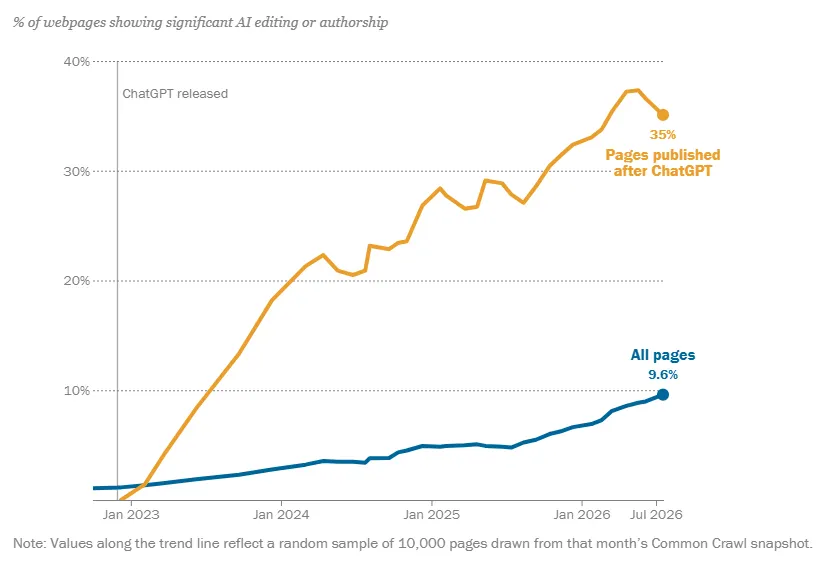
The Pew Research Center’s study, which meticulously analyzed approximately 490,000 pages pulled from the Common Crawl web archive, spanning from January 2021 through July 2026, provides a stark chronological snapshot of this accelerated shift. Researchers employed Open Pangram, a specialized AI detection model, to scrutinize the textual data for statistical patterns indicative of machine authorship. The dramatic leap from a pre-ChatGPT baseline to the current 35% for recent content published since its launch illustrates an exponential growth curve that few technologies have matched in such a short timeframe. This timeline highlights not merely a gradual adoption but an outright embrace of AI as a primary content creation engine in many corners of the digital realm.

Unpacking the Methodology: How Machines Are Spotted
Identifying AI-generated text is a complex endeavor, evolving as rapidly as the generation technology itself. The Open Pangram model utilized by Pew Research Center does not rely on a simple keyword blacklist or a single identifiable phrase. Instead, it employs sophisticated algorithms to detect statistical patterns across large volumes of text. These patterns manifest in various linguistic quirks and stylistic preferences that AI models, particularly early iterations, tend to exhibit.
The study detailed several "tells" that have become significantly more common since 2023, offering a fascinating glimpse into the nascent stylistic fingerprints of AI. For instance, the use of em dashes has roughly doubled in frequency, suggesting AI’s preference for this punctuation mark in structuring complex sentences or providing parenthetical information. Similarly, Oxford commas, often a point of contention among human grammarians, have seen a 63% increase in usage. Beyond punctuation, certain words favored by AI models have also surged in popularity. Terms like "delve," "interplay," and "testament" have more than doubled in frequency, indicating a particular lexical disposition that distinguishes AI-generated prose from average human writing.
Another intriguing marker identified is "negative parallelism"—sentence constructions such as "it’s not just X, it’s Y." While still relatively rare overall, this specific grammatical structure has nearly tripled since 2023. These findings align with observations made by other linguistic researchers and news outlets, including Decrypt, which has previously tracked similar AI tells. The growing awareness of these machine-generated stylistic tendencies even prompted Merriam-Webster to declare "slop" its word of the year, referring to the glut of low-quality, often AI-generated content flooding the web.
It is crucial to acknowledge the limitations of current AI detection models. As Pew researchers prudently note, these models can sometimes misclassify individual pages, producing both false positives and false negatives. Furthermore, "significant signs of AI authorship" does not necessarily imply that an entire page was exclusively written by a machine. In many instances, the text is likely AI-assisted, where human authors leverage AI tools for brainstorming, drafting, editing, or augmenting parts of their content, rather than outsourcing the entire creation process. This hybrid approach, combining human oversight with machine efficiency, represents a common use case for generative AI in contemporary content production.

Domain Disparities: Where AI Thrives and Where It’s Monitored
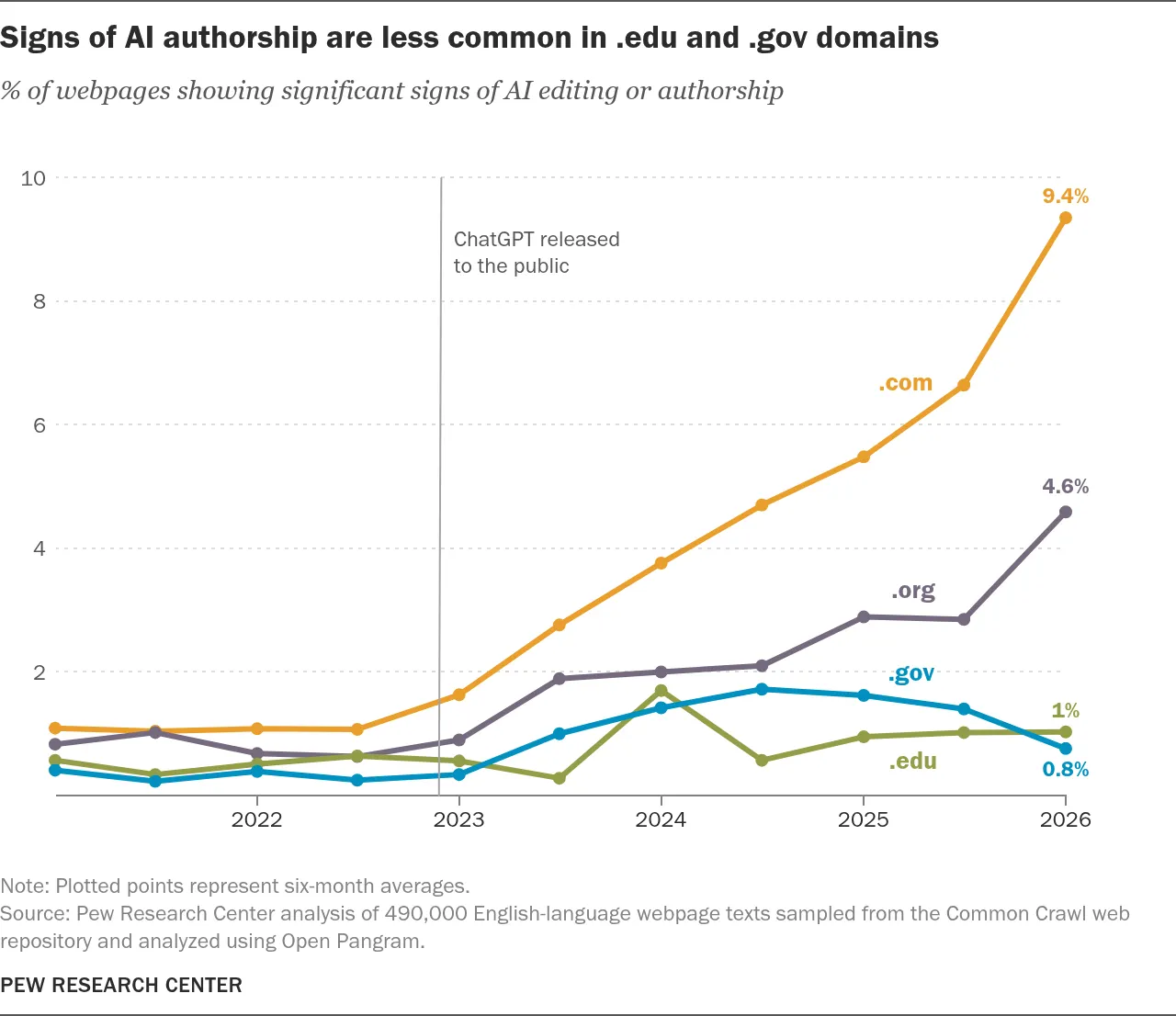
The Pew study also highlighted a significant disparity in AI authorship across different top-level domains (TLDs), revealing underlying motivations and editorial landscapes. Commercial .com domains exhibit signs of AI authorship at approximately ten times the rate of .edu (educational) or .gov (government) domains. Both .edu and .gov sites hover near a mere 1% AI authorship, while .org (organizational) sites show a rate of about 4.6%.
This stark divergence underscores the varying priorities and regulatory environments of different online spaces. In 2021, prior to the widespread availability of advanced LLMs, all four domain types showed nearly identical, very low rates of AI-influenced content. The subsequent explosion on .com domains points to a clear economic incentive driving the adoption of AI. Commercial websites, particularly those engaged in affiliate marketing, e-commerce, or high-volume content strategies (such as news aggregation or product reviews), stand to gain significantly from the cost-efficiency and speed of AI-generated text. These "content farms" can churn out thousands of pages rapidly, optimizing for search engine visibility and traffic, a pace that human editors and writers simply cannot match. The sheer volume of content required to maintain competitiveness in certain commercial niches makes AI an attractive, if not indispensable, tool.
Conversely, .edu and .gov domains typically operate under stringent editorial review processes, institutional sign-off requirements, and slower publishing cycles. The emphasis in these sectors is often on factual accuracy, official communication, and academic integrity, areas where unverified or potentially flawed AI-generated content poses significant risks. The reputational stakes for government bodies and academic institutions are high, leading to more cautious adoption and thorough human oversight. Even .org domains, representing non-profit organizations, demonstrate a comparatively lower rate, suggesting a greater emphasis on authentic human voice and mission-driven content that often undergoes community or expert review.
The trend line for .com domains vividly illustrates the acceleration: the AI-authorship rate climbed from roughly 1% in January 2021 to 9.35% just five years later, in January 2026 alone. This exponential growth within the commercial sphere signifies a fundamental shift in how businesses approach online content strategy, prioritizing quantity and SEO optimization over potentially more nuanced, human-centric creation.
Broader Impact and Implications for the Digital Ecosystem
The widespread integration of AI into web content carries profound implications across multiple dimensions of the digital ecosystem:
1. Information Integrity and Trust:
The most critical concern is the potential erosion of trust in online information. As AI-generated content becomes indistinguishable from human-authored text, users may struggle to discern credible sources from potentially fabricated or algorithmically manipulated narratives. This blurring of lines can facilitate the spread of misinformation, propaganda, and "fake news" at an unprecedented scale, making it increasingly challenging for individuals to form informed opinions or verify facts. The quality of information itself may degrade, as AI models, while capable of producing grammatically correct and coherent text, often lack the nuanced understanding, critical thinking, and lived experience that characterize genuine human insight.
2. Search Engine Optimization (SEO) and Content Quality:
Search engines like Google have long battled "spam" and low-quality content. The rise of AI-generated content presents a new frontier in this ongoing struggle. While AI can produce content optimized for keywords and search algorithms, an overabundance of such text could lead to a less diverse and less valuable search experience. Google has been adapting its algorithms to prioritize "helpful, reliable, and people-first content," and the increasing prevalence of AI content will likely accelerate efforts to detect and potentially de-rank purely machine-generated pages that lack genuine value or expertise. This creates an "arms race" between content creators seeking to leverage AI for SEO gains and search engines striving to maintain the integrity and utility of their results.
3. The Future of Human Authorship and Creative Industries:
The economic implications for human writers, journalists, marketers, and content creators are substantial. As AI tools become more sophisticated, the demand for human-generated content in certain areas may decrease, or the role of human creators may shift from primary authors to editors, fact-checkers, and prompt engineers. This transformation could lead to job displacement in some sectors while creating new roles centered around AI management and quality control. The debate over fair compensation for human work versus machine-generated output, especially when AI models are trained on existing human-created content, will continue to intensify.
4. The Evolution of AI Detection and Regulation:
The study’s findings highlight the critical need for robust AI detection mechanisms. As AI content generation becomes more advanced, so too must the tools designed to identify it. The good news, as noted by Pew, is that AI detection may become an easier task with time, not just through pattern analysis but through fundamental technological advancements. Major AI companies, such as Anthropic, are already developing "model-level text fingerprinting" or "watermarking" technologies. This would embed an imperceptible digital signature within AI-generated text, making it inherently identifiable at the source, thereby minimizing misclassification errors and offering a more reliable method for distinguishing human from machine. This technological solution could serve as a crucial safeguard against misuse and aid in fostering transparency. Beyond technology, there will likely be increasing calls for industry standards and potentially governmental regulations requiring disclosure of AI-generated content, particularly in sensitive areas like news, public health information, or financial advice.
Conclusion: Navigating a New Information Frontier
The Pew Research Center’s study serves as a crucial benchmark, illustrating the breathtaking pace at which artificial intelligence is reshaping the digital information landscape. The transition from a negligible presence to influencing over a third of new English web content in just a few years is a testament to AI’s disruptive power. While AI offers unparalleled efficiencies and capabilities, its widespread adoption also introduces complex challenges related to authenticity, trust, and quality.
As the internet continues to evolve into an increasingly hybrid space of human and machine authorship, understanding these trends is paramount. For consumers, it means developing greater media literacy and critical discernment. For content creators, it necessitates an ethical approach to AI integration and a clear understanding of its limitations. For technology developers, it underscores the responsibility to build tools that not only generate content but also ensure its provenance and integrity. The insights from this Pew study are not merely statistics; they are a call to action for stakeholders across the digital ecosystem to proactively address the implications of an AI-saturated web, ensuring that the future of online information remains informative, trustworthy, and ultimately, beneficial to humanity.














