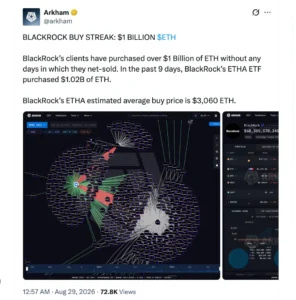
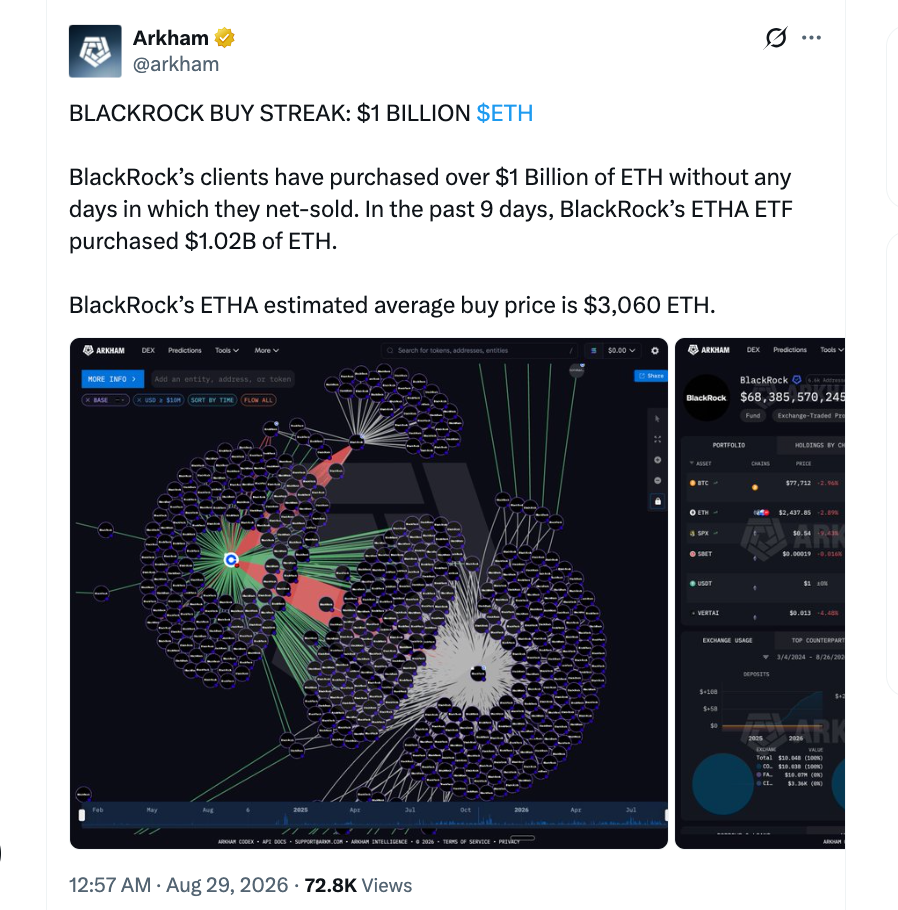
The digital asset market is abuzz with activity following significant institutional interest in Ethereum, a trend underscored by BlackRock’s substantial accumulation of the cryptocurrency and Fidelity’s pursuit of regulatory approval for a spot Ether Exchange-Traded Fund (ETF). BlackRock’s iShares Ethereum Trust has quietly amassed over $1 billion worth of Ether in just nine days, demonstrating a consistent buying pattern with no net selling, as highlighted by the on-chain intelligence platform Arkham. This strategic move by one of the world’s largest asset managers, alongside Fidelity’s ambitious ETF filing, signals a potential paradigm shift in how traditional finance engages with decentralized assets, pointing towards increased legitimacy and accessibility for Ether.
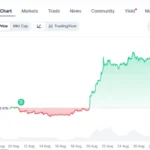
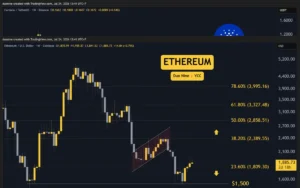
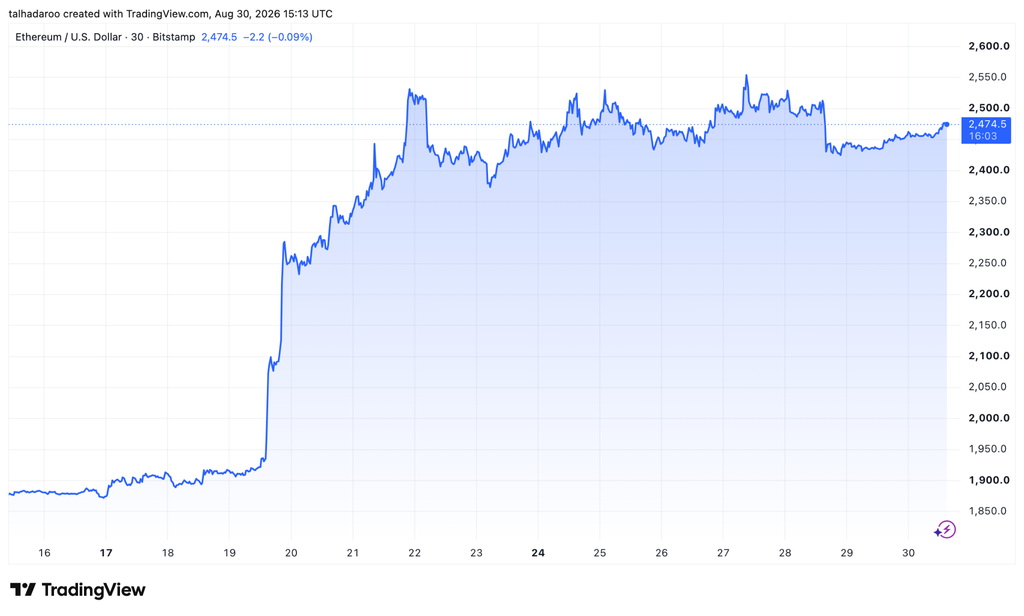
The sustained acquisition of Ether by BlackRock, reportedly at an average price of around $3,060 per coin, suggests a long-term conviction in the digital asset’s value rather than a short-term speculative play. This unbroken buying streak is particularly noteworthy in a market known for its volatility. Over the past two weeks preceding this accumulation, Ether experienced a notable price recovery, surging by more than 28%. This robust performance, coupled with BlackRock’s unwavering commitment, paints a picture of institutional confidence in Ethereum’s underlying technology and future potential, even amidst broader market fluctuations.
A Timeline of Institutional Ascent for Ethereum
The journey toward institutional acceptance for Ethereum has been a gradual but accelerating process. While Bitcoin ETFs have dominated headlines and regulatory discussions for years, the prospect of Ether-based ETFs has gained significant traction more recently.

- Early 2023: Initial discussions and filings for spot Bitcoin ETFs by major players like BlackRock began to generate anticipation.
- Late 2023 – Early 2024: Following the approval and successful launch of spot Bitcoin ETFs in the United States in January 2024, attention quickly shifted to Ethereum. BlackRock filed for its spot Ether ETF in November 2023, followed by other major financial institutions, including Fidelity.
- May 2024: The U.S. Securities and Exchange Commission (SEC) approved key rule changes that would allow for the listing of spot Ether ETFs on major exchanges. This decision marked a significant hurdle cleared for potential ETF launches.
- June 2024 (Present Focus): The current period is characterized by the active accumulation of Ether by entities like BlackRock, seemingly in anticipation of the potential launch of these new investment vehicles. Fidelity’s continued engagement with the SEC regarding its ETF application further underscores this ongoing institutional push.
BlackRock’s Unbroken Streak: A Deeper Dive
Arkham’s revelation that BlackRock’s Ethereum ETF has acquired over $1 billion in Ether without any recorded net selling is a powerful indicator of the financial giant’s strategy. This consistent accumulation suggests that BlackRock is not merely reacting to market dips or surges but is systematically building a significant position. The absence of selling orders implies a belief in the long-term appreciation of Ether, positioning it as a foundational asset within their investment portfolio.
The estimated average acquisition price of $3,060 per ETH places BlackRock’s entry point at a significant level within recent trading ranges. This price point is crucial as it suggests the institution is willing to invest substantial capital even when Ether is trading at relatively high valuations, further reinforcing the notion of conviction. In traditional finance, such consistent, large-scale buying from a reputable institution often signals market support and can influence broader investor sentiment.
Why This Accumulation Matters
BlackRock’s sustained buying spree stands out for several reasons within the cryptocurrency landscape:
- Institutional Endorsement: BlackRock’s involvement lends significant credibility to Ethereum as an asset class. Their willingness to deploy over a billion dollars signals a belief in Ethereum’s technological advancements, its role in the burgeoning decentralized finance (DeFi) ecosystem, and its potential for future growth.
- Market Stability: Consistent buying pressure from a large entity can help to absorb selling pressure and contribute to price stability. In a market prone to sharp corrections, this steady accumulation can act as a buffer, potentially mitigating extreme price swings.
- Precursor to ETF Launch: This accumulation is widely interpreted as a strategic move in anticipation of the SEC’s approval of spot Ether ETFs. By acquiring a substantial amount of Ether beforehand, BlackRock can ensure a robust supply to back its ETF offerings upon launch, facilitating smooth operations and investor access.
- Diversification for Traditional Investors: The potential launch of a spot Ether ETF would provide a regulated and accessible avenue for traditional investors to gain exposure to Ethereum without the complexities of direct crypto custody. BlackRock’s proactive acquisition of Ether underscores the growing demand for such regulated products.
The Role of Fidelity and the ETF Landscape
The pursuit of a spot Ether ETF by Fidelity Digital Assets further amplifies the significance of these developments. Fidelity, another behemoth in the financial services industry, has been actively involved in the digital asset space, including offering crypto services to its institutional clients. Their application for a spot Ether ETF, alongside other major firms, highlights a concerted effort by established financial institutions to integrate cryptocurrencies into mainstream investment products.
The SEC’s recent approval of rule changes necessary for listing spot Ether ETFs is a pivotal moment. While this approval doesn’t greenlight the ETFs themselves, it clears a major regulatory hurdle, allowing exchanges to list such products if the SEC eventually approves the underlying ETF applications. The agency’s decision was seen by many as a positive signal, though its approach to digital asset regulation remains closely watched. The approval of Bitcoin ETFs earlier in the year set a precedent, and many anticipate a similar outcome for Ethereum, albeit with potentially different timelines and considerations.
Supporting Data and Market Context
The performance of Ether leading up to and during this period of institutional accumulation provides a backdrop of market optimism. As previously noted, Ether experienced a significant rally, showcasing renewed investor interest. This price appreciation can be attributed to several factors, including:

- The Ethereum Merge and Subsequent Upgrades: The successful transition to Proof-of-Stake (PoS) with "The Merge" in September 2022 significantly reduced Ethereum’s energy consumption and laid the groundwork for future scalability upgrades. Subsequent upgrades, such as EIP-4844 (Proto-Danksharding), have focused on improving transaction efficiency and reducing gas fees, making the network more attractive for developers and users.
- Growth of the DeFi Ecosystem: Ethereum remains the dominant blockchain for decentralized finance applications, including lending, borrowing, and decentralized exchanges. The continued innovation and growth within DeFi directly contribute to the demand for ETH as a network utility token.
- Rise of NFTs and Layer-2 Solutions: While the NFT market has seen fluctuations, Ethereum continues to be a primary platform for non-fungible tokens. The development and adoption of Layer-2 scaling solutions (like Arbitrum, Optimism, and zkSync) are crucial for addressing network congestion and high transaction fees, making Ethereum more accessible and competitive.
- Anticipation of ETF Approvals: The prospect of spot Ether ETFs has been a significant driver of positive sentiment, mirroring the impact of Bitcoin ETF anticipation. Institutions building positions are likely factoring in the potential demand surge that ETFs could unlock.
Twitterati Reactions: A Spectrum of Views
The news of BlackRock’s substantial Ether holdings generated diverse reactions across social media platforms, particularly on X (formerly Twitter). These responses offer a glimpse into the broader sentiment within the cryptocurrency community, ranging from cautious optimism to outright excitement.
One prominent viewpoint expressed concern about the potential for market manipulation or misleading indicators. A user named Valerius Labs cautioned: "This current order book from BlackRock is a bit misleading, and speculators need to be careful." This sentiment reflects a historical awareness within the crypto space of how market movements can be influenced by large players, and a reminder that past patterns of speculative bubbles and subsequent crashes should be heeded. The analogy to previous market cycles, where rapid price increases were followed by sharp downturns due to inexperienced traders overleveraging, underscores a cautious approach.
Conversely, other users highlighted the strategic nature of such accumulation, referring to it as a "quiet accumulation phase." This perspective suggests that sophisticated investors often build positions discreetly during periods of price consolidation or downturn, aiming to benefit from an eventual upward trend. Another user, zxcVika_ell, commented: "The ‘quiet accumulation phase’ refers to buyers who stay under the radar and load up digital assets during a major price squeeze, when no one expects them to buy. These traders are often underrated and benefit a lot from an inevitable price rally." This interpretation frames BlackRock’s actions not as a simple reaction to price increases but as a deliberate strategy to acquire assets at favorable terms before wider market recognition. This "whale" behavior, when executed by institutional players, is often seen as a strong bullish signal for the long term.
Implications for the Future of Digital Assets
The sustained institutional interest in Ethereum, exemplified by BlackRock’s significant accumulation and Fidelity’s pursuit of an ETF, carries profound implications for the future of digital assets:
- Increased Legitimacy and Mainstream Adoption: The involvement of traditional financial giants like BlackRock and Fidelity lends significant credibility to cryptocurrencies. The potential launch of spot Ether ETFs would provide a regulated and accessible pathway for a broader investor base to participate in the digital asset market, accelerating mainstream adoption.
- Enhanced Market Liquidity and Stability: As more institutional capital flows into Ethereum, it is likely to lead to increased market liquidity and potentially greater price stability. Large, consistent buyers can absorb volatility and provide a stabilizing influence, making the asset class more attractive to risk-averse investors.
- Broader Economic Integration: The integration of digital assets into traditional financial products like ETFs could pave the way for their wider use in other financial instruments and services. This could foster greater innovation and create new opportunities within the financial sector.
- Regulatory Clarity and Evolution: The ongoing engagement between financial institutions and regulatory bodies like the SEC highlights the evolving regulatory landscape for digital assets. The approvals and denials, along with the conditions set, will shape how cryptocurrencies are regulated and integrated into the global financial system.
- Competitive Landscape: The race to launch successful Ether ETFs could intensify competition among financial institutions, leading to innovation in product offerings and services related to digital assets. This competition can benefit investors by offering more choices and potentially lower fees.
However, it is crucial to acknowledge the inherent risks and uncertainties. The digital asset market remains volatile, and regulatory frameworks are still developing. While institutional interest is a positive sign, it does not eliminate the speculative nature of cryptocurrencies. Investors must conduct thorough due diligence, understand the risks involved, and seek credible information from reliable sources. The path forward for Ethereum, and indeed the broader digital asset market, will be shaped by continued technological development, market dynamics, and the ongoing dialogue between innovation and regulation. The current actions by BlackRock and Fidelity represent a significant chapter in this ongoing evolution, signaling a maturation of the digital asset class and its growing acceptance within the traditional financial ecosystem.