The global cryptocurrency exchange Bitget became the target of a sophisticated cyberattack on September 24, 2026, resulting in the theft of approximately $387 million in digital assets. Attributed to threat actors linked to the Democratic People’s Republic of Korea (DPRK), the exploit triggered an immediate, high-stakes investigation by Chainalysis, the leading blockchain data platform. In a display of modern investigative capabilities, Chainalysis deployed proprietary, in-house artificial intelligence to counter the high-speed laundering tactics employed by the attackers. The investigation revealed that the hackers moved the stolen funds across multiple blockchains within minutes of the breach, utilizing a complex web of cross-chain protocols and decentralized exchanges to obscure the trail. By leveraging an "agentic" AI platform, Chainalysis investigators were able to compress over 20 hours of manual labor into less than 10 minutes, providing real-time intelligence to law enforcement and compliance teams worldwide.
Chronology of the Bitget Exploit and Immediate Fund Movement
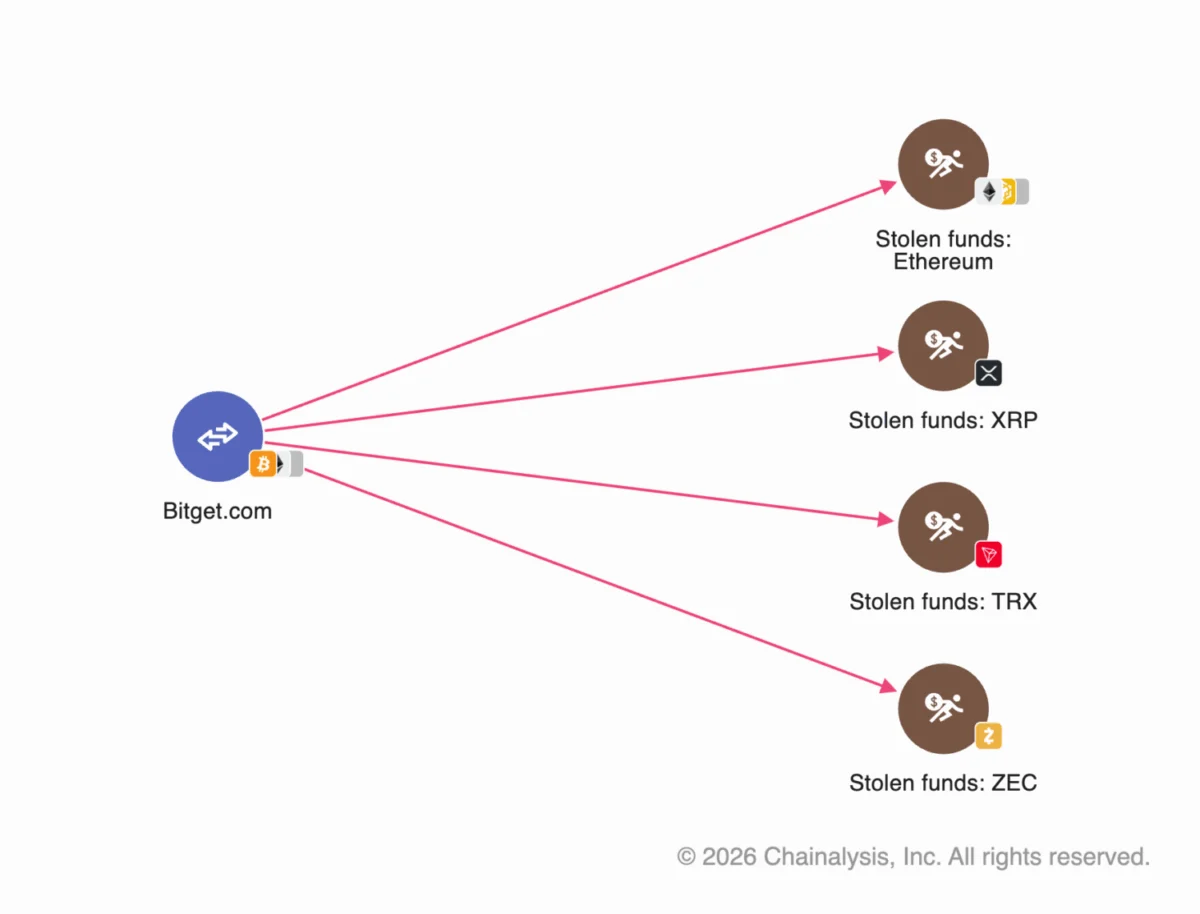
The security breach at Bitget was characterized by its scale and the surgical precision of the fund exfiltration. Within the first three hours of the initial exploit, the attackers successfully moved $387 million out of Bitget’s custody across 23 distinct transfers. The initial distribution of these funds was spread across four primary blockchain networks, a tactic designed to complicate the tracing process from the outset. Ethereum received the largest share, accounting for 49.7% of the stolen assets, followed by XRP at 40.8%. Smaller portions were moved to the Zcash (7.6%) and Tron (1.8%) networks.
As the funds landed on these various chains, the threat actors immediately initiated a series of laundering maneuvers. Unlike traditional cybercriminals who might attempt to move funds directly to centralized exchanges with high liquidity, the DPRK-linked actors utilized decentralized infrastructure. This included cross-chain liquidity protocols and messaging systems that allow for the swapping of assets between disparate blockchains without the need for a centralized intermediary. This multi-chain strategy was intended to create "dead ends" for traditional investigative tools that struggle to reconcile activity across isolated ledger environments.

Advanced AI and the "War Room" Response
In response to the rapid movement of assets, Chainalysis established a round-the-clock "war room" involving its Customer Outcomes team, Bitget’s internal security personnel, and international law enforcement partners. The cornerstone of this response was the use of custom automations powered by Chainalysis’s agentic AI platform. This technology represents a significant shift from traditional AI-assisted graphing; it allows investigators to "interrogate" massive datasets and build bespoke solutions tailored to the specific behavior of the hackers in real-time.
The primary challenge in this investigation was "bridge reconciliation"—the process of matching a deposit on one blockchain (such as XRP) to a corresponding payout on another (such as Bitcoin). Historically, this process required investigators to manually sift through thousands of transactions, looking for temporal and value-based correlations across different explorers. Chainalysis estimates that its AI-driven tools reduced the time required for this specific task from 20 hours to under 10 minutes. This acceleration allowed the team to stay ahead of the attackers, labeling destination addresses and updating the Chainalysis data platform within minutes of new fund movements. This speed is critical for compliance teams at other exchanges, who rely on these labels to freeze incoming illicit funds before they can be withdrawn into fiat currency.
Detailed Analysis of Laundering Mechanisms
The investigation into the Bitget exploit provided a rare glimpse into the sophisticated laundering pipeline used by state-sponsored actors. A significant portion of the stolen XRP was not sent to an exchange but was instead routed through a cross-chain liquidity protocol. Through this mechanism, the attackers deposited XRP on its native ledger and received Bitcoin on the other side. These protocols function by allowing users to interact with liquidity pools, effectively swapping assets without a direct link between the sender’s identity and the recipient’s address.
Chainalysis investigators were able to overcome this hurdle by utilizing over a decade of cross-chain attribution data. By analyzing the on-chain records left by these swaps, the AI tools matched the deposits to the payouts, extending the investigative trail into the Bitcoin network. Over a period of approximately 36 hours, tens of millions of dollars were funneled through these protocols. The funds eventually reached several attacker-controlled Bitcoin addresses, which are now under continuous monitoring. In addition to liquidity protocols, the actors utilized instant swaps, decentralized exchanges (DEXs), and mixers to further fragment the funds and break the "chain of custody" of the digital assets.

Supporting Data: Distribution and Destination of Funds
The data derived from the first 48 hours of the investigation highlights the following breakdown of the initial $387 million theft:
- Ethereum (ETH): $192.3 million (49.7%) – Used primarily for interaction with DeFi protocols and mixers.
- XRP: $157.9 million (40.8%) – Swapped for Bitcoin via cross-chain bridges.
- Zcash (ZEC): $29.4 million (7.6%) – Utilized for its privacy-preserving features to mask transaction amounts and addresses.
- Tron (TRX): $6.9 million (1.8%) – Often used for stablecoin transfers due to low transaction fees.
By the end of the first week, Chainalysis had identified hundreds of secondary and tertiary transfers. The use of "agentic" AI was not intended to replace human expertise but to serve as a force multiplier. Human investigators defined the underlying logic and reviewed the AI-generated outputs to ensure accuracy, but the automation handled the heavy lifting of data reconciliation across the Ethereum, Bitcoin, and XRP networks.
The Broader Context of DPRK Cyber Activity in 2026
The Bitget exploit is not an isolated incident but part of an escalating trend of state-sponsored cryptocurrency theft. With the $387 million stolen from Bitget, the total value of digital assets seized by DPRK-attributed actors in 2026 has surpassed the $1 billion mark. This highlights a strategic shift in North Korean cyber operations, which have become increasingly reliant on decentralized finance (DeFi) exploits and sophisticated automation to fund the state’s activities.
Historically, groups like the Lazarus Group have targeted centralized exchanges and bridges (such as the Ronin Bridge and Harmony Horizon Bridge). However, the 2026 tactics show an increased proficiency in using "chain-hopping" techniques. By moving assets rapidly across four or more different blockchains, the attackers aim to exploit the "visibility gap" that exists between different blockchain monitoring tools. The Bitget case proves that as attackers adopt automation to move funds, investigators must adopt even more sophisticated AI to maintain the integrity of the financial ecosystem.

Official Responses and Regulatory Implications
Bitget has remained in close communication with security firms and law enforcement since the breach. While the exchange has not released a full post-mortem of the initial entry point—whether it was a private key compromise, a smart contract vulnerability, or a social engineering attack—the rapid response of the community has led to the flagging of hundreds of wallets. Law enforcement agencies, including those in the United States and Singapore, are reportedly utilizing the data provided by Chainalysis to pursue international seizure warrants.
The incident is expected to renew calls for stricter regulations regarding cross-chain bridges and decentralized liquidity protocols. Regulators have expressed concern that these tools, while innovative, provide a "black box" for money laundering if they do not implement sufficient anti-money laundering (AML) controls. The ability of Chainalysis to "unmask" these transactions through AI suggests that while the technology can be used for illicit purposes, the transparency of the blockchain remains a powerful tool for justice.
Future Outlook for Blockchain Security
The work of tracing the Bitget funds is ongoing. Chainalysis has stated that it will continue to monitor the movement of the $387 million and update its destination labels as the hackers attempt to move the funds toward "off-ramps" or fiat conversion points. The success of the AI-driven approach in this case serves as a blueprint for future investigations.
The industry is moving toward a model where "speed to label" is the most important metric in mitigating the impact of a hack. If stolen funds can be labeled and recognized by all major exchanges within minutes, the "utility" of those stolen funds drops significantly, as they become impossible to trade or cash out. Chainalysis has hinted that this investigation is a precursor to a new generation of investigative capabilities, with further details expected to be unveiled during a formal announcement on November 19.

As the war between cybercriminals and security experts continues to evolve, the Bitget exploit stands as a landmark case where the application of agentic AI potentially turned the tide. While the $387 million remains largely in the hands of the attackers for now, the unprecedented speed of the trace and the global coordination of law enforcement provide a strong deterrent against future exploits of this magnitude. The integration of human judgment with high-speed automation remains the only viable path forward in securing the future of the digital asset economy.