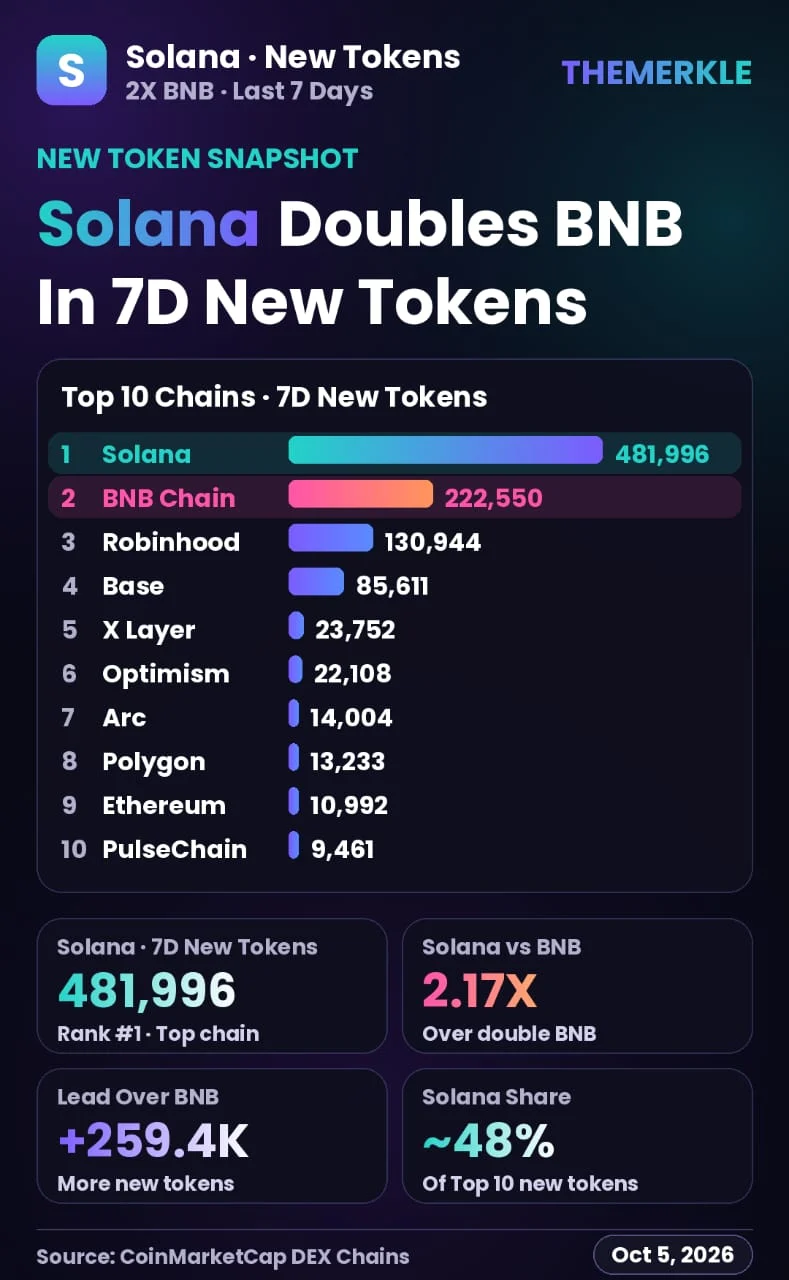
Despite recurring pronouncements of its memecoin machine’s demise, Solana continues to solidify its position as the undisputed leader in the creation of new digital tokens and a hub for decentralized exchange (DEX) activity, with recent data unequivocally refuting claims of its decline. A comprehensive analysis of CoinMarketCap’s Chain Ranking page, specifically examining the 7-day view for new tokens, reveals Solana’s commanding lead, registering an astonishing 481,996 new tokens within the week. This figure dwarfs that of its closest competitor, BNB Smart Chain, which recorded 222,550 new tokens, placing Solana at more than double its rival’s output. This significant disparity underscores a profound shift in the landscape of blockchain development and user engagement, driven by a confluence of technological advantages and strategic incentive programs.
Unpacking the Data: Solana’s Staggering Lead in Token Proliferation
The sheer volume of new tokens emerging from the Solana ecosystem is not merely a marginal advantage but a multi-faceted dominance that becomes more pronounced when examining the broader competitive field. Beyond BNB Smart Chain, the next contenders fall significantly short. Robinhood Chain secured the third position with 130,944 new tokens, followed by Base with 85,611. The decline in new token generation becomes precipitous thereafter: X Layer managed 23,752, Optimism 22,108, Arc 14,004, Polygon 13,233, and Ethereum a comparatively modest 10,992.
To put Solana’s supremacy into stark perspective, the combined total of the other ten chains within the top eleven, excluding Solana itself, amounted to approximately 537,000 new tokens over the same 7-day period. Solana, operating as a singular chain, was responsible for approximately 90 percent of that collective total. This aggregation highlights an unprecedented concentration of token launch activity on a single network, challenging conventional notions of diversified blockchain development.
Perhaps one of the most striking comparisons arises when juxtaposing Solana’s performance against Ethereum, the progenitor of smart contract platforms and the largest blockchain by market capitalization. Ethereum, despite boasting a vastly superior number of protocols—1,639 compared to Solana’s 281 and BNB Smart Chain’s 1,006—launched fewer than 11,000 tokens in the same timeframe. This means Solana generated roughly 44 times more new tokens than Ethereum. This efficiency, where fewer protocols on Solana are producing an exponentially higher volume of tokens, strongly suggests that a concentrated number of launch platforms within the Solana ecosystem are driving the overwhelming majority of this activity, creating a highly efficient, albeit potentially centralized, token generation pipeline.
Beyond Creation: Active Tokens and Unparalleled Trader Engagement
The proliferation of new tokens, while indicative of developer activity and ease of deployment, can sometimes be misleading if these tokens are swiftly abandoned or remain dormant. A more robust measure of ecosystem vitality is the count of active tokens, which reflects sustained interest and utility. Here too, Solana demonstrates an unequivocal lead. The network recorded 690,575 active tokens, substantially higher than BNB Smart Chain’s 286,023, representing a ratio of approximately 2.4 to one. Robinhood Chain and Base followed with 175,945 and 109,104 active tokens, respectively. This data suggests that Solana’s token boom is not merely a fleeting surge of ephemeral projects but translates into a significant proportion of tokens that maintain ongoing user engagement, at least according to CoinMarketCap’s metrics.
The ripple effect of this token and activity surge is profoundly evident in decentralized exchange (DEX) participation. A 30-day leaderboard for unique DEX traders further solidifies Solana’s dominance. The network logged an astounding 16.76 million unique DEX traders, a figure that dwarfs the 3.9 million recorded by BNB Smart Chain and the 3.71 million by Robinhood Chain. On this crucial metric of user participation, Solana stands at approximately 4.3 times the volume of BNB Smart Chain, its closest competitor. This wider gap in trader numbers compared to token creation figures indicates that the chain is not only excelling in the supply side of the equation—producing new tokens—but is also overwhelmingly successful in attracting the demand side, drawing a significantly larger audience of participants actively engaging in token trading. This combination of high supply and robust demand creates a powerful flywheel effect, propelling Solana to the forefront of the speculative token market.
The "Why" Behind the Surge: Strategic Incentives and Launchpad Innovation

The extraordinary surge in Solana’s token creation and trading activity is not accidental but appears to be a direct consequence of innovative and aggressive incentive programs deployed by key launch platforms within its ecosystem. A closer examination of two prominent Solana-based launchpads, Stonk and Pump.fun, provides crucial insights into the mechanisms driving this unprecedented growth.
Stonk, operating through its platform StonkFun, has openly declared on X (formerly Twitter) that it has distributed over $90 million in rewards to holders of its reward coins. This substantial payout acts as a powerful magnet, incentivizing users to acquire and hold specific tokens to qualify for these distributions. Adding another layer to its incentive structure, Stonk introduced "Community Coins" two days prior to these reward announcements. This feature mandates that each memecoin launched in "Community Mode" allocates 33 percent of its holder rewards to eligible community holders, with the remaining 67 percent distributed among the meme’s own holders. This mechanism effectively broadens the incentive base, encouraging wider community participation and cross-promotion of new tokens.
Pump.fun, another major player in the Solana launchpad arena, employs a different yet equally effective incentive strategy. The platform has reportedly awarded over $14 million to "callers" on its app. Callers are typically individuals who identify and promote promising new tokens, often acting as early influencers. Pump.fun’s pitch, encapsulated by the phrase "buy a token, share your rationale, get paid," directly rewards analytical engagement and promotional activity. This model effectively gamifies the process of token discovery and endorsement, aligning the financial interests of callers with the success of new token launches. While these figures are self-reported by the platforms and cannot be independently verified from a screenshot, their scale suggests a significant commitment to user incentivization.
Solana’s Technical Edge: A Foundation for Memecoin Mania
Beyond the incentive structures, Solana’s underlying technical architecture provides a fertile ground for the memecoin phenomenon. Known for its high transaction throughput and remarkably low transaction fees, Solana offers an environment where launching and trading tokens is both cost-effective and efficient. The network can handle tens of thousands of transactions per second (TPS), far surpassing the capabilities of many older blockchains, including Ethereum, which often struggles with scalability and high gas fees during periods of intense activity. For memecoins, which often rely on rapid trading cycles, frequent transactions, and low barriers to entry for participants, Solana’s speed and affordability are critical advantages.
The minimal transaction costs on Solana mean that even small-value trades, common in the speculative memecoin market, remain economically viable. This contrasts sharply with networks where gas fees can sometimes exceed the value of the trade itself, effectively pricing out smaller retail investors or discouraging frequent speculative activity. This technical superiority creates a frictionless environment that directly facilitates the kind of high-volume, low-cost token creation and trading observed in the recent data.
Historical Context: The Evolution of Memecoins and Solana’s Journey
The concept of memecoins is not new, tracing its origins back to Dogecoin in 2013. However, the phenomenon truly exploded in popularity during the 2021 bull run, largely on Ethereum and later on BNB Smart Chain, with tokens like Shiba Inu leading the charge. These early memecoin cycles often saw astronomical gains, drawing significant retail interest and capital into the crypto space. Yet, they were also characterized by extreme volatility, pump-and-dump schemes, and a general lack of underlying utility, leading many to view them as purely speculative assets.
Solana’s ascent in the memecoin space has been a more recent development, gaining significant traction in late 2023 and early 2024. Prior to this, Solana had faced its own set of challenges, including network outages and a downturn in market sentiment following the FTX collapse, which had close ties to the Solana ecosystem. However, the network demonstrated remarkable resilience, rebuilding trust and attracting a new wave of developers and users drawn to its technical capabilities. The resurgence of memecoins on Solana can be seen as a new chapter in this ongoing narrative, positioning the chain not just as a competitor to Ethereum in DeFi and NFTs, but as the de facto leader in the highly speculative, high-volume segment of the crypto market. The "death of Solana memecoins" narrative has often emerged during market corrections or after significant price volatility, only to be disproven by subsequent data reflecting renewed activity and interest.
Industry Reactions and Competitive Landscape

While official statements from competing blockchain foundations are rare regarding such specific metrics, the implications of Solana’s dominance are not lost on the industry. Other chains, particularly those like BNB Smart Chain, Base, and Polygon, which also cater to high-volume DApps and lower-cost transactions, are undoubtedly observing Solana’s strategy. The aggressive incentive models from Solana-based launchpads could pressure competitors to innovate their own user acquisition and retention strategies, potentially leading to a broader trend of "incentive wars" across the blockchain ecosystem.
Market analysts, while acknowledging Solana’s impressive metrics, often approach the memecoin phenomenon with a degree of caution. While it drives network activity and can bring new users into the crypto space, the speculative nature of memecoins raises concerns about market stability and the potential for significant retail investor losses. However, proponents argue that memecoins, by lowering the barrier to entry for token creation and participation, act as a gateway drug to the broader crypto ecosystem, eventually leading users to explore more utility-driven applications.
Broader Market Implications: Risks and Rewards of a Memecoin Boom
The current memecoin boom on Solana presents a dual-edged sword for the broader cryptocurrency market. On the one hand, it undeniably injects significant liquidity and user engagement into the ecosystem. The influx of millions of unique traders and the rapid creation of tokens indicate a vibrant, if speculative, market environment. This can attract new capital, drive demand for the native SOL token (used for transaction fees), and foster a sense of excitement and innovation. The accessibility of token creation also empowers a wider range of individuals to experiment with decentralized finance concepts, even if in a highly simplified and speculative form.
However, the risks associated with such a concentrated and incentive-driven surge are substantial. The primary caution lies in the inherent nature of memecoins: their value is largely derived from community sentiment, speculation, and viral trends rather than tangible utility or fundamental technology. Most memecoins, by design, are prone to rapid pumps and equally rapid dumps, leading to significant wealth transfers and potential losses for less experienced traders. The reward programs, while effective in stimulating activity, can also attract participants whose primary motivation is the payout rather than conviction in the token’s long-term viability. This "chasing the payout" mentality can contribute to short-term speculative bubbles that are unsustainable.
Furthermore, a sudden withdrawal or reduction of these incentive programs could lead to an equally rapid decline in token creation and trading activity. If the "sugar rush" of rewards subsides, the token count could fall as quickly as it rose, potentially leaving behind a trail of abandoned projects and disillusioned investors. The sheer volume of new tokens also raises questions about network congestion and the long-term sustainability of hosting such a high number of projects, though Solana’s architecture is designed to handle high throughput.
Future Outlook and Sustainability
For the time being, Solana’s lead in new token creation, active tokens, and DEX trader participation is not just real, but strikingly wide across all three metrics. The gap over BNB Smart Chain and other competitors is substantial, indicating a significant and sustained shift in market dynamics. The coming weeks and months will be crucial in determining whether this reward-driven launch boom represents a durable, fundamental shift in the blockchain landscape or a transient phenomenon fueled by aggressive promotional incentives.
If the impressive 7-day numbers continue to hold steady and are replicated in subsequent snapshots of data, it would be difficult to dismiss this as merely a temporary spike. Such sustained performance would suggest that Solana has indeed cultivated a robust and attractive environment for token creation and trading, capable of maintaining its momentum beyond initial incentive programs. It would further solidify Solana’s reputation not just as a high-performance blockchain, but as the current epicenter of retail crypto speculation and innovation, fundamentally reshaping competitive dynamics within the blockchain industry. The ongoing evolution of its launchpad strategies and the broader market’s response will undoubtedly define the trajectory of this compelling narrative.