The digital asset market is currently navigating a period of profound behavioral divergence, characterized by a sharp disconnect between broad investor sentiment and localized trading activity within the altcoin sector. While the overarching narrative in the cryptocurrency space has been one of exhaustion and declining engagement, recent data from the on-chain analytics platform CryptoQuant suggests that a specific cohort of market participants is actively positioning themselves within the mid-to-low-cap altcoin market. This activity is occurring at a time when traditional market indicators—such as total trading volume and social media sentiment—remain pinned at multi-month lows, creating a technical anomaly that historically precedes shifts in market structure.
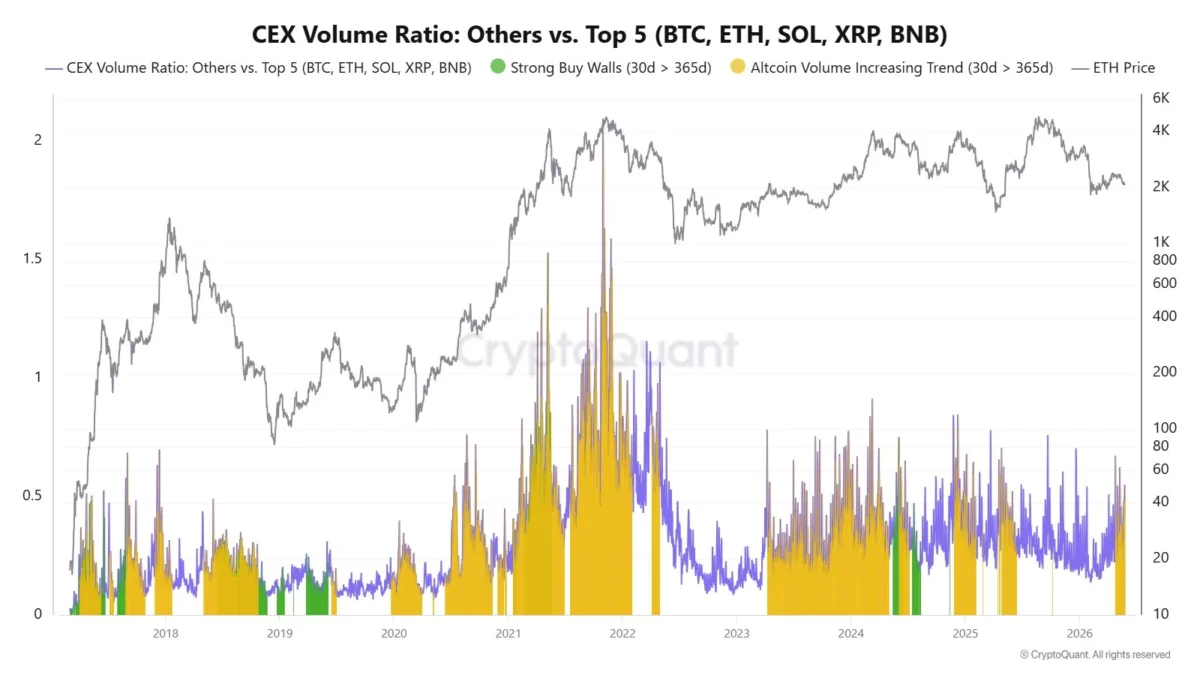
The core of this divergence lies in the "OTHERS" category of the market, which encompasses all cryptocurrencies excluding the top five dominant assets: Bitcoin (BTC), Ethereum (ETH), Solana (SOL), XRP, and Binance Coin (BNB). While the "Big Five" continue to see consolidated price action and diminishing retail interest, the exchange volume for the remainder of the market has begun to climb. This suggests that while the general public may be disengaged, sophisticated or "deliberate" participants are quietly rotating capital into higher-risk, higher-reward assets, potentially in anticipation of a broader market rotation.
The Macro Landscape: A Climate of Attrition and Apathy
To understand the significance of the current rise in altcoin volume, one must first look at the macro environment that has defined the early part of 2025. Following a volatile 2024, the cryptocurrency market entered a phase of "sideways" price action that has tested the patience of even the most seasoned traders. The initial enthusiasm seen during brief recovery attempts in early February has largely evaporated, replaced by a sentiment of skepticism and apathy.
Broadly speaking, crypto trading volumes across major centralized exchanges (CEXs) have been on a downward trajectory for several weeks. This decline is typically reflective of a "wait-and-see" approach by institutional and retail investors alike, often driven by macro headwinds such as shifting Federal Reserve policies, regulatory uncertainty in key jurisdictions, and a lack of clear catalysts for Bitcoin to break out of its established range.

However, the CryptoQuant data identifies a specific anomaly: the "Altcoin CEX Volume Ratio." This metric tracks the volume of the "OTHERS" group relative to the market leaders. When this ratio rises during a period of overall declining volume, it indicates that the trades being executed are not reactive or driven by panic; rather, they are the result of strategic accumulation. In a quiet market, every trade carries more weight, and the persistent increase in altcoin-specific volume suggests a targeted interest in assets that have been beaten down by years of underperformance.
A Chronology of Altcoin Performance: From Peak to Stabilization
The current market structure is the culmination of a multi-year cycle that began with the peak of the 2021 bull run. To contextualize the current "stabilization phase," it is necessary to trace the timeline of altcoin performance relative to Bitcoin:
- The 2021 Peak and 2022 Collapse: Following the historic highs of November 2021, the altcoin market entered a brutal "crypto winter." The collapse of the Terra-Luna ecosystem and the subsequent bankruptcy of FTX in late 2022 led to a massive flight to safety, with capital retreating from speculative altcoins back into Bitcoin or stablecoins.
- The 2023 "Bitcoin First" Recovery: As the market began to heal in 2023, the recovery was heavily skewed toward Bitcoin. The narrative was dominated by the anticipation of Spot Bitcoin ETFs, which institutionalized BTC but left the broader altcoin market largely ignored.
- The 2024 False Dawn: In early 2024, several altcoin sectors—most notably memecoins and Artificial Intelligence (AI) tokens—showed signs of life. However, this did not translate into a broad-based "Altcoin Season." Instead, the market remained fragmented, with liquidity rotating quickly between narrow niches rather than lifting the entire sector.
- Early 2025 Consolidation: Entering 2025, the OTHERS/BTC ratio reached a critical juncture. After more than two years of persistent underperformance, the aggressive sell-off phase appears to have transitioned into a sideways consolidation pattern near the 0.12 region on the OTHERS/BTC index.
This timeline illustrates that the current rise in volume is not happening in a vacuum. It is occurring after years of price depreciation, a period long enough to "flush out" speculative participants who lack the conviction to hold through extended periods of stagnation.
Technical Analysis: The OTHERS/BTC Ratio and Moving Averages
From a technical perspective, the OTHERS/BTC index remains the primary barometer for the health of the altcoin market. This index measures the total market capitalization of all cryptocurrencies excluding the top 10 assets relative to Bitcoin’s market cap. Currently, the technical structure of this ratio is described as "weak but stabilizing."
The ratio is presently trading below its 50-week, 100-week, and 200-week moving averages (MAs). In traditional technical analysis, trading below these long-term MAs confirms a structural downtrend. However, the "momentum deterioration" that defined 2024 has begun to slow. Instead of making new lower lows, the ratio has spent the last several months defending the 0.12 support level.

The defense of this range is significant for three reasons:
- Exhaustion of Sellers: The lack of a breakdown despite negative sentiment suggests that those who intended to sell have already done so.
- Absorption of Supply: The rising volume in the "OTHERS" category indicates that new buy orders are absorbing the remaining sell-side liquidity at these depressed levels.
- Historical Precedent: Major altcoin rotations historically do not begin with a vertical "V-shaped" recovery. Instead, they begin with a "rounding bottom" or a prolonged period of sideways consolidation where the "smart money" accumulates before a public breakout.
If the OTHERS/BTC ratio can successfully reclaim the 50-week moving average, it would mark the first significant trend change in nearly two years. Such a move would likely act as a signal for trend-following investors to re-enter the market, potentially leading to a rapid expansion of momentum.
Identifying the Participants: Who is Driving the Volume?
Because the current volume increase is happening against a backdrop of general market negativity, it is possible to infer the profile of the participants involved. Retail investors, who are typically driven by price action and social media hype, are currently absent from the market. This is evidenced by the low search volume for "crypto" and "altcoins" on platforms like Google Trends.
The participants generating this volume are likely "conviction-driven" actors. This includes:
- Venture Capital and Private Equity: Firms that are continuing to deploy capital into early-stage projects that have yet to reach the top 10 rankings.
- Ecosystem Funds: Foundations associated with specific blockchains (such as modular networks or Layer-2 solutions) that are providing liquidity to support their native tokens.
- Sophisticated Retail and "Whales": Investors who utilize on-chain data to identify "oversold" conditions and are willing to endure volatility in exchange for early-cycle positioning.
The CryptoQuant report emphasizes that this volume is "deliberate." In a market where liquidity is thin, every large trade has a greater impact on price and volume metrics. The fact that this volume is consistently rising suggests a systematic accumulation strategy rather than sporadic, reactive trading.

Broader Implications and Market Outlook
The divergence identified by CryptoQuant serves as a reminder that market sentiment is often a lagging indicator. By the time the general public becomes "bullish" on altcoins again, the most significant portion of the recovery may have already occurred. The current "quietness" of the market provides a veil under which accumulation can happen without triggering the massive price spikes that attract unwanted competition.
However, risks remain. The structural dominance of Bitcoin is still intact, and the altcoin market faces a high bar for recovery. Regulatory pressure, particularly in the United States, continues to cast a shadow over many smaller-cap projects. Furthermore, the "dilution" of the altcoin market—where thousands of new tokens are launched every month—means that a broad "rising tide" that lifts all boats is less likely than in previous cycles. Investors are becoming more selective, focusing on projects with clear utility, revenue models, or strong community backing.
In conclusion, while the surface of the crypto market remains calm and perhaps even discouraging to many, the underlying data reveals a different story. The increasing exchange volume for altcoins outside the top five assets, coupled with the stabilization of the OTHERS/BTC ratio, suggests that the groundwork for the next phase of the cycle is being laid. Whether this leads to a confirmed "Altcoin Season" remains to be seen, but the behavioral divergence currently visible is a technical signal that has historically preceded significant shifts in market leadership. Observers should keep a close eye on the 50-week moving average; a reclaim of that level could be the spark that turns this quiet accumulation into a public rally.