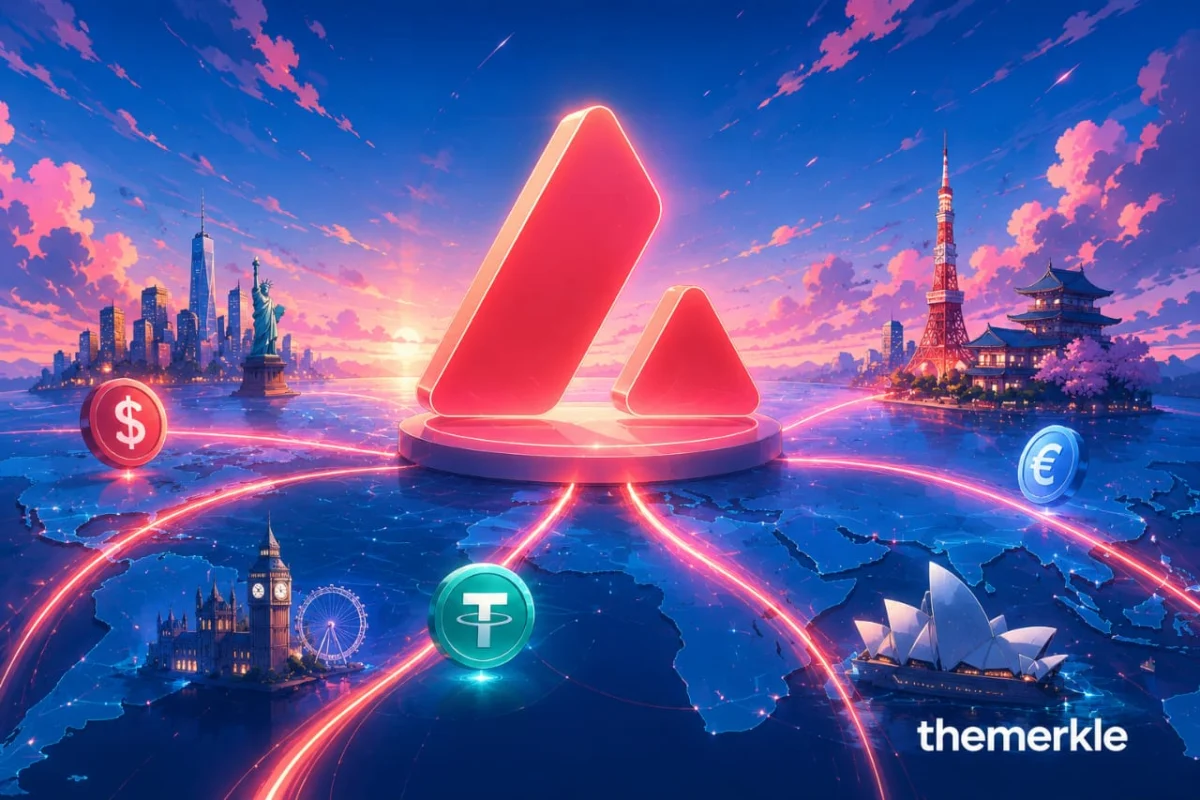
Avalanche has formally unveiled the Avalanche Payments Collective, a landmark initiative bringing together 28 diverse organizations that collectively span nearly every critical layer of the global payments ecosystem. This ambitious consortium aims to fundamentally transform cross-border transactions and enhance the efficiency, cost-effectiveness, and transparency of global money movement by leveraging blockchain technology. The announcement marks a significant step in the ongoing convergence of traditional finance (TradFi) and the nascent digital asset space, signaling a maturing landscape for blockchain adoption in enterprise-grade applications.
The founding roster of the Collective reads like a strategic cross-section of the financial world, blending established institutional players with cutting-edge crypto-native infrastructure providers. Among the prominent participants are investment management giants Franklin Templeton and VanEck, alongside leading digital asset custodians and stablecoin issuers such as Anchorage Digital and Paxos. Further enhancing the group’s capabilities are Agora, Ethena, Rain, Axiym, and Tassat, whose expertise collectively covers stablecoins, settlement services, treasury infrastructure, regulated custody solutions, and foreign exchange. This diverse amalgamation of expertise underscores a comprehensive approach to tackling the multifaceted challenges inherent in global payments.
This is not merely a symbolic gathering; the scope of the Avalanche Payments Collective is genuinely global and unprecedented in its reach. The Collective’s combined operational footprint encompasses payment flows across more than 150 countries, supports 96 distinct currencies, and taps into approximately 22 billion payout endpoints. These staggering figures are not speculative projections but reflect the existing infrastructure and operational capabilities that the founding members already command. For an industry that has long grappled with slow, fragmented, and costly payment rails, often discussing blockchain as a theoretical panacea, this initiative represents one of the most concrete and institutionally backed attempts to build a viable, large-scale replacement. The involvement of such respected names, already deeply integrated into global financial networks, lends substantial credibility and operational heft to Avalanche’s vision.
The Genesis of the Collective: Addressing Global Payment Fragmentation
The rationale behind the establishment of the Avalanche Payments Collective stems from a long-standing, well-understood problem in the global payments sector: transaction speed alone is insufficient to solve the complexities of international money movement. While blockchain technology has often been lauded for its ability to facilitate near-instantaneous settlement, the reality of cross-border payments involves a far more intricate web of requirements. As Avalanche itself articulates, the future of payments demands more than just faster transactions. Moving money across borders necessitates seamless integration and coordination across a multitude of functions including liquidity management, regulatory compliance, secure settlement, robust treasury management, trusted custody, efficient foreign exchange (FX) mechanisms, and interoperability with diverse local payment networks. Each of these components must function cohesively, rather than as independent, disconnected silos, to truly unlock efficiency.
Consider the common scenario: a stablecoin might settle in mere seconds on a blockchain, but if the compliance layer on the sending end of a transaction cannot effectively communicate with the custody layer or the receiving bank’s regulatory framework on the other end, the speed advantage evaporates. Funds remain stuck, often requiring cumbersome manual intervention, and encountering the very friction points that have made cross-border payments slow, expensive, and opaque for decades. These inefficiencies impose significant costs on businesses and consumers alike, estimated to run into hundreds of billions of dollars annually in fees and lost opportunity due to delayed settlements.
Avalanche’s journey toward this collective has been a deliberate, albeit initially understated, strategic build-out over several years. Various companies specializing in stablecoins, settlement, and treasury infrastructure have been individually developing and deploying solutions on the Avalanche network. The formal launch of the Collective now consolidates this previously scattered activity, providing a unified identity, a shared strategic roadmap, and a collaborative framework for future development. This consolidation aims to foster a network effect, where the sum of integrated parts far exceeds the capabilities of isolated solutions.
A Coalition of Giants: The Founding Participants and Their Roles
The diverse composition of the founding participants is critical to the Collective’s potential success, embodying a deliberate strategy to bridge the gap between traditional finance and blockchain innovation. Each member brings a distinct, yet complementary, capability to the table:
- Traditional Asset Managers: Firms like Franklin Templeton and VanEck represent the bedrock of established asset management. These institutions manage trillions of dollars in institutional capital and have been at the forefront of exploring tokenized fund products and digital assets. Their involvement signals a profound institutional endorsement of blockchain’s utility beyond speculative trading, specifically in the realm of operational efficiency for financial products and services. Franklin Templeton, for instance, has already launched tokenized money market funds on-chain, demonstrating a practical commitment to integrating digital assets into their core offerings.
- Regulated Custody and Stablecoin Infrastructure: Anchorage Digital and Paxos are pivotal players, providing the kind of regulated, audited, and secure infrastructure that large financial institutions demand before committing meaningful volume to on-chain operations. Anchorage Digital, as one of the few federally chartered digital asset banks in the U.S., offers institutional-grade custody services that meet stringent regulatory requirements. Paxos is a leading regulated blockchain infrastructure platform, known for its stablecoin issuance (like USDP) and its blockchain-based settlement services, which are critical for secure and compliant digital asset transactions. Their involvement addresses the crucial trust and compliance hurdles that have historically impeded broader institutional adoption of blockchain.
- Specialized Payment and Settlement Providers: Agora and Ethena contribute further stablecoin and settlement capacity, enhancing the Collective’s ability to facilitate efficient value transfer. Rain, Axiym, and Tassat round out the group with expertise spanning card issuance, business payments, and additional settlement infrastructure, ensuring a comprehensive coverage of payment types and use cases. Tassat, for example, is known for its TassatPay platform, which enables real-time payments for banks, demonstrating its capabilities in modernizing payment rails.
Individually, these companies operate within specialized niches. The genius of the Avalanche Payments Collective lies in its ability to stitch these disparate lanes together into a coherent, interconnected system. Within this framework, custody solutions can seamlessly communicate with settlement layers, which in turn integrate with treasury infrastructure, and flow into foreign exchange mechanisms. All these processes are designed to run through the unified Avalanche blockchain layer, eliminating the need for each member to build and maintain complex, bespoke integrations with multiple disconnected systems.
Avalanche’s Strategic Foundation: A History of Institutional Focus
Avalanche’s underlying architecture and strategic development have positioned it as a compelling choice for institutional applications. Its innovative Subnet architecture allows for the creation of application-specific blockchains with customizable parameters, including gas fees, virtual machine specifications, and validator sets. This flexibility is crucial for enterprises that require bespoke environments to meet specific regulatory, privacy, or performance demands. Institutions can launch their own private or permissioned Subnets, maintaining control over who can participate and what rules govern their transactions, while still benefiting from the security and decentralization of the broader Avalanche network.
Furthermore, Avalanche boasts high transaction throughput and rapid finality, which are non-negotiable requirements for high-volume payment systems. Its consensus mechanism, Snowman, is designed for scalability and robustness, offering near-instant transaction finality – a critical feature for financial settlements where certainty of transaction completion is paramount. Over the past few years, Avalanche has actively pursued partnerships and initiatives aimed at attracting institutional users, including collaborations in asset tokenization and enterprise blockchain solutions, laying the groundwork for initiatives like the Payments Collective. This deliberate focus on enterprise-grade features and institutional readiness has made it an attractive platform for financial incumbents looking to explore blockchain’s potential.
The Unprecedented Scale: Global Reach and Existing Infrastructure
The figures associated with the Avalanche Payments Collective – payment flows across 150+ countries, 96 currencies, and 22 billion payout endpoints – are not hyperbole. They represent the aggregated, existing operational infrastructure that the founding members already command. This distinction is crucial: Avalanche is not claiming to build this infrastructure from scratch, but rather to connect and optimize what already exists by routing an increasing share of these flows through a shared on-chain layer.
The 22 billion payout endpoints figure is particularly striking. It encapsulates the vast network of individual bank accounts, mobile wallets, card networks, and other payment channels that the Collective’s members already touch through their regular business operations, spanning nearly a hundred different currencies. This number is not contingent on future crypto adoption curves or speculative growth projections; it reflects the real-world reach of established financial players. What the Collective changes is the underlying mechanism by which these payments are processed. By routing them through a shared blockchain layer, it enables settlement, compliance, and liquidity to move together synchronously, rather than through disparate systems that historically operate in isolation. This integrated approach promises to unlock efficiencies that were previously unattainable.
Differentiating from Past Attempts: Credibility and Regulatory Adherence
The blockchain industry has seen numerous projects proclaim themselves as the future of payments, with many failing to deliver beyond marketing rhetoric. What distinguishes the Avalanche Payments Collective is the unparalleled seniority, institutional trust, and regulatory standing of its participants.
The involvement of firms like Franklin Templeton and VanEck is not merely a name-drop; these are entities with decades of institutional trust, robust regulatory oversight, and substantial capital under management. Their willingness to actively integrate into Avalanche’s ecosystem carries immense weight, far exceeding the credibility of smaller, less established crypto-native startups. Their participation signals a belief that Avalanche provides a secure, scalable, and compliant platform for real-world financial applications.
Similarly, Anchorage Digital’s presence is a game-changer. As one of the very few federally chartered digital asset banks in the United States, its involvement signifies that the critical function of custody for this payments infrastructure is not being handled by an unregulated or opaque intermediary. Instead, it is managed by an institution that already meets the rigorous regulatory standards and expectations of traditional finance. This detail alone addresses a major hurdle that many earlier blockchain-based payment rails struggled to overcome: the pervasive need for trust, regulatory compliance, and robust security in financial transactions. By bringing these elements to the forefront, the Avalanche Payments Collective positions itself as a legitimate contender to revolutionize global payments within the existing regulatory framework, rather than attempting to bypass it.
The Broader Implications: Reshaping the Financial Landscape
The successful implementation and expansion of the Avalanche Payments Collective could have profound implications across the global financial landscape.
- Reduced Costs and Increased Efficiency: By streamlining complex cross-border payment processes, reducing intermediaries, and accelerating settlement times, the Collective has the potential to significantly lower transaction costs for businesses and individuals. This could unlock substantial economic value, particularly for small and medium-sized enterprises (SMEs) engaged in international trade, and for migrant workers sending remittances.
- Enhanced Transparency and Auditability: Blockchain’s inherent transparency and immutable ledger provide a clear audit trail for every transaction. This can improve regulatory reporting, reduce fraud, and enhance trust among participants in the payment network.
- Liquidity Management and FX Optimization: By integrating stablecoins and tokenized assets, the Collective can facilitate more efficient liquidity management across different currencies, potentially reducing the need for pre-funded Nostro/Vostro accounts and optimizing foreign exchange operations.
- Competitive Pressure on Traditional Systems: The success of such a blockchain-powered network will undoubtedly exert pressure on traditional correspondent banking systems and payment networks (like SWIFT) to innovate and adapt. While these legacy systems have their own modernization efforts underway, the agility and cost-effectiveness of a blockchain-native solution could prove a formidable challenge.
- Catalyst for Broader Digital Asset Adoption: The Collective’s institutional backing and real-world application could serve as a powerful catalyst for broader institutional and enterprise adoption of digital assets and blockchain technology. It demonstrates that blockchain is not just for speculative investment but a viable infrastructure for core financial services.
Challenges and Outlook
Despite its formidable potential, the Avalanche Payments Collective will face significant challenges. Regulatory harmonization across 150+ countries remains a complex undertaking, requiring ongoing dialogue and adaptation. Interoperability with existing legacy systems, as well as with other emerging blockchain networks and Central Bank Digital Currencies (CBDCs), will be crucial for true global ubiquity. User adoption, while supported by the existing customer bases of its members, will still require education and a compelling value proposition to shift entrenched behaviors.
Nevertheless, the Avalanche Payments Collective represents a pivotal moment in the evolution of global finance. By bringing together a powerful coalition of traditional financial giants and leading blockchain innovators, and by directly addressing the intricate layers of global money movement beyond mere speed, Avalanche is poised to drive a meaningful transformation in how value is transferred across borders. This initiative is not just about building a new payment rail; it’s about constructing a more integrated, efficient, and resilient global financial infrastructure for the digital age, grounded in credibility and institutional trust.