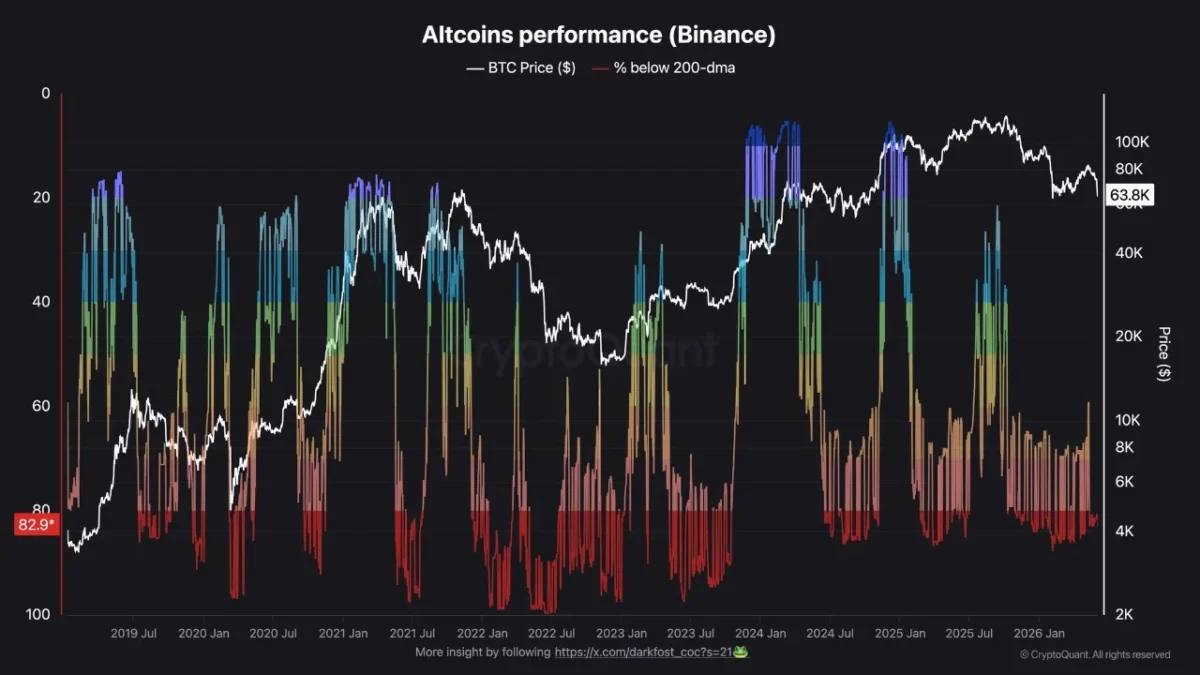
The global financial landscape underwent a period of intense volatility last week, sending shockwaves through both traditional equity markets and the nascent digital asset sector. As bearish sentiment took hold of the technology sector, particularly surrounding artificial intelligence and semiconductor stocks, the ripple effects were felt acutely across the cryptocurrency market. According to recent data and analysis from seasoned market observer Darkfost, altcoins—cryptocurrencies excluding Bitcoin—are currently navigating a precarious environment defined by significant capital outflows and a breakdown in long-term technical support levels. This downturn has seen more than $1 trillion in market capitalization evaporated from US financial markets in a single trading session, with the contagion spreading rapidly to the digital asset class.
The Anatomy of a Market Flush: Macroeconomic Pressures
The catalyst for the recent downturn originated in the traditional corridors of Wall Street. On Friday, a wave of selling pressure hit the US markets, fueled by weakening sentiment regarding the valuation of AI-driven enterprises and semiconductor manufacturers. The tech-heavy Nasdaq Composite led the decline with a 4.7% drop, while the broader S&P 500 index retreated by 2.6%. This risk-off environment immediately impacted Bitcoin, which saw a 4% decline, but the damage to the altcoin sector was disproportionately severe.
While Bitcoin has historically served as a bellwether for the entire crypto market, the current cycle has revealed a widening divergence. Altcoins have struggled to maintain a positive correlation with Bitcoin’s price appreciation since late 2024. As investors sought the perceived safety of Bitcoin or retreated to cash, the liquidity pool for smaller, more speculative assets dried up. This structural weakness has left the altcoin market in its most vulnerable state in several years, characterized by a lack of buying pressure and a failure to capitalize on Bitcoin’s earlier surges toward all-time highs.
Technical Breakdown: The Significance of the 200-Day Moving Average
Central to the analysis provided by Darkfost, a prominent contributor to the CryptoQuant platform, is the status of altcoins relative to their 200-day moving average (200DMA). The 200DMA is widely regarded by institutional and retail traders alike as a definitive barometer for long-term market health. When an asset trades above this line, it is generally considered to be in a macro uptrend; conversely, trading below it signals a sustained bearish phase.

The data reveals a staggering statistic: 83% of all altcoins are currently trading below their 200DMA. This metric is a clear indicator of a deep-seated bearish trend that transcends individual projects, suggesting a systemic rejection of the broader altcoin market. Since 2022, the percentage of altcoins trading below this key level has fluctuated between 60% and 90%, but the current reading of 83% places the market in a zone of extreme underperformance.
For many investors, the 200DMA serves as a "line in the sand." The inability of the majority of the market to reclaim this level suggests that the "altseason" many had anticipated for early 2025 has been indefinitely postponed. This technical failure reflects a lack of confidence among market participants, who are increasingly hesitant to hold assets that lack the institutional backing and ETF-driven inflows currently supporting Bitcoin.
The $520 Billion Capital Flight: Analyzing the TOTAL3 Index
To quantify the scale of the altcoin retreat, analysts point to the TOTAL3 chart provided by TradingView. This index tracks the total market capitalization of all cryptocurrencies, excluding Bitcoin and Ethereum, providing the most accurate representation of the "broad" altcoin market. The data shows a dramatic contraction in valuation. Since reaching a local peak in October 2024, the TOTAL3 index has shed approximately $520 billion in market value.
At its height in late 2024, the combined valuation of these assets stood significantly higher, but it has since plummeted to roughly $670 billion. This decline has effectively erased nearly six months of gains, returning the market to valuation levels not seen since November 2024. The velocity of this capital flight underscores the fragility of the current crypto ecosystem. In previous cycles, altcoins often followed Bitcoin’s lead with a short delay, but in the current environment, the "trickle-down" effect of capital has been notably absent. Instead, the market is witnessing a "flight to quality," where capital is being consolidated into Bitcoin or exiting the crypto space entirely to cover losses in traditional equity portfolios.
Chronology of the Altcoin Decline
The current state of the market is the result of a multi-month erosion of investor confidence. A timeline of the events leading to the current crisis reveals a pattern of diminishing returns:

- October 2024: The altcoin market reaches a local peak as the TOTAL3 index hits a high for the cycle. Optimism is high following Bitcoin’s initial push toward $70,000, and many investors begin rotating into mid-cap and small-cap assets.
- December 2024: A notable decoupling begins. While Bitcoin continues to trade near its highs, altcoins fail to reach new milestones. The percentage of assets trading above their 200DMA begins to slide from its March highs.
- January 2025: Macroeconomic uncertainty regarding interest rate cuts and US fiscal policy begins to weigh on risk-on assets. Altcoins experience a "slow bleed" as liquidity migrates toward Bitcoin ETFs.
- February 2025: The "Friday Wipeout." Weakness in the AI and semiconductor sectors triggers a massive sell-off in US equities. The resulting margin calls and de-risking lead to a $1 trillion loss in US markets and a final blow to altcoin support levels, pushing 83% of the market below the 200DMA.
Market Sentiment: Extreme Pessimism as a Contrarian Indicator
Despite the grim statistics, Darkfost’s analysis offers a contrarian perspective that is often found in veteran market cycles. Historically, periods of extreme pessimism—where the vast majority of assets are trading below their long-term averages—have preceded significant market bottoms.
The analyst notes that periods of peak optimism, such as March and December 2024, when nearly 90% of altcoins were trading above their 200DMA, actually represented higher-risk entry points with limited upside. In contrast, the current "breadth contraction" represents a washout of speculative fervor. During the 2017 and 2021 cycles, similar levels of underperformance eventually paved the way for explosive growth once the market reached a point of maximum exhaustion.
However, the path to recovery is fraught with challenges. The current market cycle is fundamentally different from those of the past due to the sheer number of tokens in existence. The "dilution" of the altcoin market, caused by the daily launch of thousands of new tokens on platforms like Solana and Base, has made it difficult for capital to concentrate in a way that drives a broad-based rally.
The Role of Institutional Dominance and the Bitcoin Halving Aftermath
The broader implications of this altcoin slump are tied to the changing structure of the cryptocurrency market. With the introduction of Spot Bitcoin ETFs in the United States, Bitcoin has effectively been separated from the rest of the asset class in the eyes of institutional investors. While Bitcoin is now viewed as a "digital gold" or a legitimate hedge within a diversified portfolio, altcoins remain categorized as high-risk venture bets.
Furthermore, the post-halving period of 2024 and early 2025 has not yet delivered the parabolic "altseason" that historical patterns suggested. The lack of retail participation, which usually drives altcoin manias, is a significant factor. High inflation and the cost of living have reduced the disposable income of the average retail investor, who was the primary driver of the 2021 memecoin and DeFi booms.

Future Implications and Investor Strategy
As the market digests the $520 billion loss in altcoin valuation, the focus shifts to what might trigger a reversal. Analysts suggest that a stabilization in the Nasdaq and a cooling of the volatility in the AI sector are prerequisites for a crypto recovery. If the US Federal Reserve signals a more dovish stance on interest rates, the return of "cheap money" could reignite the appetite for riskier altcoin investments.
For now, the market remains in a state of "wait and see." The 200DMA will continue to serve as the primary resistance level to watch. Until a significant percentage of the market can reclaim this average, the trend remains firmly bearish. Investors are being cautioned to focus on projects with strong fundamentals, real-world utility, and sustainable tokenomics, as the "junk" tokens that proliferated during the height of the market are unlikely to recover from this level of capital flight.
In conclusion, the altcoin market is currently enduring a "stress test" of historic proportions. The combination of global macroeconomic instability, a technical breakdown of long-term support, and a shift in capital toward institutional-grade assets like Bitcoin has created a perfect storm. While historical data suggests that such periods of extreme despair can be fertile ground for long-term gains, the structural weaknesses currently on display indicate that the road to recovery will be long and characterized by a rigorous "survival of the fittest" among digital assets.