The cryptocurrency landscape is once again grappling with the harsh realities of economic sustainability, as the Blast network, a Layer 2 solution that once boasted over $2 billion in total value locked (TVL), now reports a mere $110 in chain revenue over the last 24 hours, according to data from DefiLlama. This dramatic decline, starkly illustrated by a revenue figure roughly equivalent to the price of a mid-range pair of sneakers, underscores a critical flaw in certain growth strategies within the decentralized finance (DeFi) space, particularly those heavily reliant on substantial airdrops to bootstrap liquidity and user engagement. The network’s impending shutdown, announced by its core team, serves as a sobering case study on the often-misunderstood dynamics between initial capital attraction and long-term viability.
The Precipitous Decline of Blast: From Billions to Barely Breaking Even
Blast emerged onto the scene with considerable fanfare, positioning itself as an Ethereum Layer 2 network offering native yield for both ETH and stablecoins. Its association with Blur, a prominent NFT marketplace, and its founder, known pseudonymously as Pacman, lent it significant credibility and attracted an initial wave of enthusiasm. The promise of "Blast Points" for early deposits, even before the official token launch, proved to be a powerful magnet, drawing substantial liquidity into the ecosystem. At its peak, DefiLlama data indicated that Blast’s TVL soared past the $2 billion mark, a testament to the market’s appetite for novel yield opportunities and speculative airdrop incentives.
However, this initial surge appears to have been largely transient. The recent DefiLlama snapshot paints a grim picture: a total value locked of $32.14 million, with 24-hour chain fees registering $124 and actual chain revenue at a paltry $110. While the same page shows approximately $20,800 in 24-hour app revenue, the caveat is crucial: nearly all of this revenue originates from a single, now-deprecated lending protocol, offering little insight into the chain’s inherent economic health. Furthermore, a separate bridged-TVL figure of around $117 million, encompassing both bridged assets and Blast’s native tokens, does not alter the fundamental conclusion: the network itself is generating almost negligible income.
The Blast team officially announced its decision to shut down, citing that its ongoing operational costs have far outstripped the revenue the chain generates. In a statement to its community, the team expressed that it sees "no credible path to sustainability," a stark admission of strategic failure. Users have been given until October 26 to withdraw their assets through the standard interface. Following this deadline, any remaining funds will require direct interaction with the underlying bridge contracts on Ethereum, a process that can be technically challenging for less experienced users. By current estimations, the network is concluding its operations approximately two years and three months after the much-anticipated airdrop that was ostensibly designed to cement its long-term presence.
Airdrop Mechanics and Their Unintended Consequences
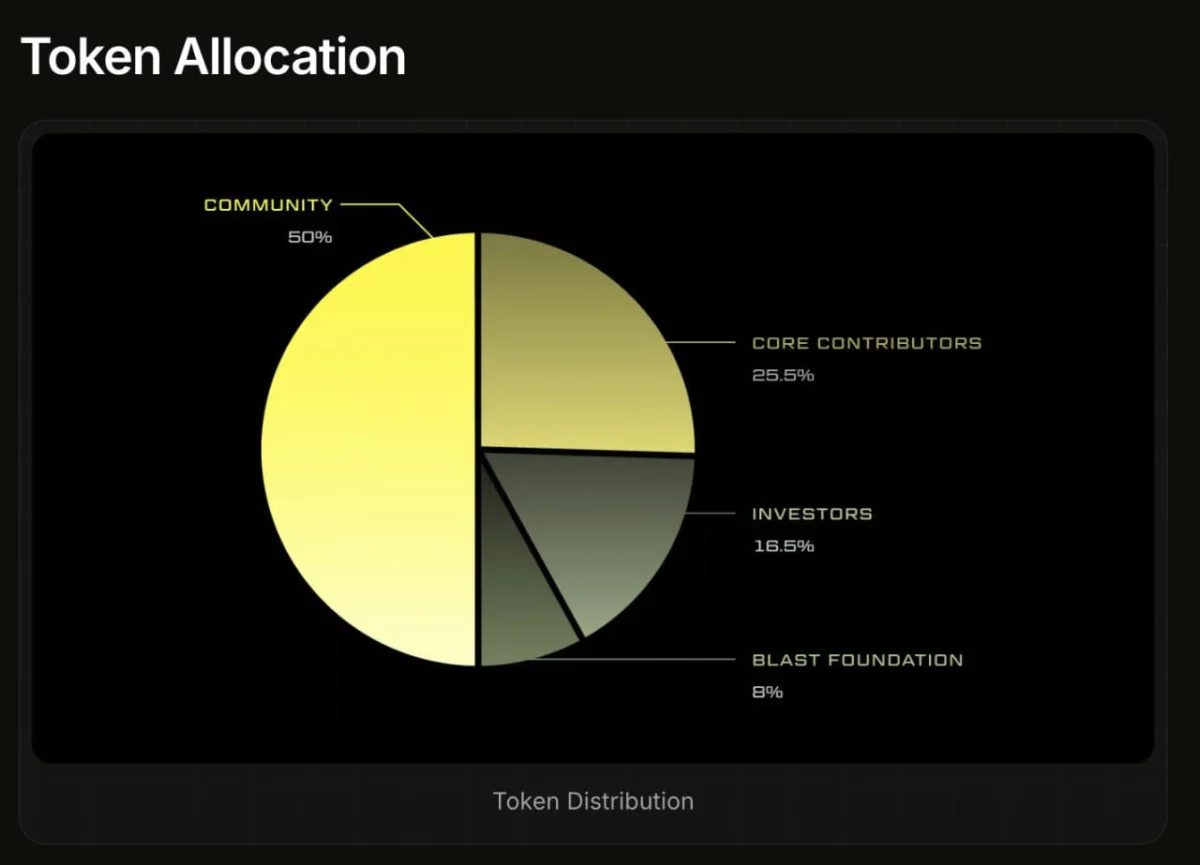
A significant factor contributing to Blast’s trajectory was its aggressive airdrop strategy. According to its tokenomics documentation, a substantial 50% of the total 100 billion BLAST supply was earmarked for community allocation. This was distributed across multiple phases: Phase 1 allocated 7% to Blast Points holders and another 7% to Blast Gold participants, followed by a prorated 5% in Phase 2. Additionally, the Blur Foundation received 3% in Phase 1, bringing the total proportion of supply distributed through airdrops to approximately 22%.

A critical detail in the tokenomics was the linear unlock schedule for the community allocation, set to occur over three years from the token’s launch. This meant that tokens continued to flow into users’ wallets even as the network’s actual usage and economic activity dwindled. The continuous supply, coupled with diminishing demand, inevitably led to a significant depreciation in the token’s value. DefiLlama currently estimates the entire token’s market capitalization at around $19 million, with BLAST trading at a minuscule $0.00027. This continuous dilution and lack of intrinsic value generation highlight a fundamental disconnect between the distribution of free tokens and the creation of a self-sustaining ecosystem.
The ZeroLend Precedent: Another Casualty of Airdrop Dependency
Blast is not an isolated incident. The year has seen other projects grappling with similar challenges, notably ZeroLend. As an Aave V3 fork spread across several Layer 2 networks, ZeroLend also pursued an ambitious airdrop strategy. Its token documentation specified that 53% of the ZERO supply was reserved for the community, with a substantial 18% of the total supply distributed via airdrop. Furthermore, 40% of these airdropped tokens were released upfront, creating immediate selling pressure.
On February 17, 2026, the ZeroLend team announced its decision to wind down operations after three years. Their stated reasons echoed Blast’s struggles: inactive chains, loss of critical oracle support, and increasingly thin lending margins across its deployed networks. The financial data from DefiLlama for ZeroLend paints a clear picture of its decline. Gross protocol revenue peaked in the first quarter of 2025 at approximately $2.04 million, but subsequently plummeted, settling between $229,000 and $419,000 per quarter, before crashing to a mere $59,000 in the third quarter of 2026. With a current TVL of $1.45 million and ZERO trading near $0.00000073 against a recorded high of $0.0058, it is evident that the extensive airdrop failed to halt the project’s downward spiral. In a gesture reflecting the project’s dire state, the team even stated its intention to use its own Linea airdrop allocation to partially refund affected users, a rare admission of accountability in the often-unforgiving crypto space.
The Illusion of Liquidity: Why Airdrops Attract Visitors, Not Customers
The recurring pattern observed in projects like Blast and ZeroLend underscores a critical flaw in using large-scale airdrops as a primary growth strategy: they often select for the wrong type of user behavior. A points program, or any incentive structure offering free tokens, inherently pays individuals to engage with a platform. While this can rapidly inflate metrics like TVL and transaction volume, it often attracts "farmers" – users whose primary motivation is to accumulate and offload free tokens for profit, rather than to genuinely use the underlying product or contribute to the network’s long-term health.
This phenomenon results in "rented liquidity" rather than organically earned engagement. Blast’s early deposits, arriving under a points program even before a token existed, exemplify this. Much of that liquidity was speculative, transient capital, ready to exit once the incentives diminished or the airdrop concluded. Farmers, acting rationally within the established incentive framework, will naturally leave when the payout ends or becomes less attractive.
The fundamental mistake lies in conflating a one-time giveaway with a sustainable revenue model. A legitimate business, whether in traditional finance or DeFi, requires customers who derive sufficient value from its services to pay more than the cost of providing those services. Neither Blast nor ZeroLend, once the initial incentives dried up, could demonstrate a robust base of users willing to generate consistent revenue, exposing their underlying economic fragility. The operational costs of maintaining blockchain infrastructure, developing smart contracts, and supporting a developer ecosystem are substantial. Without a corresponding revenue stream from genuine, sustained usage, such projects are destined for collapse.

Beyond Airdrop Size: What Truly Separates Survivors from Casualties
While the narratives of Blast and ZeroLend might suggest a simple correlation between large airdrops and project failure, the reality is more nuanced. It would be an oversimplification to conclude that large airdrops inevitably lead to demise, while small or no airdrops guarantee survival. The crypto ecosystem offers counter-examples that challenge such a binary view.
For instance, established and highly successful projects like Uniswap and Arbitrum have executed significant airdrops and continue to thrive. Uniswap, a pioneering decentralized exchange, solidified its user base and market position before its UNI token airdrop. Arbitrum, a leading Ethereum Layer 2, utilized its ARB airdrop to reward early adopters and decentralize governance, building upon an already robust technical foundation and a growing ecosystem of dApps. Their success, post-airdrop, suggests that a strong product-market fit, an existing utility, and a genuine need for the network’s services are paramount. These projects had built substantial utility and organic demand that transcended the temporary allure of free tokens.
Conversely, the absence of an airdrop is not a panacea for success. Botanix, a Bitcoin Layer 2 project, aimed to grow without a token, an airdrop, or even a points program, relying instead on its technical merits and market demand. Yet, in June 2026, Botanix also announced its shutdown, citing low fee revenue and weak demand as key factors. This demonstrates that even projects eschewing airdrops can fail if they do not find a sustainable user base willing to pay for their services.
The critical differentiator between surviving projects and casualties lies in their ability to generate real usage that translates into sustainable revenue after the initial rewards or speculative hype dissipate. The size of an airdrop is only relevant insofar as it influences the composition and motivations of a project’s user base. A massive giveaway, particularly one poorly designed, can effectively obscure a weak product or a flawed business model for a year or two, creating an artificial sense of success. However, it rarely, if ever, fixes fundamental issues related to product utility, market demand, or economic viability.
Implications for the DeFi and Layer-2 Ecosystem
The closures of Blast and ZeroLend, alongside the struggles of others, carry significant implications for the broader DeFi and Layer 2 ecosystem.
- Rethinking Tokenomics Design: The failures underscore the urgent need for more sophisticated and carefully considered tokenomics models. Future designs must prioritize long-term network health, sustainable value accrual, and genuine utility over short-term liquidity boosts. Incentives need to be aligned with productive participation, not just speculative farming.
- Investor Due Diligence: These events serve as a stark reminder for investors to look beyond inflated TVL figures and social media hype. A deeper analysis of actual transaction volumes, fee generation, active user counts, and the underlying revenue model is crucial. Projects with demonstrably strong product-market fit and organic growth will likely prove more resilient.
- The Crowded Layer 2 Landscape: The Layer 2 sector has become increasingly competitive. Simply offering a scalable solution or some form of native yield is no longer sufficient. Projects must differentiate themselves through unique technological advantages, robust developer ecosystems, compelling dApps, or a clear path to generating sustainable fees from genuine user activity.
- Regulatory Scrutiny: The failure of projects heavily reliant on speculative incentives and significant token distributions could attract increased scrutiny from financial regulators. The line between legitimate growth initiatives and unregistered securities offerings or manipulative practices might become a point of greater focus.
- Focus on Real-World Utility: Ultimately, the longevity of any blockchain project, like any technological venture, hinges on its ability to solve real-world problems or provide tangible value that users are willing to pay for. Crypto projects must pivot from merely attracting speculative capital to building robust platforms that generate inherent demand through their utility.
In conclusion, the precipitous fall of networks like Blast and ZeroLend serves as a powerful cautionary tale for the cryptocurrency industry. While airdrops can be an effective tool for initial distribution and community building, they are not a substitute for a viable business model. Sustainable growth in the decentralized economy, much like in traditional markets, ultimately depends on a compelling product, genuine user demand, and the ability to generate sufficient revenue to cover operational costs. The lesson is clear: free tokens may attract initial attention, but only real value can sustain a project in the long run.