The cryptocurrency market is currently navigating one of its most challenging periods of the current cycle, as a profound divergence between Bitcoin and the broader altcoin sector leaves the latter in a state of significant distress. According to recent data and analysis from seasoned market analyst Darkfost, the altcoin market has entered a precarious phase characterized by structural weakness and a massive erosion of valuation. This downturn has been exacerbated by a broader contagion in global financial markets, where a sudden shift in sentiment regarding artificial intelligence (AI) and semiconductor equities triggered a massive sell-off. On a single Friday, more than $1 trillion in value was liquidated from United States financial markets, sending shockwaves through both traditional and digital asset classes. The resulting fallout saw the S&P 500 decline by 2.6%, the Nasdaq composite drop by 4.7%, and Bitcoin itself shed 4% of its value. However, while Bitcoin has shown relative resilience in its recovery efforts, altcoins remain mired in a bearish trend that has persisted for months.
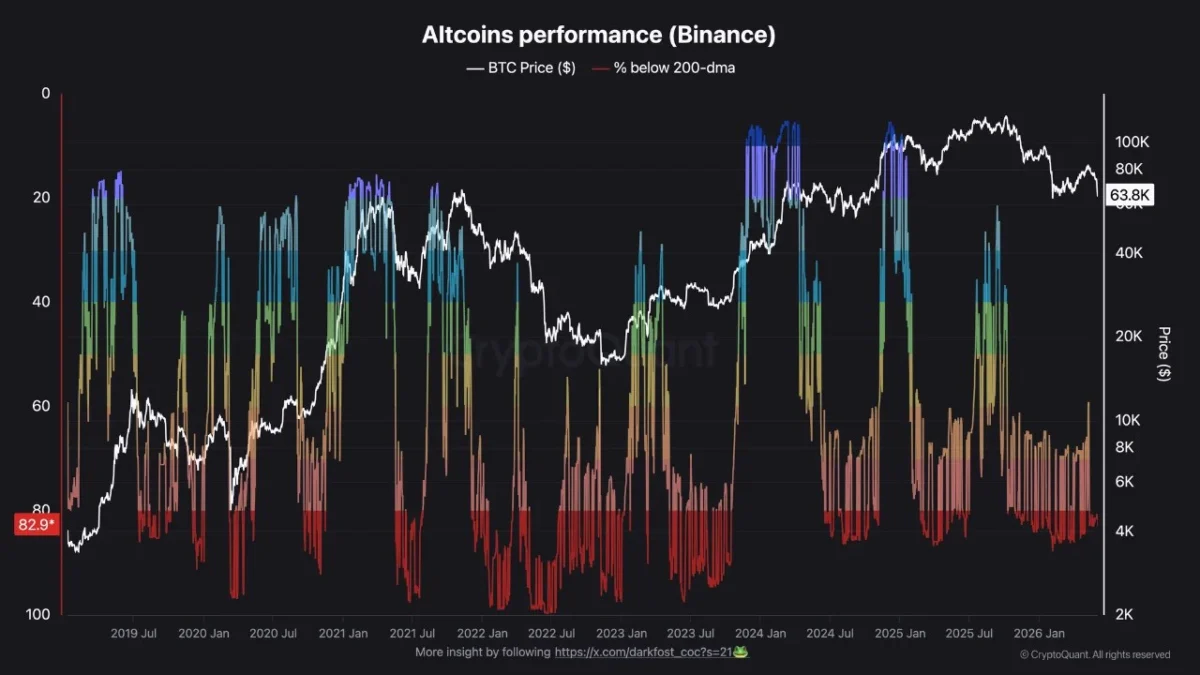
The depth of the current altcoin "winter" is best illustrated by the percentage of assets failing to maintain long-term technical support. Darkfost’s research, utilizing data from CryptoQuant, reveals that a staggering 83% of altcoins are currently trading below their 200-day moving average (200DMA). The 200DMA is widely regarded by institutional and retail traders alike as a definitive barometer for long-term market health. When an asset trades above this line, it is generally considered to be in a macro uptrend; conversely, trading below it signals a sustained bearish phase or a lack of buying conviction. The fact that the vast majority of the altcoin market has fallen beneath this threshold suggests that the "altseason" many investors anticipated in late 2024 and early 2025 has failed to materialize, replaced instead by a concentration of capital into Bitcoin and stablecoins.
The Structural Decline of the Altcoin Sector
The underperformance of altcoins is not a recent phenomenon but rather a trend that has solidified over the past two years. While the 2020-2021 bull cycle was defined by a rising tide that lifted all boats—from decentralized finance (DeFi) protocols to non-fungible tokens (NFTs)—the current cycle has been markedly different. Since December 2024, altcoins have struggled to maintain a positive correlation with Bitcoin’s price appreciation. This decoupling has left many investors holding "bags" of mid-cap and small-cap assets that continue to bleed value even when the primary cryptocurrency reaches for new all-time highs.
Darkfost notes that the current reading of 83% of altcoins below the 200DMA is among the weakest recorded in the present market cycle. Historically, the share of altcoins trading below this moving average has fluctuated between 60% and 90% during bearish or consolidatory phases. However, the persistence of this high percentage indicates a structural weakness that goes beyond mere price volatility. It suggests a fundamental shift in investor behavior, where the speculative appetite for unproven or high-inflation tokens has diminished in favor of "flight-to-quality" assets. The analyst points out that since 2022, the altcoin market has failed to achieve a broad-based breakout, leading to a sense of exhaustion among retail participants who typically drive the liquidity in these smaller markets.

A $520 Billion Market Cap Evaporation
The technical breakdown of the altcoin market has translated into tangible financial losses on a massive scale. By analyzing the TOTAL3 chart on TradingView—an index that tracks the total market capitalization of all cryptocurrencies excluding Bitcoin and Ethereum—analysts have identified a staggering loss of approximately $520 billion. At its peak in October 2024, the TOTAL3 valuation reached heights that suggested a burgeoning bull market for alternative assets. However, a series of sharp corrections has since driven the market cap down to approximately $670 billion.
This contraction effectively erases nearly half a year of gains, returning the altcoin market to valuation levels last observed in November 2024. The implications of this $520 billion "wipeout" are profound. It represents a significant exit of retail liquidity and a potential revaluation of the entire "utility token" ecosystem. Many projects that launched with high valuations during the 2023-2024 recovery phase are now seeing their market caps decimated, leading to concerns about the long-term viability of their development treasuries and ecosystem incentives. The flight of capital has not been random; it appears to be a calculated move by investors to seek refuge in the perceived safety of Bitcoin, which has been bolstered by the introduction of spot Exchange-Traded Funds (ETFs) in the United States, providing a level of institutional support that altcoins currently lack.
The Macroeconomic Catalyst: AI and Semiconductor Sentiment
To understand the severity of the altcoin decline, one must look toward the broader macroeconomic environment. The recent $1 trillion loss in US financial markets was driven by a cooling of the "AI hype" that had propelled the Nasdaq to record highs throughout 2024. As investors began to question the immediate profitability of massive capital expenditures in artificial intelligence, semiconductor giants and tech behemoths saw their stock prices tumble. Because the cryptocurrency market is increasingly integrated with global liquidity cycles, this "risk-off" sentiment translated immediately into the digital asset space.
Altcoins, which are positioned at the furthest end of the risk spectrum, are often the first assets to be sold when institutional players deleverage their portfolios. The 4.7% drop in the Nasdaq served as a leading indicator for the 4% drop in Bitcoin and the even more severe double-digit percentage drops seen in many high-beta altcoins. This synchronicity suggests that as long as the traditional tech sector remains volatile, the path to recovery for altcoins will be fraught with resistance. The lack of independent catalysts for most altcoin projects means they remain tethered to the whims of global liquidity and interest rate expectations set by the Federal Reserve.
Historical Precedents and the Contrarian Opportunity
Despite the prevailing gloom, Darkfost’s analysis offers a silver lining for long-term contrarian investors. The analyst argues that periods of extreme pessimism—where the vast majority of assets are underperforming their long-term averages—historically represent the most lucrative entry points. The data shows that when the market is "over-extended" in its bearishness, it often precedes a period of mean reversion.

For comparison, the analyst highlighted two specific windows in March and December 2024 where nearly 90% of altcoins were trading above their 200-day moving average. During those times, market sentiment was overwhelmingly bullish, and social media platforms were flooded with "moon" predictions. However, those periods of peak optimism actually marked local tops, offering reduced upside potential for new buyers. The "breadth expansion" seen during those windows was the strongest since the 2017 bull run, reflecting a level of market participation that was ultimately unsustainable.
The current environment is the polar opposite. With 83% of the market "underwater" relative to the 200DMA, the "froth" has been effectively removed. For investors with a multi-year horizon, these levels of despondency have historically been followed by significant recoveries, provided the underlying projects possess actual utility and a sustainable economic model.
The Role of Bitcoin Dominance and Institutional Shifts
Another factor contributing to the altcoin struggle is the rising "Bitcoin Dominance" (BTC.D) index. Throughout this cycle, Bitcoin has captured a larger share of the total crypto market cap, often at the expense of Ethereum and other altcoins. The institutionalization of Bitcoin via ETFs has created a "walled garden" where capital flows into the primary asset but does not necessarily "trickle down" to the rest of the ecosystem as it did in previous cycles.
In 2017 and 2021, a surge in Bitcoin’s price typically led to a "wealth effect," where investors took profits and moved them into "the next big thing" in the altcoin space. In 2025, however, much of the capital entering Bitcoin is institutional and "sticky," meaning it is held in brokerage accounts and pension funds that do not have the mandate or the technical capability to easily swap into decentralized exchange (DEX) tokens or memecoins. This fundamental change in market structure has left the altcoin market reliant on a retail base that is currently struggling with inflationary pressures and a lack of disposable income.
Future Outlook: A Selective Recovery?
As the market looks toward the remainder of the year, the consensus among analysts is that a "rising tide" may no longer be the norm. Instead, a "selective recovery" is more likely. While 83% of altcoins are below their 200DMA, the remaining 17% that have managed to stay above this level are being closely watched. These "outperformers" often belong to specific sectors—such as Real World Assets (RWA), Decentralized Physical Infrastructure Networks (DePIN), or high-performance Layer 1 blockchains—that are showing signs of genuine adoption.

The path forward for the $670 billion altcoin market depends heavily on a stabilization of global tech sentiment and a potential easing of monetary policy. If the Federal Reserve moves toward interest rate cuts, the resulting increase in global liquidity could provide the "spark" needed for a broader altcoin reversal. Until then, the data suggests a period of further consolidation and "survival of the fittest," where only projects with strong fundamentals and community support will manage to reclaim their long-term moving averages.
In conclusion, the altcoin market is currently enduring a "stress test" of historic proportions. The combination of a $520 billion valuation loss and a massive technical breakdown below the 200DMA paints a sobering picture for the short term. However, for the disciplined investor, this "rust" in the market may be the necessary precursor to a healthier, more sustainable growth phase in the future. The divergence from Bitcoin highlights a maturing market where assets are beginning to be judged on their individual merits rather than purely on speculative correlation. For now, the 200-day moving average remains the most important line in the sand for those looking for a sign that the altcoin winter is finally beginning to thaw.