The global cryptocurrency market is currently navigating a period of intense volatility and structural realignment, with altcoins bearing the brunt of a significant capital flight. According to a comprehensive market analysis by Darkfost, a seasoned analyst at the blockchain analytics platform CryptoQuant, the altcoin sector has entered a precarious phase characterized by persistent underperformance and a decoupling from Bitcoin’s price action. This downturn is not occurring in a vacuum; it follows a massive contraction in the broader US financial markets, where over $1 trillion in valuation was erased in a single Friday trading session. This systemic sell-off was primarily triggered by weakening sentiment surrounding artificial intelligence (AI) and semiconductor equities, which rippled through the S&P 500 and Nasdaq, posting losses of 2.6% and 4.7%, respectively. As risk-off sentiment took hold, Bitcoin retreated by 4%, but the damage to the altcoin market has proven far more institutional and enduring.
The Structural Decline of the Altcoin Sector
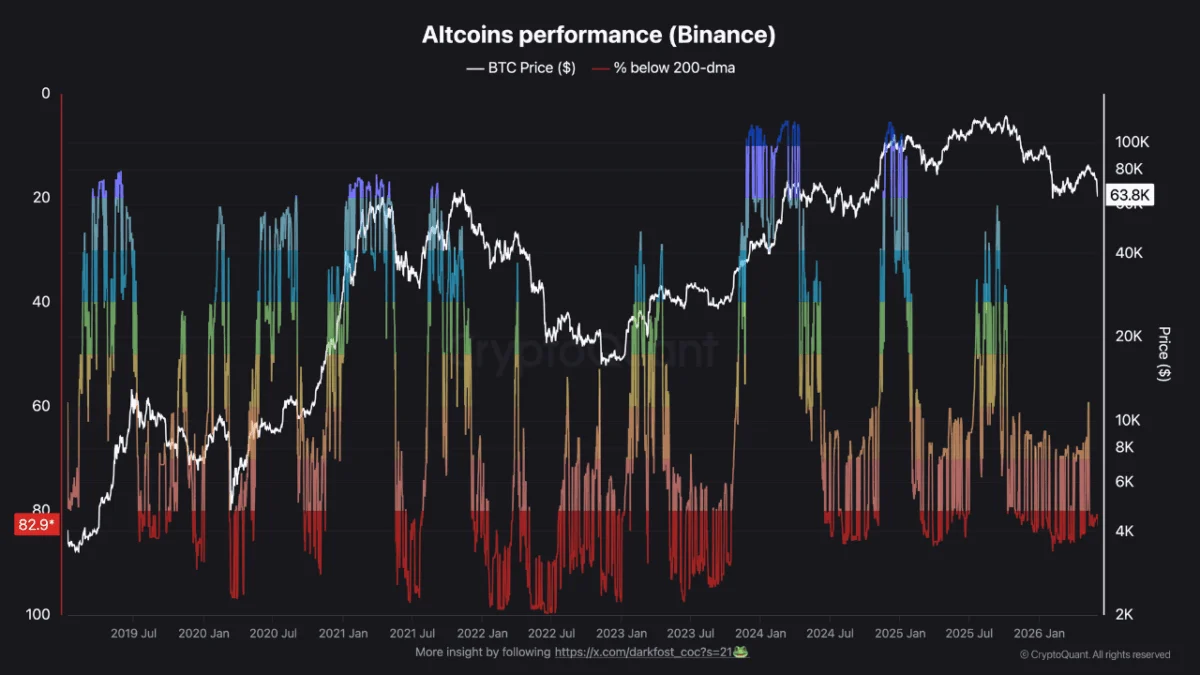
Since the final weeks of 2024, the altcoin market has struggled to maintain the momentum seen in previous cycles. While Bitcoin has benefited from institutional inflows and the stabilizing presence of Spot ETFs, alternative cryptocurrencies have largely failed to replicate this success. Darkfost’s data reveals a sobering statistic: approximately 83% of all altcoins are currently trading below their 200-day moving average (200DMA). The 200DMA is widely regarded by technical analysts as a "line in the sand" for long-term trends; an asset trading below this level is generally considered to be in a structural bear market.
This widespread failure to hold key support levels suggests that investor sentiment toward the broader crypto ecosystem—excluding Bitcoin—has turned deeply bearish. The concentration of capital into Bitcoin, often referred to as "Bitcoin Dominance," has intensified, leaving the altcoin market starved of the liquidity necessary for sustained price appreciation. Since early 2022, the percentage of altcoins trading below their 200DMA has frequently fluctuated between 60% and 90%, but the current reading represents one of the weakest points in the present market cycle. This suggests that the "Altseason" many retail investors anticipated has been deferred by a fundamental shift in how capital is allocated within the digital asset space.
Quantifying the Losses: A $520 Billion Contraction
The financial impact of this underperformance is starkly illustrated by the TOTAL3 index, which tracks the total market capitalization of all cryptocurrencies excluding Bitcoin and Ethereum. According to Darkfost, the TOTAL3 chart has seen a staggering $520 billion wiped from its valuation since its relative peak. From a high point of approximately $1.19 trillion, the index has tumbled to roughly $670 billion. This contraction has effectively erased months of gains, returning the altcoin market to valuation levels not seen since November 2024.
This massive drawdown reflects a broader "flight to quality" among both retail and institutional participants. In previous cycles, profits from Bitcoin rallies would typically rotate into mid-cap and small-cap altcoins, driving explosive growth across the board. However, in the current environment, that rotation has been replaced by a withdrawal into cash or stablecoins, or a reinvestment into Bitcoin. The data underscores a lack of confidence in the utility and long-term value propositions of many secondary blockchain projects, many of which are struggling to maintain user engagement and developer activity amidst a more discerning investment landscape.
The Macroeconomic Catalyst: AI and Semiconductor Cooling
The immediate catalyst for the most recent leg down in the altcoin market can be traced to the traditional equity markets. On a pivotal Friday in early February, the US financial sector witnessed a historic "wipeout" driven by concerns over the valuation of AI-centric companies. Heavyweights in the semiconductor industry, which have served as the engine for the S&P 500’s growth over the past year, saw sharp corrections as investors questioned whether the immediate returns on AI infrastructure justified current stock prices.
Because cryptocurrencies are increasingly viewed as high-beta risk assets, they are highly sensitive to shifts in liquidity and sentiment within the tech sector. When the Nasdaq experiences a 4.7% drop, it signals a reduction in the global "risk appetite." For speculative assets like altcoins, which lack the institutional "floor" provided by Bitcoin’s ETF backers, these macro shocks result in disproportionate losses. The correlation between tech equities and the crypto market remains a double-edged sword; while it fueled the rally in early 2024, it is now acting as a weight on the sector’s recovery.
Understanding the 200-Day Moving Average (200DMA)
To appreciate the gravity of the current market state, one must understand the role of the 200DMA in market psychology. The 200-day moving average is the average closing price of an asset over the last 200 trading sessions. It is a lagging indicator that smooths out daily volatility to reveal the primary trend.
- Dynamic Support and Resistance: In a healthy bull market, the 200DMA acts as a floor. When prices dip to this level, "dip buyers" typically step in, viewing the asset as undervalued relative to its long-term trend.
- Sentiment Gauge: When 83% of a sector is below this line, it indicates that the vast majority of investors who bought in the last six months are currently "underwater" (holding positions at a loss). This creates "overhead supply," where any attempt at a price rally is met with selling pressure from investors looking to break even.
- Institutional Filter: Many institutional trading desks and algorithmic funds are prohibited from taking long positions on assets trading below their 200DMA, as the risk of further downside is statistically higher.
The fact that only 17% of altcoins remain above this threshold suggests that the "breadth" of the market is incredibly narrow. Only a handful of projects—likely those with strong narrative tailwinds such as specific Layer 1 blockchains or decentralized physical infrastructure networks (DePIN)—are managing to defy the prevailing downtrend.

Historical Context and the "Pessimism Opportunity"
While the current data paints a grim picture, Darkfost notes that periods of extreme market breadth contraction have historically preceded significant buying opportunities. The analyst points out a contrarian relationship between market sentiment and future returns. For instance, in March and December of 2024, nearly 90% of altcoins were trading above their 200DMA. While these periods felt exuberant and profitable, they actually signaled a market that was "overbought" and nearing a local top.
Conversely, when the market reaches a state where the vast majority of assets are deemed "broken" by technical standards, it often indicates that a bottoming process is underway. The analyst highlighted that the breadth expansion seen in early 2024 was the strongest since the 2017 bull run, suggesting that while the current correction is deep, it is occurring within the context of a market that has shown it can achieve high levels of participation. For long-term "value" investors, the current $520 billion loss in market cap represents a "reset" that could eventually provide a healthier foundation for the next leg up, provided the macroeconomic environment stabilizes.
Institutional Reactions and the Role of Bitcoin Dominance
The current divergence between Bitcoin and altcoins is also a reflection of the "ETF Era." With the approval of Bitcoin ETFs, the premier cryptocurrency has effectively been reclassified by the market as a "digital gold" or a core portfolio asset. Altcoins, however, have not yet received the same level of regulatory or institutional clarity.
Market observers note that institutional investors are currently prioritizing liquidity and regulatory safety. Bitcoin offers both, whereas the altcoin market remains fragmented and subject to regulatory scrutiny from the SEC and other global bodies. This has led to a "winner-takes-most" scenario in the current cycle. Until there is a clear catalyst—such as the approval of more altcoin-based ETFs or a significant breakthrough in blockchain adoption—capital is likely to remain concentrated in the most established assets.
The Path Forward: What to Watch
As the market processes the recent $1 trillion loss in US equities and the subsequent crypto decline, several factors will determine if altcoins can reclaim their 200-day moving averages. First, the stability of the US tech sector is paramount. If semiconductor and AI stocks find a floor, the pressure on high-risk assets may ease. Second, the "TOTAL3" index needs to reclaim the $800 billion mark to signal that the capital flight has been arrested.

Investors are also keeping a close eye on the Federal Reserve’s interest rate trajectory. High interest rates generally favor "safe" assets like Treasury bonds, while lower rates increase the appeal of speculative assets like altcoins. If the Fed signals a more aggressive pivot toward rate cuts in response to the recent market volatility, it could provide the liquidity injection necessary to revive the altcoin sector.
In conclusion, the altcoin market is currently enduring a "stress test" of historic proportions. With 83% of assets trading in a technical bear market and half a trillion dollars in value erased, the sector is facing a crisis of confidence. However, if historical patterns of extreme pessimism hold true, this period of structural weakness may eventually be viewed as a necessary purging of speculative excess, paving the way for a more sustainable and selective growth phase in the future. For now, the "rust runs deep," and the road to recovery remains contingent on both internal market dynamics and the broader health of the global financial system.