


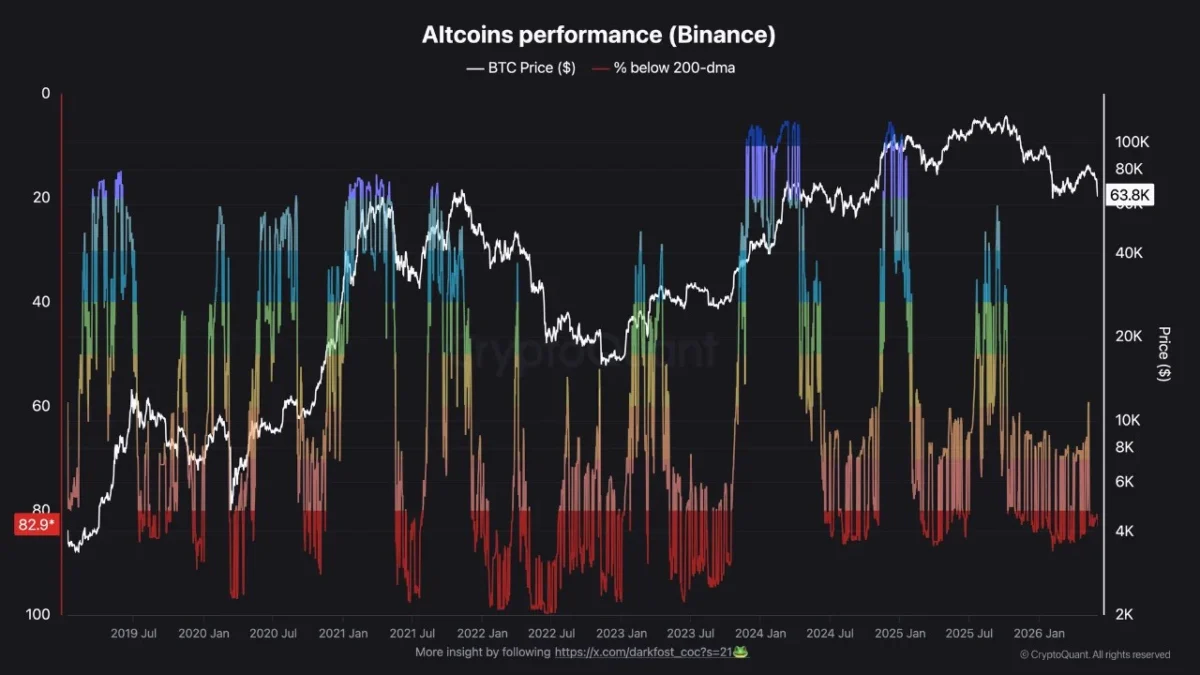
The global cryptocurrency market is currently grappling with a profound divergence in performance, as alternative cryptocurrencies, commonly referred to as altcoins, endure one of their most challenging periods in recent history. While Bitcoin has managed to maintain a level of institutional support and relative price stability, the broader altcoin sector is showing signs of systemic exhaustion. Recent data highlights a stark reality for digital asset investors: approximately 83% of all altcoins are currently trading below their 200-day moving average (200DMA), a critical technical threshold that separates long-term bullish trends from bearish territory. This technical breakdown coincides with a massive contraction in market capitalization, with over $520 billion in value evaporating from the altcoin sector since its local peak in late 2024.
The current downturn in the digital asset space does not exist in a vacuum. It follows a tumultuous period in global financial markets, characterized by a sharp sell-off in U.S. equities. On a single Friday in February 2025, over $1 trillion was wiped from the U.S. stock market, driven largely by cooling sentiment surrounding artificial intelligence (AI) and semiconductor stocks—sectors that had previously been the primary engines of market growth. The S&P 500 recorded a 2.6% decline, while the tech-heavy Nasdaq plummeted by 4.7%. Bitcoin, often viewed as a high-beta risk asset, saw a 4% retracement. However, the damage to altcoins was significantly more severe, reflecting a broader flight to quality as investors abandoned speculative positions in favor of liquidity and established assets.
The Technical Breakdown: Understanding the 200-Day Moving Average
The revelation that 83% of altcoins are trading below their 200DMA serves as a grim indicator of the sector’s health. In technical analysis, the 200-day moving average is widely considered the "line in the sand" for long-term investors. When an asset’s price remains above this line, it is generally perceived to be in a structural uptrend, attracting trend-following capital and institutional interest. Conversely, trading below the 200DMA suggests that the asset is in a long-term decline, often leading to a self-reinforcing cycle of selling pressure as automated systems and risk-averse traders exit their positions.
According to seasoned market analyst Darkfost, the current reading is among the weakest observed in the present market cycle. For much of the period since late 2022, the percentage of altcoins trading below this key average has fluctuated between 60% and 90%. The fact that the market is currently hovering near the upper bound of this range indicates a lack of "market breadth"—a term used to describe the participation of a wide variety of assets in a market rally. Without breadth, the crypto market remains top-heavy, relying almost entirely on Bitcoin and a handful of high-cap assets to sustain its total valuation.
The $520 Billion Evaporation: Analyzing the TOTAL3 Contraction
To quantify the scale of the altcoin retreat, analysts point to the TOTAL3 index, a metric provided by TradingView that tracks the total market capitalization of all cryptocurrencies excluding Bitcoin and Ethereum. This index provides the clearest picture of the "pure" altcoin market, removing the distorting influence of the two largest assets.
The data reveals a staggering decline. From a peak in October 2024, the TOTAL3 market cap has shed nearly $520 billion, falling from its highs to a current valuation of approximately $670 billion. This contraction has effectively erased nearly six months of progress, returning the altcoin market to valuation levels last seen in November 2024. This "round trip" in price action suggests that the speculative fervor of late 2024 was not supported by sustainable capital inflows but was instead a temporary expansion of liquidity that has since retreated.
The capital flight from altcoins into Bitcoin or stablecoins underscores a shift in investor psychology. During the early stages of a bull market, investors typically "climb the risk curve," moving from Bitcoin into smaller, more volatile assets in search of higher returns. The current trend suggests a "de-risking" phase where the opposite is occurring. Investors are seeking the relative safety of Bitcoin, which has been bolstered by the success of spot ETFs and its growing reputation as "digital gold," leaving the rest of the ecosystem to struggle with diminishing liquidity.
Macroeconomic Headwinds and the AI Sentiment Shift
The broader macroeconomic environment has played a pivotal role in the altcoin sector’s underperformance. For much of 2024, the narrative of "AI-driven growth" fueled both traditional stocks and crypto-related AI projects. However, as questions arise regarding the immediate profitability of massive AI infrastructure investments, the semiconductor sector has faced a sharp correction. Because the crypto market is highly sensitive to global liquidity conditions, the $1 trillion loss in U.S. markets on a single Friday acted as a catalyst for a margin-call-style liquidation across all risk assets.
Furthermore, the decoupling of altcoins from Bitcoin has become more pronounced. In previous cycles, a rising Bitcoin price typically acted as a "rising tide that lifts all boats." In the current cycle, however, Bitcoin’s dominance has remained high, often hovering near or above 50-60% of the total market share. This suggests that the institutional capital entering the space via ETFs is strictly "Bitcoin-only" and does not necessarily flow into the broader ecosystem of decentralized finance (DeFi), non-fungible tokens (NFTs), or layer-1 blockchains.

Historical Context: From Peak Optimism to Structural Weakness
To understand the severity of the current situation, it is helpful to look back at the brief windows of optimism that occurred in 2024. In March and December of that year, the market witnessed a "breadth expansion," where nearly 90% of altcoins were trading above their 200-day moving averages. These periods were characterized by widespread retail participation and a sense that a new "altseason" was imminent.
Darkfost notes that the breadth expansion seen in 2024 was the strongest recorded since the 2017 bull run. During those peaks, the market was flooded with optimism, and price targets for various altcoins were being revised upward daily. However, as is often the case in financial markets, extreme optimism frequently precedes a major correction. Those who entered the market during these high-breadth periods are now likely underwater, contributing to the "overhead supply" that makes a recovery difficult.
The current period of underperformance has lasted nearly two years for many assets in the altcoin space. While Bitcoin reached new all-time highs in 2024, many altcoins remained 50% to 90% below their 2021 peaks. This suggests a structural change in the market, where the sheer number of new tokens being launched—often referred to as "token inflation"—is diluting the available capital, making it harder for any single asset to sustain a rally.
Contrarian Perspectives: Is Extreme Pessimism a Buy Signal?
Despite the prevailing gloom, some analysts argue that the current state of the market represents a generational opportunity for long-term investors. Historical data suggests that periods of extreme pessimism, where the vast majority of assets are trading below their long-term averages, often mark the bottom of a market cycle.
The logic behind this contrarian view is that "weak hands" have already been shaken out of the market. When 83% of assets are below the 200DMA, the market is arguably in an "oversold" state. Darkfost suggests that while the short-term outlook remains precarious, the current valuation levels for TOTAL3 are significantly more attractive than they were during the euphoric peaks of March 2024. For investors with a multi-year horizon, the current "rust" in the altcoin market may be the precursor to a more sustainable, value-driven recovery.

The Road Ahead: What is Needed for an Altcoin Reversal?
For the altcoin market to regain its footing, several factors must align. First, a stabilization of the global macroeconomic environment is essential. As long as the U.S. tech sector remains volatile and interest rate uncertainty persists, investors are unlikely to return to high-risk crypto assets.
Second, the market requires a "narrative shift." The AI and meme coin crazes provided temporary boosts, but the sector lacks a cohesive theme that demonstrates real-world utility and attracts sustainable capital. The ongoing development of decentralized physical infrastructure networks (DePIN) and the tokenization of real-world assets (RWA) are two areas that proponents hope will provide the next leg of growth.
Finally, Bitcoin must enter a period of "sideways" consolidation. Historically, altcoins perform best when Bitcoin is stable, allowing liquidity to rotate out of the market leader and into smaller projects. If Bitcoin continues to either drop sharply or surge aggressively, it tends to suck the liquidity out of the altcoin market, leaving "alts" in a perpetual state of catch-up.
As the crypto ecosystem navigates this period of structural weakness, the distinction between "zombie projects" and those with genuine adoption will become increasingly clear. The current $520 billion loss serves as a stark reminder of the risks inherent in the digital asset space, but it also sets the stage for the next evolution of the market, where only the most resilient and utility-driven projects are likely to survive and eventually cross back above their 200-day moving averages.














