


Uniswap, a leading decentralized exchange (DEX) protocol, has significantly expanded its offerings by making tokenized securities directly accessible across its web application, wallet, and API. This pivotal integration now allows users to trade tokenized versions of high-profile companies such as SpaceX, Apple, Tesla, and NVIDIA directly through Uniswap’s consumer-facing products. This development marks a critical juncture in the convergence of decentralized finance (DeFi) and traditional finance (TradFi), effectively closing a long-standing gap where these regulated assets existed on the protocol’s backend but lacked seamless integration into user interfaces. The move is poised to open regulated asset markets to a considerably broader on-chain audience, fostering new avenues for liquidity and investment.
The launch represents a notable leap in Uniswap’s coverage of real-world assets (RWAs). To date, the protocol has already facilitated over $9.1 billion in transactions through various real-world asset pools, underscoring the burgeoning demand and foundational activity in this sector. These transactions encompass more than 2.6 million swaps conducted across a diverse base of over 140,000 unique wallets. As Uniswap itself proclaimed on X, formerly Twitter, on June 12, 2026, "The world’s value is moving onchain. And now, you can access it all through Uniswap." This statement encapsulates the ambitious vision behind the initiative: to position Uniswap as a primary conduit for the global migration of value onto blockchain infrastructure.
The Growing Nexus of Real-World Assets and Decentralized Finance
The integration of tokenized securities on Uniswap is a testament to the accelerating trend of bringing real-world assets onto the blockchain. Real-world assets encompass a vast array of tangible and intangible assets, including equities, fixed income instruments, real estate, commodities, and even intellectual property, which are represented as digital tokens on a blockchain. This process, known as tokenization, offers numerous advantages over traditional financial systems. These benefits include fractional ownership, allowing investors to buy a portion of high-value assets; enhanced liquidity, as tokens can be traded 24/7 on global markets; increased transparency through immutable blockchain ledgers; reduced settlement times from days to mere minutes or seconds; and programmability, enabling complex financial instruments and automated compliance.
The market for tokenized assets is experiencing exponential growth, driven by both retail interest and significant institutional adoption. Leading financial institutions and consulting firms project the tokenized asset market to reach trillions of dollars in the coming decade. For instance, a report by Boston Consulting Group (BCG) and ADDX estimated that asset tokenization could become a $16 trillion business by 2030. This optimistic outlook is fueled by increasing regulatory clarity in various jurisdictions, technological advancements in blockchain infrastructure, and a growing recognition of the efficiencies that tokenization can bring to capital markets. Global financial giants like BlackRock, Franklin Templeton, and Siemens have already ventured into tokenization, issuing tokenized funds or bonds, signaling a profound shift in traditional finance. Uniswap’s move positions it at the forefront of this transformation, providing a crucial on-ramp for decentralized access to these burgeoning markets.
Uniswap’s Strategic Evolution Towards Regulated Assets
Uniswap has historically been a cornerstone of the DeFi ecosystem, renowned for pioneering the automated market maker (AMM) model that revolutionized decentralized trading. Since its inception, the protocol has processed an astounding cumulative volume exceeding $4.4 trillion, establishing itself as a dominant force in crypto asset exchange. Its journey towards integrating real-world assets is not a sudden pivot but rather a strategic evolution, building upon its robust infrastructure and liquidity depth.
Prior to this direct integration, tokenized securities could exist on the Ethereum blockchain, often facilitated by specialized RWA protocols, but trading them directly within Uniswap’s main user interfaces was not streamlined. Users might have had to navigate multiple platforms or use complex contract interactions. The current update simplifies this significantly, making the user experience for tokenized securities mirror that of standard cryptocurrency swaps. This ‘closing the gap’ enhances accessibility and lowers the barrier to entry for a wider demographic of investors, including those less familiar with the intricacies of underlying blockchain interactions.
A critical enabler for Uniswap’s venture into regulated assets is its underlying protocol infrastructure, particularly features anticipated in future iterations like Uniswap v4’s "hooks." While v4 is still under development, the concept of hooks allows for customizable logic to be executed at various points in a swap’s lifecycle. This configurability is paramount for supporting regulated asset markets on-chain, as it enables issuers to embed compliance requirements directly into the pool logic. Such requirements can include Know Your Customer (KYC) verification, Anti-Money Laundering (AML) checks, whitelists of approved wallets, and specific jurisdictional restrictions. This capability ensures that tokenized securities traded on Uniswap can adhere to existing financial regulations, a non-negotiable aspect for their widespread adoption. Geographic gates and allowlists can thus be seamlessly integrated, providing a robust framework for regulatory adherence without sacrificing the benefits of decentralized liquidity.
Seamless User Experience and Robust Compliance Framework
Accessing these tokenized securities through Uniswap is designed to be intuitive and familiar to existing users. Eligible individuals can navigate to the "Explore Page" on the Uniswap Web App, where they will find the newly integrated assets. The trading process itself mirrors any standard token swap on the platform: users connect a compatible cryptocurrency wallet, select the desired tokenized asset (e.g., Apple stock token), specify the amount, and confirm the transaction.
However, a crucial distinction for tokenized securities lies in the compliance layer. Unlike permissionless cryptocurrency trading, transactions involving tokenized securities are subject to issuer-imposed KYC requirements, whitelists, and jurisdictional restrictions. These measures are mandated by financial regulators to prevent illicit activities, protect investors, and ensure market integrity. For example, a tokenized security issued by a company based in the United States might only be tradable by verified U.S. residents who have completed specific identity checks. Uniswap’s integration ensures that these compliance parameters, defined by the asset issuers, are enforced at the protocol level, allowing for regulated trading within a decentralized environment. This balance between decentralization and regulation is key to unlocking institutional participation and mainstream adoption.
Empowering Builders and Issuers through Protocol Infrastructure
Beyond direct user access, Uniswap’s enhanced protocol infrastructure also serves as a powerful tool for developers and asset issuers. Builders looking to integrate tokenized stocks, bonds, or yield-bearing assets into their own applications can do so seamlessly through the existing Uniswap API. This means that no additional complex configuration is needed for developers to expose these regulated assets to their users, significantly reducing development friction and accelerating innovation within the RWA space. The same sophisticated routing and liquidity infrastructure that powers crypto asset trading on Uniswap now extends to securities, ensuring consistency and reliability.
This continuity in infrastructure is a major advantage for teams building on top of Uniswap. They can leverage the protocol’s proven track record of handling massive transaction volumes and providing deep liquidity. With over $4.4 trillion in cumulative volume processed since its launch, Uniswap offers a robust and practical backend for tokenized asset markets, capable of supporting the scale required for global financial instruments.
A significant structural advantage of on-chain assets is their ability to trade outside traditional market hours. Unlike their TradFi equivalents, which are typically confined to specific trading windows, tokenized securities on Uniswap can be traded 24 hours a day, seven days a week. This "always-on" availability is particularly beneficial in a globally interconnected financial landscape, allowing for immediate reaction to international news or market events, and catering to a diverse, global investor base.
Furthermore, assets settled on-chain inherently possess composability across various wallets, applications, and DeFi protocols. This means that any agent or interface with API access can tap into the same underlying liquidity pools, fostering a highly interconnected and efficient financial ecosystem. This composability is fundamental to the broader buildout of on-chain financial infrastructure, enabling developers to create novel financial products and services by combining different tokenized assets and DeFi primitives. It also actively works to reduce fragmentation across various tokenized asset platforms, promoting a more unified and liquid market.
Market Reaction and Future Implications
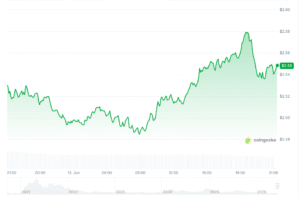
At the time of publication, the UNI token, Uniswap’s native governance token, traded at $2.54, reflecting a modest increase of 0.43% in the prior 24 hours. Weekly gains stood at 4.84%, indicating moderate positive market momentum around the announcement. While not a dramatic surge, this steady performance suggests that investors recognize the long-term strategic value of Uniswap’s expansion into tokenized securities. The market’s measured response could also be attributed to the inherent complexities and regulatory nuances associated with integrating traditional finance assets into the decentralized world, implying a recognition that this is a foundational step rather than an immediate catalyst for speculative fervor.
The implications of Uniswap’s move are far-reaching for the entire financial ecosystem. For Uniswap itself, it signifies a strategic diversification, reducing its sole reliance on highly volatile crypto assets and attracting a new segment of users, including traditional finance investors and potentially institutional players. It solidifies Uniswap’s position as a crucial bridge between the nascent DeFi space and the established world of TradFi.
For the broader DeFi ecosystem, this integration represents a significant step towards maturation and legitimacy. By bringing substantial "real-world" value on-chain, DeFi protocols can expand their utility beyond speculative crypto trading, demonstrating their potential to revolutionize mainstream finance. This could lead to a substantial increase in Total Value Locked (TVL) within DeFi, attracting more capital and talent.
For traditional finance, Uniswap’s initiative presents both opportunities and challenges. While it offers a pathway to leverage blockchain efficiencies – such as improved liquidity, lower operational costs, and faster settlement – it also highlights the potential for disintermediation of traditional financial intermediaries. The ability to trade tokenized securities 24/7 on a decentralized protocol challenges the conventional structures of stock exchanges and brokerage firms.
Looking ahead, the successful integration of tokenized securities on Uniswap will likely pave the way for a wider array of real-world assets to migrate on-chain. This could include further types of fixed-income products, real estate, precious metals, and even alternative assets like art and collectibles. However, the path forward is not without challenges. Regulatory uncertainty remains a primary hurdle, as jurisdictions worldwide grapple with how to classify and oversee tokenized securities. Technological hurdles related to scalability, interoperability, and security will also need continuous innovation. Finally, widespread user adoption will depend on sustained education, user-friendly interfaces, and the continued building of trust in decentralized platforms.
In conclusion, Uniswap’s direct integration of tokenized real-world securities marks a significant milestone in the ongoing convergence of DeFi and traditional finance. By making regulated assets like shares of Apple and Tesla readily accessible on its platform, Uniswap is not merely expanding its product offering; it is actively shaping the future of global financial markets, proving that the world’s value is indeed moving on-chain.














