


The digital asset landscape is currently witnessing a pivotal shift in market dynamics as the long-anticipated rotation of capital from Bitcoin into the broader altcoin market begins to show quantifiable momentum. For the majority of the current market cycle, investors have faced a period of prolonged frustration, characterized by Bitcoin’s overwhelming dominance and the repeated failure of altcoins to sustain meaningful rallies. However, recent data from the blockchain analytics firm CryptoQuant suggests that the structural underpinnings of the market are evolving. By tracking trading volumes across major centralized exchanges, analysts have identified an acceleration in altcoin participation that transcends mere market noise, signaling that the "Bitcoin season" which defined much of the past year may finally be yielding to a more diversified market environment.
The Statistical Emergence of Altcoin Momentum
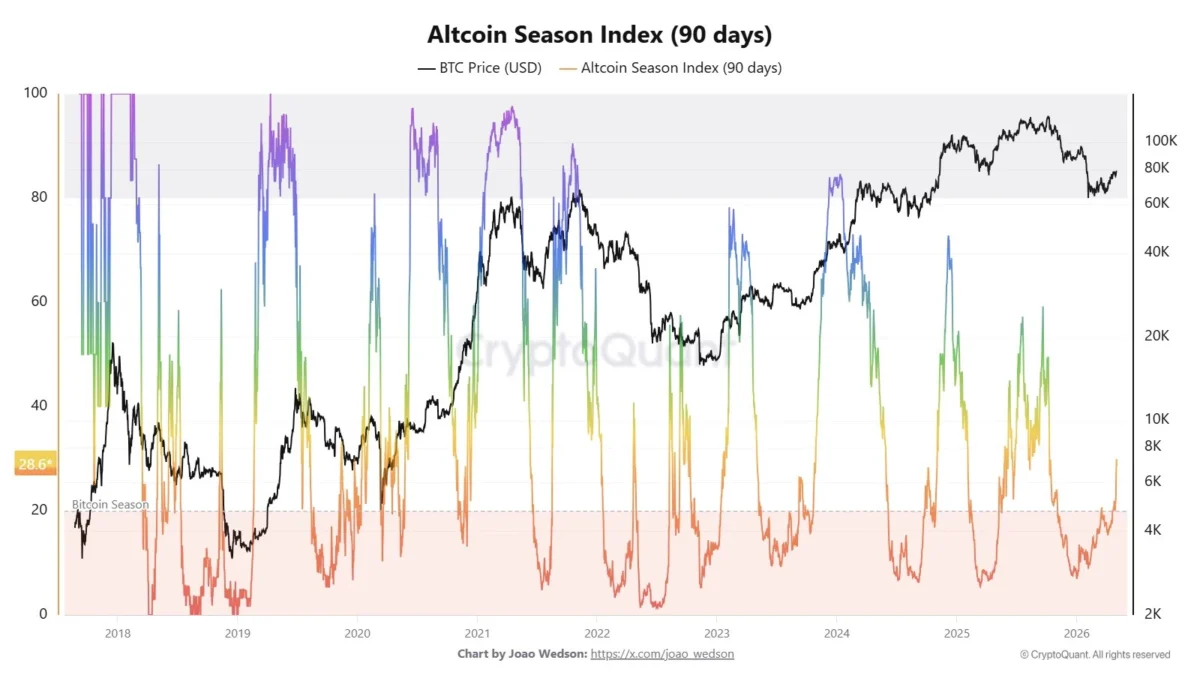
The primary catalyst for the renewed optimism in the altcoin sector is a marked increase in trading volume for assets excluding the top five cryptocurrencies by market capitalization. Unlike previous "fake-outs" where gains were concentrated in a handful of high-profile tokens or speculative meme coins, the current trend reflects a broad-based increase in participation. This shift is most clearly illustrated by the 90-day AltSeason Index, a metric designed to track the relative performance and capital flow between Bitcoin and alternative assets.
According to the latest reports, this index has surged to 28.6. While still below the threshold of 75 typically required to declare a full-blown "Altcoin Season," the velocity of the move is significant. In the context of the current cycle, where the index remained suppressed for an unusually long duration, this uptick represents a behavioral change among both retail and institutional participants. The data suggests that capital is no longer merely "resting" in Bitcoin or exiting the market into stablecoins; instead, it is being redistributed into higher-beta assets as risk appetite returns to the ecosystem.
A Cycle of Unmet Expectations: The Historical Context
To understand the significance of the current signal, it is necessary to examine the historical trajectory of this market cycle. Traditionally, crypto cycles follow a predictable path: Bitcoin leads the initial charge, breaking new all-time highs and attracting institutional liquidity. Once Bitcoin enters a period of consolidation, capital typically "trickles down" into Ethereum, followed by large-cap altcoins, and eventually the broader mid-to-small-cap market.

In 2024, this rotation failed to materialize at the scale witnessed in 2017 or 2021. Although the AltSeason Index saw a modest peak in early 2024, the subsequent outperformance of altcoins was short-lived and lacked the depth of previous cycles. This led to a period of "pent-up rotation." Because the typical discharge of capital from Bitcoin into altcoins never fully occurred, a massive amount of liquidity remained trapped in the primary asset. Analysts suggest that this extended period of suppression has created a coiled-spring effect, where the eventual rotation could be more explosive than if it had occurred naturally earlier in the cycle.
Ethereum as the Gateway Asset
Central to the thesis of an impending altcoin resurgence is the technical and fundamental positioning of Ethereum. As the second-largest cryptocurrency and the primary platform for decentralized finance (DeFi) and non-fungible tokens (NFTs), Ethereum serves as the gateway for liquidity entering the altcoin ecosystem. The CryptoQuant analysis highlights a rare nine-year technical convergence in the Ethereum price charts, suggesting that the asset is approaching a resolution of a long-term structural setup.
Historically, a sustained move in Ethereum’s price acts as a "rising tide" that lifts all boats. When Ethereum outperforms Bitcoin, it provides the necessary confidence for investors to move further down the risk curve into smaller protocols. The current technical setup for ETH is particularly noteworthy because it arrives at a time when the network’s fundamentals—including its transition to a deflationary supply model under certain conditions and the growth of Layer 2 scaling solutions—are more robust than in previous years. If Ethereum successfully breaks through its multi-year resistance levels, it is expected to validate the altcoin rotation signal and catalyze a broader market rally.
Analyzing the "OTHERS" Index and Key Inflection Zones
The health of the altcoin market is often measured by the "OTHERS" index, which tracks the total market capitalization of all cryptocurrencies excluding the top 10 assets. Currently, this index is testing a critical inflection zone between $190 billion and $200 billion. This region is not merely a psychological barrier; it represents a structural transition from a distribution phase into a potential accumulation zone.
Technical analysis of the OTHERS chart reveals that the market is currently interacting with the 200-week moving average. In long-term crypto cycles, this moving average has historically served as a definitive pivot point. Holding above this level suggests that the long-term bullish trend remains intact despite the volatility seen over the past year. Furthermore, the 50-week moving average has begun to flatten and curl upward, a classic indicator that downside momentum is exhausting and a trend reversal may be in its early stages.

However, market observers remain cautious. While the price has reclaimed short-term moving averages, it is currently facing dynamic resistance at the 100-week moving average. For a definitive "Altseason" to be confirmed, the OTHERS index would need a clean break above the $220–$240 billion range. Such a move would establish a "higher high" on the weekly timeframe, providing the technical confirmation needed for trend-following institutional algorithms to enter the space.
Volume Profiles and Market Participation
A nuanced look at volume behavior provides further insight into the current market structure. The capitulation events seen earlier in 2025 and late 2024 were marked by high-volume selling, which effectively "cleansed" the market of over-leveraged positions. The subsequent recovery has been characterized by a gradual decline in selling pressure rather than an immediate explosion of aggressive buying.
This "quiet" start to the altcoin season is often viewed by professional traders as a positive sign. It suggests that the current price appreciation is organic and driven by the removal of supply rather than speculative mania. As supply on exchanges continues to dwindle and the AltSeason Index moves higher, the market becomes more sensitive to new inflows. If the current base-building phase holds, the absence of heavy sell walls could allow for rapid price appreciation once aggressive buying volume eventually returns.
Broader Implications for the Crypto Ecosystem
The potential shift toward an altcoin-dominated environment carries significant implications for the broader blockchain industry. During Bitcoin-heavy phases, the focus remains largely on "digital gold" and store-of-value narratives. An altseason, by contrast, shifts the spotlight back to utility, innovation, and ecosystem growth.
- DeFi Revitalization: Increased capital flow into altcoins typically benefits decentralized finance protocols. Higher token prices increase the Total Value Locked (TVL) in these systems, improving liquidity and making the platforms more attractive for users.
- Layer 2 Expansion: With Ethereum expected to lead the charge, its scaling solutions—such as Arbitrum, Optimism, and Base—are likely to see increased adoption. The success of these platforms is often tied to the price performance of the underlying Ethereum asset.
- Institutional Diversification: While Bitcoin ETFs dominated the headlines in 2024, a sustained altcoin season may spark renewed interest in diversified crypto products. This could lead to a broader range of exchange-traded products (ETPs) focusing on assets like Solana, Chainlink, or Avalanche.
Risk Factors and Counter-Narratives
Despite the constructive data, several risks could derail the burgeoning altcoin rotation. The most immediate threat is a sharp correction in Bitcoin’s price. Because Bitcoin remains the liquidity "sun" around which all other assets orbit, a significant deleveraging event in the primary asset often leads to even steeper losses in altcoins, regardless of their individual technical setups.

Additionally, the regulatory environment continues to be a source of uncertainty. While the United States has shown signs of a more favorable stance toward digital assets, specific altcoins still face potential classification as securities, which could hamper their liquidity and listing status on centralized exchanges. Finally, the "reduced selling pressure" identified in the volume data must eventually be replaced by "aggressive buying pressure" to sustain a long-term bull market. If new capital fails to enter the system, the current rally could remain a range-bound fluctuation rather than a trend-defining breakout.
Conclusion: A Market in Transition
The data provided by CryptoQuant and the technical behavior of the OTHERS index suggest that the cryptocurrency market is at a crossroads. The transition from a Bitcoin-only narrative to a broader altcoin participation model appears to be underway, supported by rising exchange volumes and a strengthening AltSeason Index. While the "Altseason" that many expected in 2024 never arrived, the resulting period of consolidation has built a technical foundation that may support a more sustainable move in the coming months.
As Ethereum approaches its nine-year technical resolution and altcoin market caps test multi-year moving averages, the coming weeks will be critical in determining whether this shift is a temporary rotation or the start of a new, diversified growth phase for the digital asset class. For now, the evidence points to a market that is slowly but surely moving out of the shadow of Bitcoin dominance.














