


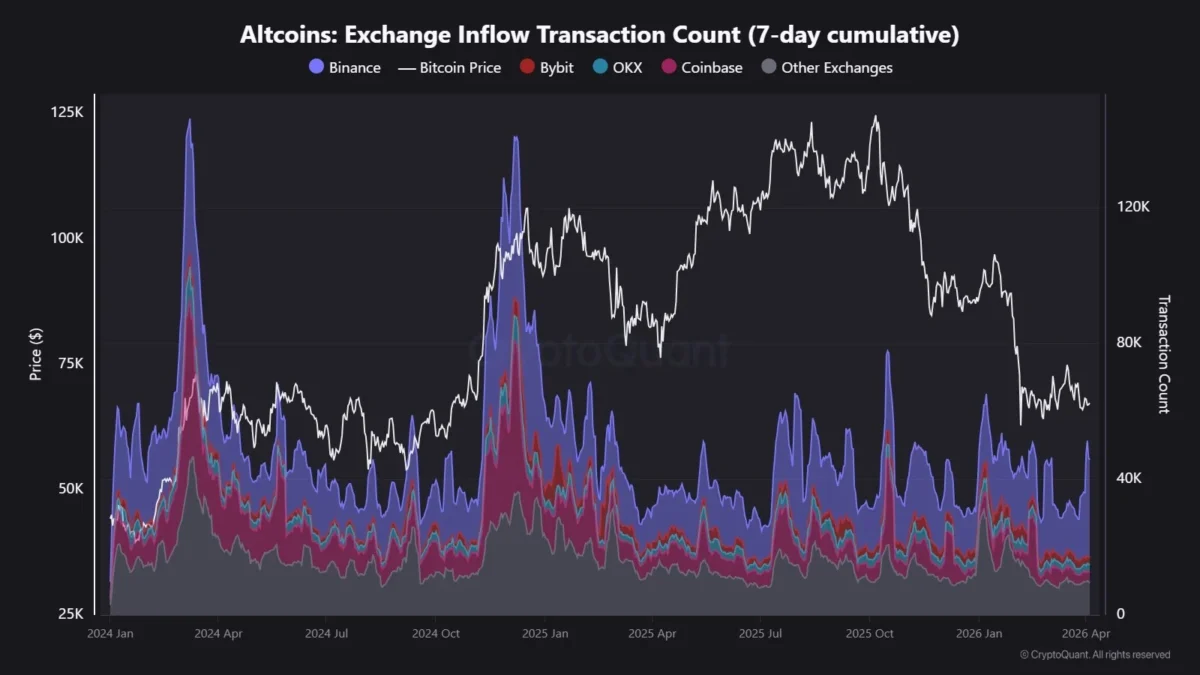
The global cryptocurrency market is currently navigating a period of heightened volatility and structural uncertainty, characterized by a notable divergence between major assets and the broader altcoin landscape. On April 2, a significant technical anomaly occurred on Binance, the world’s largest cryptocurrency exchange by trading volume, that has caught the attention of market analysts and institutional observers. Data indicates that altcoin inflow transactions to the platform surged to approximately 34,000 in a single day—a level not seen in nearly three months. Crucially, this phenomenon was entirely isolated to Binance, failing to register on other major trading venues such as Coinbase, Bybit, or OKX, suggesting a platform-specific catalyst rather than a generalized return of investor appetite for decentralized assets.
According to a detailed report from CryptoQuant analyst Maartunn, this spike in activity represents a "signal" rather than a mere data artifact. Under normal market conditions, a massive surge in altcoin inflows across an exchange typically signals a coordinated return of retail or institutional interest, usually reflected across the entire derivatives and spot landscape. When traders move back into altcoins at scale, the liquidity footprint is visible across all major liquid venues simultaneously. The fact that this 34,000-transaction surge was contained within Binance’s ecosystem points toward a specific internal development that incentivized traders to move their holdings onto the platform.
The Catalyst: Integration of Traditional Finance Commodities
The investigation into the cause of this isolated spike points to a major product rollout that occurred just 24 hours prior. On April 1, Binance expanded its suite of futures instruments to include new contracts tied directly to traditional commodities, specifically Natural Gas and WTI Crude Oil. These additions joined an existing array of traditional finance (TradFi) tickers on the platform, which already included gold and silver.
The timing of the altcoin inflow spike on April 2 suggests a direct correlation with these launches. Market data shows that these new commodity pairs did not remain peripheral offerings; instead, they immediately ascended to Binance’s top volume pairs. In the days following the launch, trading volume for WTI Crude Oil and Natural Gas futures began competing for liquidity with established crypto-native pairs like Bitcoin (BTC) and Ethereum (ETH).

This migration suggests that the traders who moved altcoins onto Binance on April 2 were not doing so to participate in a "buy the dip" scenario for digital assets. Rather, they were likely liquidating or using their altcoin holdings as collateral to gain exposure to energy markets. This represents a significant pivot in how speculative capital is being utilized within the crypto ecosystem. Instead of rotating from Bitcoin into smaller-cap altcoins—the traditional "Altseason" path—liquidity is now rotating from altcoins into traditional macroeconomic hedges like oil and gas, all while remaining within the technological framework of a crypto exchange.
Chronology of the Liquidity Shift
To understand the magnitude of this shift, it is necessary to examine the timeline of events leading up to the April 2nd anomaly:
- Late March: Altcoin markets began showing signs of exhaustion as the "OTHERS" chart (total crypto market cap excluding the top 10 assets) failed to maintain levels above the $300 billion threshold.
- April 1: Binance officially listed Natural Gas and WTI Crude Oil futures contracts. These contracts are settled in stablecoins, allowing crypto-native traders to hedge against or speculate on global energy prices without leaving the Binance interface.
- April 2: The "Inflow Spike" occurred. Approximately 34,000 altcoin transactions were recorded entering Binance. Analysts noted that other exchanges remained flat, confirming the move was driven by Binance’s new product suite.
- April 3–April 7: Commodity volumes on Binance remained high, while the broader altcoin market cap continued to weaken, breaking below key technical support levels.
This chronology highlights a "vampiric" liquidity effect. The same pool of speculative capital that once drove the volatility and growth of the altcoin sector is now finding more attractive opportunities in assets that respond to geopolitical tensions and macroeconomic shifts, such as the ongoing instability in energy-producing regions and fluctuating inflation data.
Technical Analysis: Altcoin Market Structure Weakens
While Binance sees a flurry of activity in its commodity section, the underlying health of the altcoin market is showing signs of systemic decay. The total crypto market cap excluding the top 10 assets is currently hovering near $172 billion, a figure that reflects a persistent "lower high" structure on the weekly timeframe.
From a technical perspective, the rejection from the mid-2025 highs marked a transition from a phase of expansion to one of distribution. The altcoin market cap has notably broken below its 50-week moving average, a level that historically serves as a dividing line between bullish and bearish regimes. While there has been a brief test and bounce from the 200-week moving average near the $150 billion zone, the recovery has lacked the conviction necessary to reclaim the 100-week moving average.

All three major moving averages—the 50, 100, and 200-week—are currently flattening or trending downward. This alignment suggests a loss of trend strength. In technical terms, the market is no longer in a "discovery" phase; it is in a "corrective" or "range-bound" phase. For altcoins to regain structural strength, a sustained reclaim of the $200 billion level is required. Conversely, if the current support range of $160 billion to $170 billion fails to hold, analysts project a further downside toward the $130 billion level.
Implications of the "Commodity Migration"
The implications of this shift are twofold. First, for Binance, the successful integration of TradFi commodities proves that crypto exchanges are evolving into "everything exchanges." By offering oil, gas, gold, and silver alongside crypto, Binance is capturing the "bid-side liquidity" that would otherwise exit the platform for traditional brokerages during periods of crypto stagnation.
Second, for the altcoin market, this migration is fundamentally "non-neutral." Every dollar of capital that moves from an altcoin pair to a WTI Crude Oil contract is a dollar that is no longer supporting the price of decentralized protocols. This creates a liquidity vacuum. When traders use their altcoins as "gas" to enter commodity trades, they often sell those altcoins for stablecoins (USDT or USDC) to meet margin requirements. This constant sell-side pressure, even if gradual, prevents altcoins from forming the explosive "moons" seen in previous cycles.
Industry experts suggest that this trend reflects a more "mature" but also more "cautious" trader profile. The speculative fervor that once defined the altcoin space is being tempered by a global macroeconomic environment where tangible assets—energy and precious metals—offer more predictable volatility than micro-cap utility tokens.
Broader Impact on the Crypto Ecosystem
The events of early April may be remembered as the moment the "Altcoin Dominance" narrative was challenged by "Commodity Dominance" within the same infrastructure. The isolation of the Binance inflow spike serves as a case study in how platform innovation can redirect capital flows.

As other exchanges observe Binance’s success with commodity futures, it is highly probable that Coinbase or OKX may follow suit, further integrating traditional assets into the digital asset landscape. If this occurs, the "Altcoin Season" that many investors are waiting for may look very different than in the past. Rather than a broad-based rally across all tokens, liquidity may become hyper-concentrated in a few high-utility assets, while the rest of the speculative capital remains parked in commodities or Bitcoin.
The current volume patterns reinforce this sobering view. Selling pressure has been noticeably more aggressive during market downturns, while recovery attempts have been characterized by weak participation and low volume. This asymmetry suggests that the "smart money" is rotating away from smaller, high-risk digital assets and toward instruments that offer exposure to the geopolitical and macroeconomic forces currently dominating global headlines.
In conclusion, the 34,000-transaction spike on April 2 was not the starting gun for an altcoin rally. Instead, it was the footprint of a migration. As Binance bridges the gap between the blockchain and the oil fields, the altcoin market must contend with a new reality: it is no longer the only game in town for high-leverage speculators. For the altcoin market cap to recover, it will need to provide a value proposition that outweighs the current allure of global commodities—a task that remains difficult in the current economic climate.














