


XRP reserves held on Binance have plummeted to levels not observed since February 2024, marking a significant and sustained outflow of approximately 500 million XRP from the exchange over the past year. This considerable decline in exchange holdings has transpired even as the digital asset experienced a sharp price correction, falling from a peak of $3.66 to approximately $1.35—a substantial 63% drawdown. Market analysts and observers are increasingly pointing to a confluence of factors, including a discernible trend towards long-term accumulation by holders and the market introduction of spot XRP Exchange-Traded Funds (ETFs), as primary drivers behind this notable contraction in readily available supply on one of the world’s largest cryptocurrency exchanges.
The sustained reduction in XRP held on Binance, a bellwether for market sentiment and institutional activity, suggests a fundamental shift in how investors are managing their XRP holdings. Exchange reserves, often viewed as a proxy for potential selling pressure, typically decrease when investors move assets off platforms for self-custody or deployment into other financial products. Conversely, an increase in reserves can signal an intent to sell or trade, contributing to market volatility. The current trend on Binance, therefore, warrants close examination for its implications on XRP’s market dynamics and future price trajectory.
A Deep Dive into Binance’s Shrinking XRP Holdings
The monthly average of XRP reserves on Binance has demonstrated a pronounced downward trend since late 2025. Specifically, the average holdings decreased from an estimated 3.1 billion XRP in November 2025 to roughly 2.6 billion XRP as of early September 2026. This equates to a net outflow of approximately 500 million tokens over this ten-month period. At XRP’s current trading price of $1.35, this represents a staggering value of approximately $675 million moving off the exchange. This data point, meticulously tracked and highlighted by on-chain analyst Darkfost on social media, underscores a significant shift in asset distribution. Darkfost’s observations indicate a recurring pattern: Binance reserves tend to increase during periods of XRP price rebounds, only to recede again during subsequent retracements. This cyclical movement suggests that some investors are strategically moving their tokens off exchanges during market downturns, potentially for long-term holding or increased security through self-custody solutions, rather than positioning them for immediate sale.
The broader context of this outflow is crucial. The cryptocurrency market has, in recent years, seen a growing emphasis on self-custody following high-profile exchange collapses and security breaches. While Binance itself maintains a strong security record and robust operational protocols, the general market sentiment favors greater control over digital assets. This philosophical shift towards "not your keys, not your crypto" resonates deeply with a segment of the investor base, leading them to withdraw assets from centralized exchanges into hardware wallets or other self-managed solutions. This trend is not unique to XRP but is amplified by the specific catalysts impacting the asset.
The Chronology of Outflows and Market Developments
To fully appreciate the significance of the declining reserves, it is important to contextualize the events:
- February 2024: XRP reserves on Binance were last at these low levels. This period predates the significant market activity and regulatory clarity that would emerge later in the year.
- Late 2025 (November/December): This marks the beginning of the accelerated decline in Binance’s XRP reserves, coinciding directly with a pivotal development for the asset: the market debut of spot XRP Exchange-Traded Funds. These investment products, appearing on registries like the DTCC, signified a maturation of the market and a new avenue for institutional and traditional investors to gain exposure to XRP without directly holding the underlying asset.
- November 2025 – September 2026: The period during which the 500 million XRP outflow occurred. This sustained reduction over nearly a year points to a persistent underlying demand or shift in investor behavior rather than transient market fluctuations.
- September 1, 2026: On-chain analyst Darkfost published their findings, drawing wider attention to the multi-year low in Binance’s XRP reserves and prompting further market discussion.
- Current Period: XRP has demonstrated resilience despite the broader market conditions, posting close to 30% gains for the month leading up to the current date, even with a recent 8.10% pullback over the past seven days. This price action alongside continued outflows reinforces the narrative of accumulation.
The timing of the reserve decline alongside the launch of spot XRP ETFs in late 2025 is particularly compelling. ETF issuers, upon receiving regulatory approval, typically acquire the underlying assets to back their fund shares. This acquisition process often involves buying significant quantities of the asset on the open market, thereby exerting buying pressure and potentially drawing supply away from exchanges. While the exact volume of XRP acquired by ETF issuers is not publicly disclosed, it is plausible that these new institutional buyers have contributed substantially to the recorded outflow, reducing the available supply on major trading platforms like Binance. This mechanism mirrors the dynamics observed with Bitcoin and Ethereum ETFs, where significant inflows into the funds often correlate with a decrease in exchange reserves of the respective cryptocurrencies.
Supporting Data and Market Context
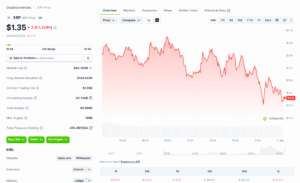
At the time of writing, XRP traded around $1.34, experiencing a modest 2.85% decline over the past 24 hours. Despite this short-term dip, the asset’s trading volume remained robust, nearing $1.95 billion within the same period, indicating active market participation. With a circulating supply of approximately 55 billion XRP out of a total supply of 100 billion, and a market capitalization hovering around $74 billion, XRP remains one of the largest cryptocurrencies by market cap. The 500 million XRP outflow represents nearly 1% of the total circulating supply, a significant figure that can influence market dynamics, particularly in terms of liquidity and perceived scarcity on exchanges.
The notion of long-term accumulation is further supported by the observed price behavior. Despite a substantial 63% drawdown from its peak of $3.66 to $1.35, the outflow of XRP from Binance persisted. This suggests that even during periods of price weakness, a segment of investors is choosing to hold or acquire XRP rather than sell it. Such behavior is often indicative of strong conviction in the asset’s future prospects and can contribute to a more stable price floor over time.
Beyond institutional demand from ETFs, other factors contributing to off-exchange movements include increased utility for XRP on the XRP Ledger (XRPL). As the ecosystem around XRPL grows, with new decentralized applications, DeFi protocols, and payment solutions emerging, users may be moving their XRP into these applications or directly into self-custody for participation, rather than keeping them on centralized exchanges primarily for trading. This diversification of utility reduces the "tradable" supply on exchanges.
Inferred Reactions and Official Stances
While specific statements from Binance or Ripple regarding these particular reserve movements are not typically issued, general stances can be inferred.
- Binance: The exchange consistently emphasizes its commitment to maintaining deep liquidity across all listed assets, robust security protocols, and transparent operations. Any significant outflow would likely be managed within their standard operational procedures, ensuring withdrawal efficiency and platform stability. Binance’s role is to facilitate trading and custody, and fluctuations in reserves are a natural part of a dynamic market.
- Ripple and XRP Community: Proponents of XRP and the broader Ripple ecosystem would likely view sustained outflows from exchanges as a positive development. It reinforces the narrative of investor confidence, long-term holding, and potentially reduced selling pressure. Moreover, it aligns with a vision of decentralization where assets are held by a diverse base of users rather than concentrated on a few large platforms. The increasing adoption of self-custody solutions and the launch of regulated investment products like ETFs are often cited by the community as signs of market maturity and growing mainstream acceptance for XRP.
- ETF Issuers: These entities operate under strict regulatory frameworks and would primarily focus on the operational aspects of their funds, including the efficient acquisition and custody of underlying assets to match share creation and redemption. Their activities would be driven by investor demand for the ETF product itself, indirectly influencing the demand for spot XRP.
Broader Impact and Technical Price Analysis
The confluence of declining exchange reserves and ongoing price consolidation paints a complex yet potentially bullish long-term picture for XRP. On the technical front, XRP’s price action is currently testing crucial support and resistance levels. Trader ChartNerd highlighted two recent rejections at the 50-week Exponential Moving Average (EMA) near $1.53, a level that has acted as significant resistance during recent attempts to move higher. Conversely, the 20-week EMA, currently positioned around $1.27, is identified as a potential support floor. A break below $1.36 on lower timeframes could bring this $1.27 level into play.
ChartNerd’s analysis suggests that price compression between these two key moving averages is a relatively common pattern that often precedes a decisive directional breakout. For now, XRP appears to be consolidating within this broader range. A confirmed move beyond either the $1.27 support or the $1.53 resistance would likely attract significant fresh trader attention and dictate the asset’s short-to-medium-term trajectory.
From a fundamental perspective, sustained reserve outflows are generally interpreted as a constructive long-term signal for an asset. Reduced supply on exchanges, particularly amidst increasing demand from new investment vehicles like ETFs, can create a supply-demand imbalance that favors price appreciation. If fewer XRP are available for immediate sale on exchanges, any significant buying pressure—whether from retail investors, institutional funds, or ETF issuers—could lead to more pronounced price movements.
The implications extend beyond mere price speculation. The shift towards self-custody contributes to the broader decentralization narrative, a core tenet of the cryptocurrency ethos. As more users take direct control of their assets, the market becomes less susceptible to single points of failure associated with centralized platforms. Furthermore, the success of spot XRP ETFs could pave the way for similar regulated products for other digital assets, signaling increasing maturity and acceptance of the crypto market within traditional finance.
In conclusion, the sustained decline in XRP reserves on Binance to multi-year lows, coupled with the backdrop of spot XRP ETF launches and persistent accumulation even during price drawdowns, indicates a significant structural shift in the XRP market. While short-term price action remains subject to technical levels and broader market sentiment, the long-term implications of reduced exchange supply, increased institutional participation, and a growing preference for self-custody are likely to shape XRP’s trajectory into the next quarter and beyond. Traders and investors will continue to monitor the critical $1.27 to $1.53 range, with the evolution of XRP reserves serving as a key indicator of underlying market health and future potential.














