


The latest intricate investigation by the renowned on-chain detective ZachXBT has illuminated a chilling series of violent home invasion robberies in France, diverging from typical digital exploits to expose a physical crime spree intertwined with sophisticated cryptocurrency laundering and ultimately, the perpetrator’s digital carelessness. The probe, which began not with stolen credentials or complex hacks but with accounts of five men forcibly entering a private residence, meticulously traces approximately $667,000 in stolen cryptocurrency through various blockchain networks, ultimately leading to a substantial asset freeze and the alleged identification of a suspect who seemingly flaunted his ill-gotten gains on social media. This case underscores the dual nature of blockchain technology – its potential for privacy, yet its indelible public ledger that, when meticulously analyzed, can serve as a powerful tool for justice, even against violent offenders.
A Spring of Violence: Two French Home Invasions
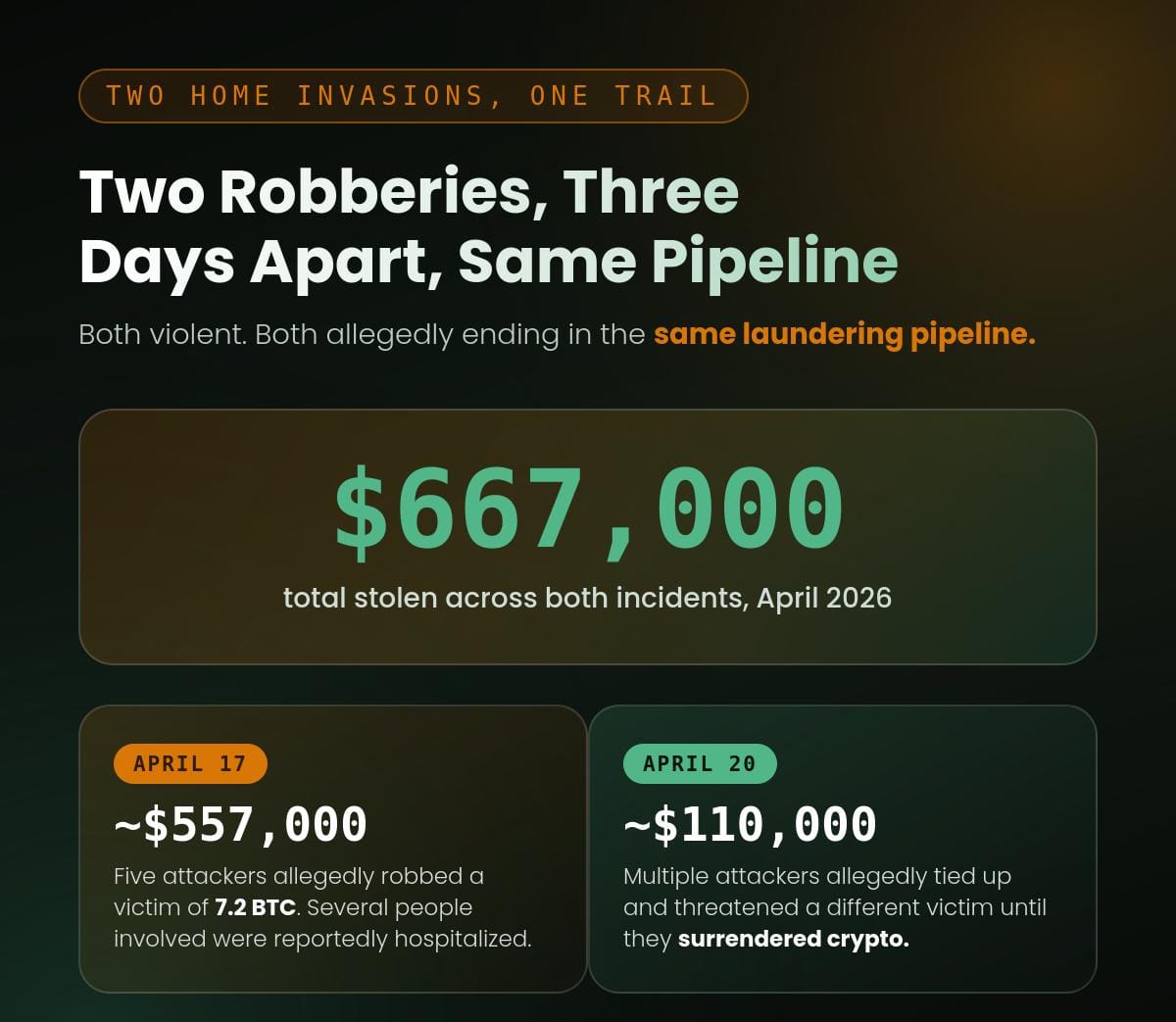
The genesis of ZachXBT’s public investigation lies in two separate, violent home invasion robberies that transpired within a mere three days of each other in April 2026, both targeting individuals in France for their cryptocurrency holdings. These incidents collectively netted the perpetrators an estimated $667,000, representing a significant sum in both traditional and digital currencies.
The first incident, occurring on April 17, saw five assailants allegedly break into a victim’s home, employing violent tactics to coerce the surrender of approximately 7.2 Bitcoin (BTC). At the time of the robbery, this amount was valued at around $557,000. The severity of the attack was such that several individuals involved reportedly required hospitalization, highlighting the brutal nature of these crypto-related home invasions. Following the robbery, the stolen funds were allegedly moved from a Bitcoin wallet address commencing with bc1qrdq5acl9nw4gt3cjte2629lw9qcg9xxkf3x02k.
Just three days later, on April 20, a second, equally disturbing incident unfolded. Multiple attackers reportedly targeted a different victim in France, resorting to tying them up and issuing threats until the victim capitulated, yielding approximately $110,000 in various cryptocurrencies. These funds were subsequently transferred out of an address beginning with 0x3000d2a2. The close proximity of these two violent events, both geographically and chronologically, coupled with the similar modus operandi and subsequent on-chain fund movements, immediately flagged the attention of ZachXBT, suggesting a connected network of perpetrators.
The Intricate Web of On-Chain Laundering

ZachXBT’s investigation then delved into the complex world of cryptocurrency money laundering, a process that, while appearing mundane to the untrained eye, often involves sophisticated techniques to obscure the origin and destination of illicit funds. The tracing of the stolen assets revealed a common, albeit elaborate, pipeline designed to obfuscate the trail.
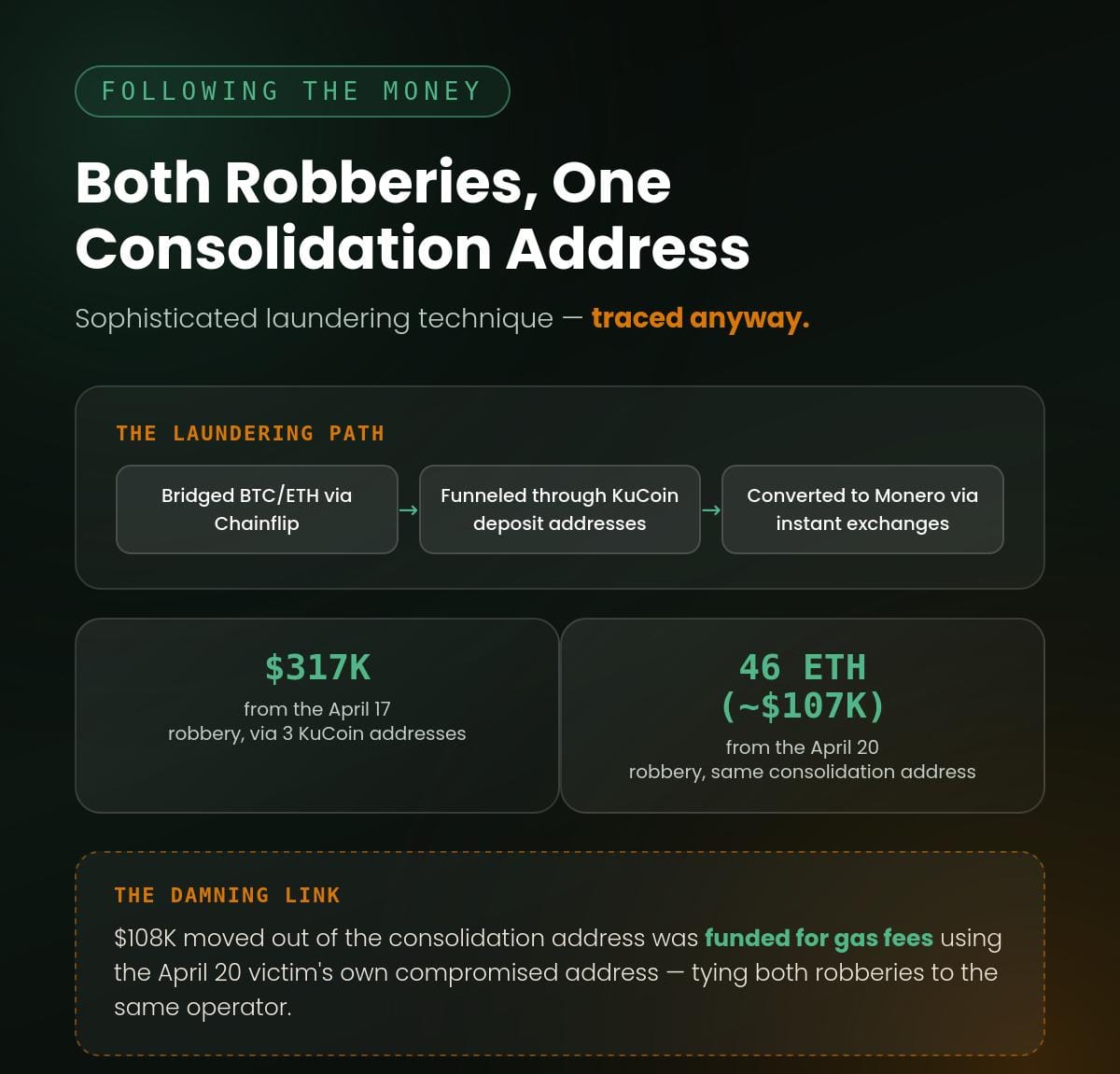
For the funds stolen on April 17, the approximately $557,000 in Bitcoin was first "bridged" to the Ethereum network. This cross-chain transfer was reportedly facilitated through Chainflip, a platform designed for interoperability between different blockchains. Bridging is a common tactic used by criminals to diversify their assets across different networks, often complicating tracing efforts. Once on Ethereum, a substantial portion, approximately $317,000, was then allegedly funneled through three distinct deposit addresses on KuCoin, a popular centralized cryptocurrency exchange. ZachXBT’s meticulous timing analysis of withdrawals from these KuCoin addresses revealed a critical link: these disparate deposits were ultimately consolidated into a single Ethereum address, 0xe744d8890792eb4b51ac6565e3d409076b62b302. Further complicating the trail, another batch of funds from this robbery was allegedly converted into Monero, a privacy-focused cryptocurrency, via two instant exchanges and a platform named Wagyu. The use of Monero is a well-known tactic among criminals seeking to enhance anonymity, as its privacy features make subsequent tracing significantly more challenging compared to public ledgers like Bitcoin or Ethereum.
The funds from the April 20 robbery followed a strikingly similar, if not identical, laundering trajectory. After being stolen, these assets were also bridged to the Ethereum network. Subsequently, approximately 46 ETH, valued at roughly $107,000 at the time, was allegedly laundered through another KuCoin deposit address. Crucially, ZachXBT’s investigation established that withdrawals from this KuCoin account also traced back to the very same consolidation address, 0xe744d8890792eb4b51ac6565e3d409076b62b302, thereby unequivocally linking both violent robberies to the same alleged operator. From this consolidation address, a sum of $108,000 was then reportedly moved to a separate wallet, where it was swapped from ETH to USDT (Tether), a stablecoin pegged to the US dollar. A small but profoundly damning detail emerged in this transaction: the gas fees required to execute this swap were allegedly paid using the April 20 victim’s own compromised address, establishing a direct and undeniable link between the victim and the subsequent laundering steps. This detail serves as a powerful piece of forensic evidence, often overlooked by even sophisticated criminals.
From Digital Traces to Real-World Consequences: The $93,000 Freeze
The ability to trace stolen funds through the labyrinthine world of blockchain transactions is a formidable skill, but transforming that digital intelligence into tangible consequences – specifically, freezing illicit assets – represents a far rarer achievement in the realm of crypto crime. ZachXBT’s investigation reached this critical juncture by moving beyond mere documentation to direct action.
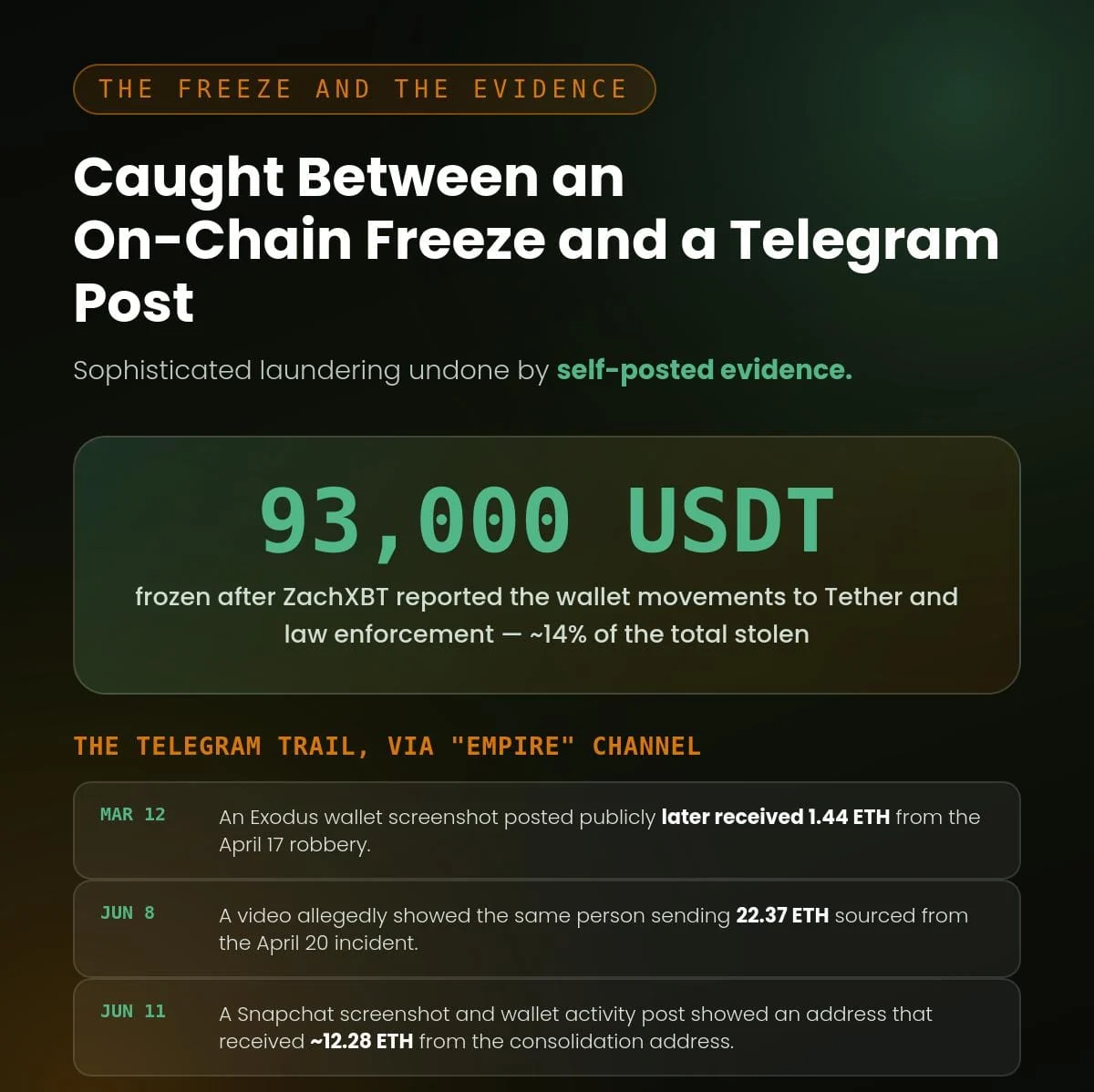
Following the extensive on-chain analysis, ZachXBT promptly reported the detailed wallet movements and the alleged connections to both Tether, the issuer of USDT, and relevant law enforcement agencies. This proactive collaboration reportedly yielded a significant breakthrough: the successful freeze of 93,000 USDT at the address 0x47967fe27f07fb54e9f4daa2541c0f75e27ddde7. This is not merely a technical footnote; it signifies a meaningful recovery of funds directly tied to the two violent robberies, preventing them from being fully laundered and irrevocably lost.
The freezing of these assets is particularly noteworthy in the context of cryptocurrency crime. In many instances, once funds are stolen and moved on-chain, they are often considered unrecoverable, vanishing into the digital ether within days. The successful recovery of roughly 14% of the combined $667,000 total stolen amount – before it could be fully cashed out – stands as a testament to the efficacy of detailed on-chain analysis combined with rapid, strategic coordination with centralized entities like Tether and law enforcement. This outcome offers a rare glimmer of hope for victims of crypto-related crimes, demonstrating that recovery, while challenging, is not impossible.
The Fatal Flaw: Social Media Flexing and Self-Incrimination
While the on-chain laundering techniques employed in this case were demonstrably sophisticated, the alleged unraveling of the perpetrator’s identity ultimately came down to a fundamental human error: carelessness and a desire for public validation. ZachXBT’s investigation reportedly identified a Telegram channel named "EMPIRE," allegedly operated by an individual using the alias "M1llionz." This channel became the primary conduit for the alleged perpetrator’s self-incrimination.
"M1llionz" reportedly posted multiple screenshots of his Exodus wallet to the "EMPIRE" Telegram channel. These screenshots, when cross-referenced with the traced stolen funds, revealed a direct connection. Specifically, wallets showcased in these public posts allegedly went on to receive approximately $84,000 directly traceable to the two home invasion incidents. For example, a wallet publicly shared on March 12 reportedly later received 1.44 ETH originating from the April 17 robbery. Further incriminating evidence emerged from a video posted on June 8, which allegedly depicted the same individual sending 22.37 ETH, funds demonstrably sourced from the April 20 incident. On June 11, two additional posts – a Snapchat conversation screenshot and another Exodus wallet activity screenshot – allegedly displayed the same address, which reportedly received approximately 12.28 ETH on May 9 directly from the consolidation address identified earlier, tying both robberies together.
Beyond these direct financial links, ZachXBT’s investigation also characterized "M1llionz" as an individual who openly promoted bank fraud services within the "EMPIRE" Telegram channel. His public persona, curated through posts showcasing a lavish lifestyle of expensive hotels, flights, luxury cars, and designer goods, painted a picture of someone enjoying newfound wealth. Ironically, while consistently blurring his face in photos – a detail that might suggest a degree of caution – this act reads less like effective anonymity and more like a perpetrator aware of the risks, yet unable to resist the urge to flaunt his illicit gains. Through open-source intelligence (OSINT) techniques, ZachXBT reportedly identified several aliases potentially linked to this persona, distinct from the "M1llionz" handle, along with multiple email addresses connected to associated social media accounts, further solidifying the digital footprint.
Broader Implications and Challenges for Law Enforcement
The revelations from ZachXBT’s investigation carry significant implications for the broader landscape of cryptocurrency crime, law enforcement, and the personal security of crypto holders. In recent weeks, "M1llionz" has reportedly gone conspicuously quiet across his TikTok and Telegram channels, with his TikTok account subsequently set to private. This shift, while not definitive proof of guilt, is often interpreted as a reaction to perceived surveillance or active investigation, suggesting the alleged perpetrator has realized he is being watched.
The investigation’s scope extends beyond these two documented robberies. ZachXBT has indicated that he has identified two further attacks within two transaction hops of the same alleged operator’s over-the-counter (OTC) addresses, suggesting a potentially larger criminal enterprise that may span beyond the initial two violent incidents. This ongoing work underscores the persistent nature of such criminal activities and the continuous need for vigilance.
ZachXBT himself has been candid about the inherent limits of this specialized work. He emphasizes that home invasion robberies are among the cases he prioritizes most, given their violent nature and severe impact on victims. His efforts have reportedly led to the freezing of funds in multiple seven-figure incidents across both the United States and the European Union, with several additional perpetrators identified in cases he hopes to make public once sensitive investigative details allow. However, he also highlights the critical constraint that the sensitive nature of these investigations often precludes immediate public disclosure. Prematurely publishing findings could tip off suspects, destroy evidence, or significantly complicate active law enforcement efforts, requiring a delicate balance between transparency and strategic discretion.
Regarding the French legal system, ZachXBT offered a nuanced perspective. He noted that French law enforcement agencies generally demonstrate a commitment to assisting victims and solving these complex cases. However, he also pointed out that existing legal frameworks and inefficiencies can sometimes impede the translation of this effort into concrete outcomes, highlighting the ongoing need for legal adaptation to the rapidly evolving nature of cryptocurrency crime.
This case serves as a stark reminder of the paradox inherent in many modern criminal enterprises. While the perpetrators in this instance employed sophisticated techniques for cross-chain bridging, exchange-based laundering, and privacy coin conversion – methods that can be genuinely challenging to trace – their ultimate downfall appears to have been rooted in a fundamental lack of digital discipline. The public posting of wallet screenshots and confirming control of illicit funds via social media platforms represents a profound act of self-sabotage, an elementary blunder that no amount of on-chain sophistication can effectively undo. It reinforces the notion that in the digital age, every action leaves a trace, and even the most cunning criminals can be undone by their own hubris and carelessness.
This incident also shines a light on the increasing trend of violent, physical crimes motivated by cryptocurrency holdings. As the value and prevalence of digital assets grow, so too does the risk of individuals being targeted by criminals seeking to bypass digital security measures through force. It underscores the critical importance of operational security, not just online, but also in the physical world, for anyone holding significant amounts of cryptocurrency. The collaboration between independent on-chain investigators like ZachXBT, stablecoin issuers, and law enforcement agencies is becoming increasingly vital in combating these evolving threats and bringing perpetrators to justice, offering a blueprint for future investigations in the complex intersection of digital finance and real-world crime.














